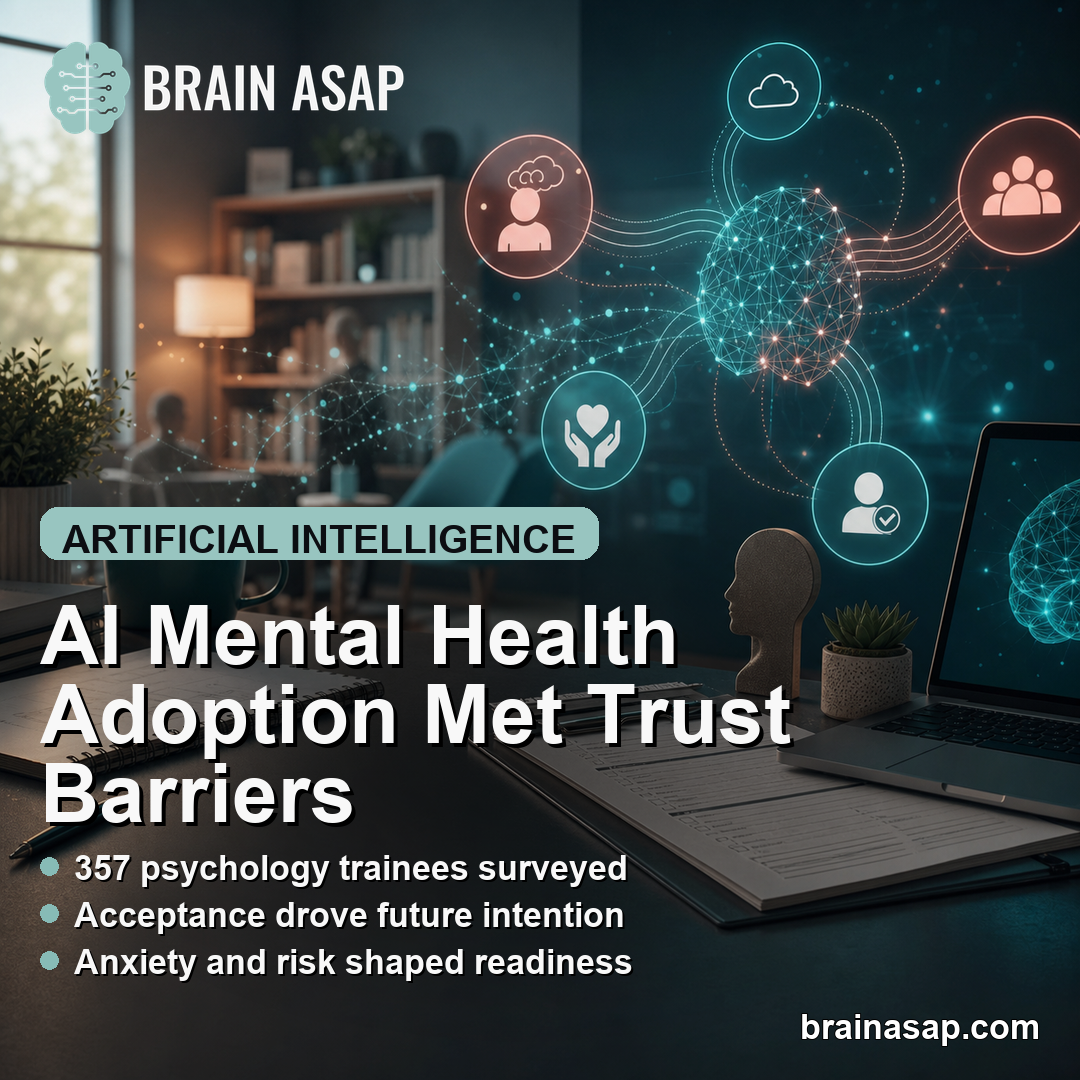
TL;DR: A 2026 study in Journal of Medical Internet Research found that psychology trainees were generally open to artificial intelligence-based precision mental health technologies (AI-PMHTs), but fear, perceived risk, resistance to change, and reliability concerns shaped whether they expected to use them.
Key Findings
- 357 psychology trainees: The cross-sectional survey included undergraduate and master’s psychology students, with a mean age of 20.71 years and 84.3% identifying as female.
- Moderate-to-high AI acceptance: Participants generally reported positive attitudes, facilitating conditions, acceptance, perceived usefulness, satisfaction, and future intention to use AI-PMHTs.
- Women reported more AI anxiety: AI-related anxiety was higher among women than men, with a moderate effect size (Hedges g=-0.55), while men reported slightly higher facilitating conditions.
- Frequent users looked more ready: High-frequency AI users showed stronger attitudes, acceptance, prior experience, usefulness, satisfaction, and future intention, but fear and perceived risk did not fall with use.
- The model explained intention well: The partial least squares structural equation model explained 61% of variance in future intention to use AI-PMHTs, led by acceptance and usage frequency.
Source: Journal of Medical Internet Research (2026) | Noheda et al.
AI Precision Mental Health Tools Were Acceptable, but Not Emotionally Neutral
Artificial intelligence-based precision mental health technologies (AI-PMHTs) were defined for participants as AI systems that could support measurement-based care, monitoring, data-driven decision-making, and personalized mental health interventions.
Researchers surveyed 357 psychologists in training because trainees are a practical early group for adoption research. Their future clinical habits may be shaped before AI tools are placed inside routine services.
The overall pattern was not simple enthusiasm. Students generally saw AI as useful and expected to use it, but AI-related anxiety and perceived risk varied enough to matter for implementation.
357 Psychology Students Completed a Mixed-Methods Survey
The sample came from a university psychology-training context. It included 301 women, a mean age of 20.71 years, and students from first-year undergraduate through master’s-level training.
The study combined quantitative scales with open-ended questions. That design let the researchers model adoption statistically while also seeing what students said helped or blocked their AI use.
- Technology acceptance: The survey adapted UTAUT-2 constructs, including usefulness, ease of use, social influence, facilitating conditions, trust, and acceptance.
- Psychological predictors: Measures included AI anxiety, Big Five personality traits, resistance to change, and conspiratorial thinking.
- Open-ended responses: Students named practical facilitators and barriers, which were then grouped through thematic analysis.
Because this was a cross-sectional survey, the findings describe associations. They do not prove that one trait or attitude caused later AI use.
Frequent AI Use Raised Acceptance but Did Not Reduce Fear
Students who used AI more often had more favorable adoption profiles. Compared with low-frequency users, they reported more positive attitudes, stronger facilitating conditions, higher acceptance, greater prior experience, more perceived usefulness, more satisfaction, and stronger future intention to use AI-PMHTs.
The largest use-frequency differences were for prior experience (g=-1.11), perceived usefulness (g=-1.02), and future intention to use (g=-0.88). In practical terms, using AI more often lined up with feeling more ready to keep using it.
Fear did not move the same way. Students who used AI frequently did not report lower AI-related anxiety or lower perceived risk than students who used it less often.
That distinction is important for mental health training programs. Hands-on exposure may improve confidence and perceived utility, but it may not resolve worries about professional identity, trust, reliability, or loss of human judgment.
Learning Support Was the Top AI Facilitator
The open-ended responses gave a concrete view of what trainees liked about AI tools. The most common facilitator was support for learning and understanding, identified in 47.7% of facilitator responses.
Other benefits were practical rather than futuristic:
- Rapid information access: 27.2% of facilitator responses described quick answers or easier information searching.
- Efficiency and time savings: 24.3% described faster coursework, summarizing, or task completion.
- Organization of work: 11.6% described help structuring ideas, texts, assignments, or job tasks.
- Personalized support: 4.0% described constant availability, repeated questioning, or nonjudgmental help.
These responses fit the quantitative model: students were more likely to accept AI when it felt useful, easy to fit into work, and backed by favorable early experiences.
Reliability Was the Main Barrier to AI-PMHT Adoption
The strongest barrier was not privacy, cost, or technical access. It was lack of reliability and inaccuracies, identified in 31.9% of barrier responses.
Students also reported interaction problems, overdependence concerns, task limitations, and access constraints:
- Difficult interaction: 17.7% reported trouble prompting the system or getting relevant responses.
- Overdependence risk: 11.3% worried that AI use could reduce effort, critical thinking, creativity, or independent learning.
- Specific-task limits: 9.3% described weak performance on numerical, complex, or highly specific tasks.
- Access barriers: 8.4% mentioned paid features, usage limits, technical restrictions, or institutional constraints.
For clinical AI tools, reliability concerns carry extra weight. A student can tolerate an imperfect study assistant, but a professional mental health workflow needs explainable, auditable, and clinically bounded output.
AI Anxiety and Perceived Risk Sat Upstream of Intention
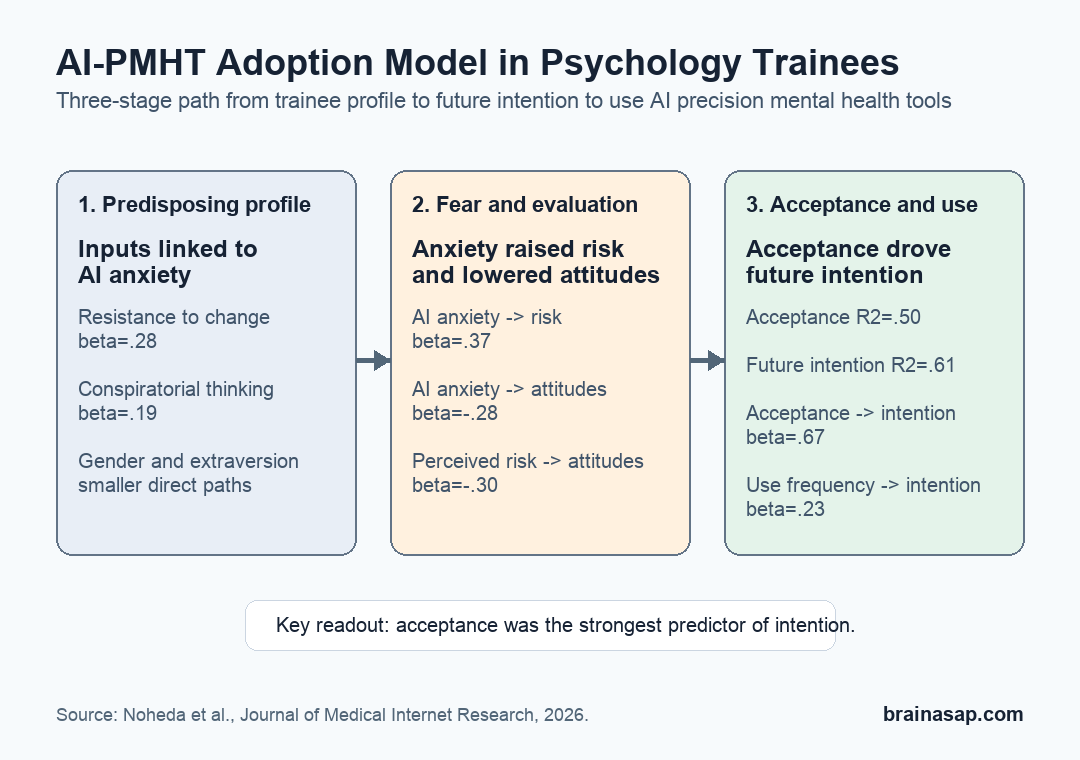
The structural model placed emotional and dispositional factors early in the adoption pathway. Resistance to change (beta=.28), conspiratorial thinking (beta=.19), gender (beta=.16), and extraversion (beta=.13) were directly associated with AI anxiety.
AI anxiety then raised perceived risk (beta=.37) and lowered positive attitudes toward AI (beta=-.28). Perceived risk also lowered positive attitudes (beta=-.30).
Downstream, positive attitudes predicted facilitating conditions (beta=.36) and AI acceptance (beta=.42). Facilitating conditions also predicted AI acceptance (beta=.37).
The strongest final pathway ran through acceptance. Acceptance and predisposition toward AI directly predicted future intention to use AI-PMHTs (beta=.67), while usage frequency had a smaller but still significant direct association (beta=.23).
Training Programs May Need to Teach Trust, Not Just Tool Use
The study’s practical message is that AI-PMHT adoption is layered. A curriculum that only teaches how to operate a tool may raise exposure and usefulness, while leaving fear and perceived risk untouched.
A more complete implementation approach would address three levels:
- Predisposing profiles: Some trainees may begin with more anxiety, resistance to change, or distrust of AI systems.
- Precipitating risk: Fear and perceived risk may need transparent regulation, explainable design, and clear professional boundaries.
- Maintenance factors: Positive early experiences, usability, supervision, and institutional support may help acceptance become sustained use.
The limits are equally important. The study used self-report data from psychology trainees, not practicing clinicians, hospitals, or community mental health services.
It also measured attitudes at one point in time, so the model should guide future research rather than be treated as proof of clinical implementation.
Citation: DOI: 10.2196/93893. Noheda et al. Adoption of Artificial Intelligence-Based Precision Mental Health Technologies Among Psychology Trainees: Mixed Methods Cross-Sectional Survey Study. Journal of Medical Internet Research. 2026;28:e93893.
Study Design: Mixed-methods cross-sectional online survey with thematic analysis and partial least squares structural equation modeling.
Sample Size: 357 psychologists in training, including undergraduate and master’s psychology students.
Key Statistic: The structural model explained 61% of variance in future intention to use AI-PMHTs; acceptance directly predicted intention with beta=.67.
Caveat: The sample was academic, mostly female, and cross-sectional, so the findings describe trainee readiness and associations rather than real-world clinical AI implementation.