TL;DR: A 2026 scoping review in Sleep Science linked seasonal timing, daylight exposure, daylight saving time (DST), sleep-wake rhythm disruption, and driver drowsiness to traffic-crash risk, but found that few studies directly integrate seasonality with chronobiology in one model.
Key Findings
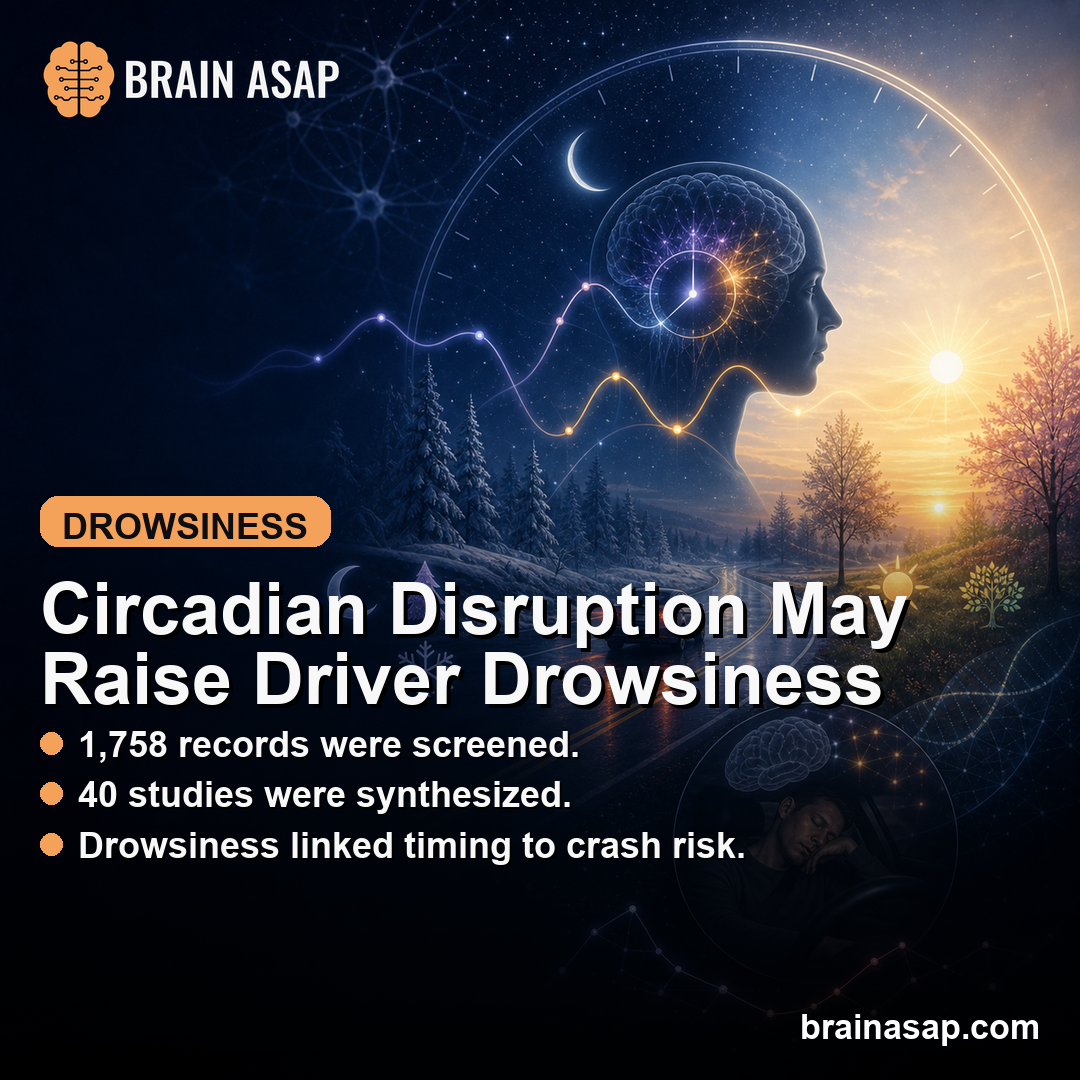
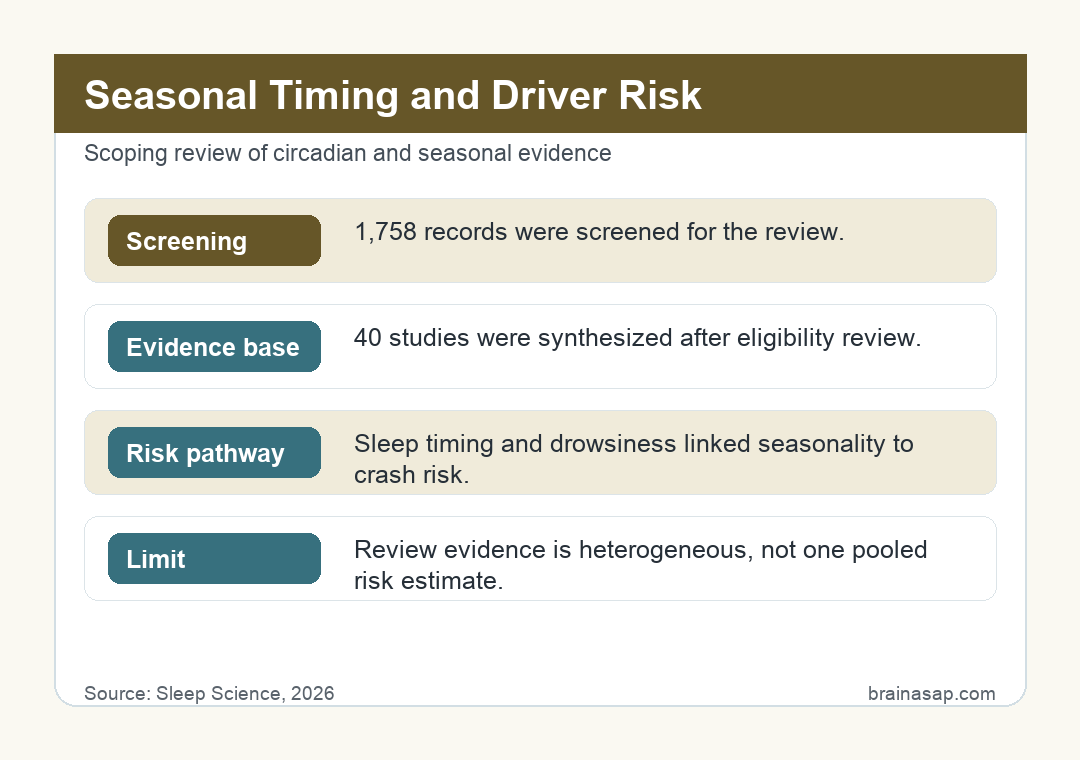
- 1,758 records screened: The scoping review used PRISMA-ScR methods and screened 1,758 records before full-text review.
- 40 studies synthesized: Researchers selected 40 studies for the main synthesis, but only 9 jointly addressed seasonality and chronobiology in relation to traffic accidents or driver behavior.
- Winter light exposure mattered: Reduced winter photoperiod can affect melatonin timing, sleep quality, mood, and daytime alertness.
- DST raised fatigue concerns: Daylight saving time transitions were linked to driver fatigue, drowsiness, and short-term crash-risk vulnerability.
- Drowsiness remained central: Driver sleepiness was treated as a key pathway connecting circadian disruption with attention lapses and crash risk.
Source: Sleep Science (2026) | Assis et al.
Seasonal Light Changes Can Shift Driver Alertness
Seasonal and circadian timing can influence driving through sleep pressure, daylight exposure, mood, weather, road conditions, and social schedules. This scoping review brings those strands together under one safety question: when do biological timing changes make drivers more vulnerable?
The paper starts from a public-health problem. Road-traffic crashes cause large global mortality and economic burden, and driver sleepiness is a known contributor to impaired attention, slower reaction time, and poorer decision-making.
Seasonality adds another layer.
Crash risk can vary by month, weather, holiday travel, tourism, school schedules, daylight duration, and road conditions.
Chronobiology adds internal timing: circadian rhythm, sleep-wake regulation, melatonin secretion, cortisol rhythms, and fatigue.
PRISMA-ScR Review Screened 1,758 Records
The review used the PRISMA extension for scoping reviews, or PRISMA-ScR, a reporting framework for mapping broad evidence rather than calculating a pooled effect size. Researchers searched PubMed/MEDLINE, LILACS, SciELO, Cochrane Library, and EMBASE.
The search identified 1,758 records. After duplicate removal, 1,634 records went through title and abstract screening, 103 articles were read in full, and 40 studies were chosen for synthesis.
Only 9 studies jointly addressed seasonality and chronobiology in relation to traffic accidents or driver behavior. That small intersection is one of the paper’s main findings: the relevant mechanisms are often discussed separately.
- Seasonality evidence: Studies covered month, season, holidays, winter conditions, daylight exposure, and traffic-exposure patterns.
- Chronobiology evidence: Studies covered circadian rhythm, sleep quality, drowsiness, melatonin, shift work, and alertness.
- Driving outcomes: Evidence included accidents, crash severity, lane departures, driver performance, and drowsiness measures.
- Evidence type: Included work ranged from observational studies to reviews and expert-opinion context, consistent with a scoping-review purpose.
That design means the review should not be read as a meta-analysis proving one numeric crash-risk estimate. It is a map of plausible and repeatedly observed pathways that need more integrated testing.
Melatonin and Sleep-Wake Timing Were Central Mechanisms
Melatonin is a hormone that helps regulate sleep-wake timing and is strongly influenced by light exposure. Shorter winter daylight and seasonal changes in photoperiod can shift circadian timing, sleep duration, and daytime alertness.
The review describes driver vulnerability through two interacting sleep-regulation processes.
Process S is homeostatic sleep pressure, the need for sleep that builds during wakefulness.
Process C is the circadian timing signal, generated by the brain’s suprachiasmatic nuclei, that helps regulate alertness across the 24-hour day.
When high sleep pressure overlaps with a circadian phase that promotes sleepiness, drivers may enter a high-risk window. Seasonal changes can worsen that overlap by disrupting light exposure, sleep timing, and behavioral schedules.
Winter can also affect mood and psychological well-being. Seasonal sensitivity and seasonal affective symptoms may reduce alertness, motivation, and cognitive control in some drivers, although the review notes that causal pathways remain difficult to isolate.
Daylight Saving Time Was Linked to Driver Drowsiness
Daylight saving time transitions received special attention because they abruptly shift social time relative to biological time. Even a 1-hour clock change can produce short-term sleep loss, circadian misalignment, and morning sleepiness in some people.
The review describes DST as a period when fatigue and drowsiness may increase driver vulnerability. The concern is strongest around the spring transition, when clocks move forward and many people lose sleep.
Crash risk after DST changes is difficult to study because traffic exposure, weekday patterns, geography, weather, and reporting systems vary. Still, the review treats DST as a clear example of how social schedules can disturb biological timing.
- Clock shift: Social time changes abruptly, while circadian timing adjusts more slowly.
- Sleep loss: The spring transition can shorten sleep in the days immediately after the clock change.
- Morning risk: Early driving after sleep loss may combine low alertness with routine commuting demands.
- Policy relevance: DST is modifiable at the population level, unlike many individual sleep-risk factors.
The paper does not claim that DST explains all seasonal crash patterns. It places DST inside a broader set of timing exposures that can change alertness, attention, and driver behavior.
Winter Conditions Added Weather and Biology Risks
Winter crash risk is not only a brain-timing issue. Bad weather, reduced visibility, slippery roads, darker commutes, holiday travel, and regional road conditions can all contribute.
The review argues that winter may combine external and internal risks. Drivers may face more demanding road conditions at the same time that reduced daylight, altered melatonin timing, mood changes, and sleep disruption lower vigilance.
Cortisol and other hormones may also show seasonal patterns.
Large medical-record analyses cited in the review suggest seasonal endocrine set points, with some peaks in winter and early spring.
The review links those patterns to possible effects on cognitive control, emotional regulation, and risk assessment.
Evidence was not uniform across regions. Some settings reported higher crash burden in summer because tourism, outdoor activity, and traffic exposure increased; others emphasized winter because weather and daylight conditions worsened.
Drowsiness Was the Main Driver-Safety Pathway
Across the review, drowsiness was the clearest biological bridge between seasonality and crash risk. Driver sleepiness can reduce sustained attention, slow responses, impair lane control, and increase microsleep risk.
Professional drivers and shift workers are especially relevant because they may face irregular schedules, night driving, accumulated sleep debt, and limited recovery sleep. Seasonal timing can compound those occupational risks.
Younger drivers also appeared repeatedly in the evidence base. Young male drivers are overrepresented in severe crash outcomes globally, and some studies described greater vulnerability in younger or less experienced drivers during high-risk seasonal or timing windows.
- Individual biology: Chronotype, sleep duration, circadian phase, mood, and seasonal sensitivity can affect alertness.
- Work schedule: Night shifts, early starts, and long driving periods can increase sleep pressure.
- Environment: Darkness, glare, rain, snow, heat, and road conditions can raise task demands.
- Social timing: Holidays, school schedules, commuting patterns, and DST can change both exposure and fatigue.
That layered model is why simple seasonal crash counts can be misleading. A higher crash count in a given month may reflect more vehicles on the road, worse weather, more tired drivers, circadian disruption, or all of those at once.
Traffic Safety Studies Need Integrated Chronobiology Models
The review’s main limitation is the evidence base itself.
Many studies address seasonality, weather, or traffic exposure without measuring sleep and circadian variables.
Others study drowsiness or shift work without modeling seasonal context.
That separation leaves a measurement gap. To test the combined pathway, future studies would need season, latitude, photoperiod, weather, sleep duration, chronotype, shift schedule, DST exposure, crash timing, and driver behavior in the same design.
The review also notes that many available studies are cross-sectional or ecological. Those designs can identify patterns but struggle to prove temporal sequence or causality.
- Better exposure measurement: Use actual daylight, local weather, clock transitions, and road-exposure data rather than broad season labels alone.
- Better biology measurement: Include sleep timing, sleep duration, chronotype, drowsiness, and when feasible, melatonin or related circadian markers.
- Better driver segmentation: Analyze professional drivers, shift workers, novice drivers, older drivers, and high-mileage commuters separately.
- Better prevention timing: Target warnings, scheduling policies, and fatigue monitoring to DST transitions, winter low-light periods, early mornings, and high-exposure holidays.
The practical takeaway is that fatigue prevention should be seasonal and time-aware. Road safety programs that ignore sleep timing may miss predictable windows when drivers are biologically and environmentally more vulnerable.
Citation: DOI: 10.1055/s-0046-1819711. Assis et al. Influence of Seasonal and Chronobiological Factors on Driver Behavior and Traffic Accident Risk: A Scoping Review. Sleep Science. 2026;19:00461819711.
Study Design: PRISMA-ScR scoping review mapping seasonality, chronobiology, driver behavior, and traffic-accident evidence.
Sample Size: 1,758 records screened; 40 studies synthesized, including 9 that jointly addressed seasonality and chronobiology.
Key Statistic: Evidence supported seasonal crash patterns and plausible circadian pathways through melatonin disruption, DST-related sleep loss, winter light exposure, drowsiness, and driver alertness.
Caveat: Scoping review rather than meta-analysis; many included studies examined seasonality or chronobiology separately, limiting causal inference.