TL;DR: A 2026 preprint in medRxiv found that under-mattress sleep sensors associated lower nighttime respiratory rate and more unstable nighttime movement with higher odds of next-day agitation in dementia, while the same features did not predict how severe agitation became once it occurred.
Key Findings
- 55 dementia patients supplied the main dataset: Researchers matched 333 nights of under-mattress sensor data with next-day agitation ratings in two long-term care cohorts.
- Lower respiratory rate predicted agitation occurrence: A higher minimum nighttime respiratory rate was associated with 40% lower odds of next-day agitation after adjustment.
- Movement instability pointed the other way: Higher nighttime activity standard deviation, a marker of unstable movement during sleep, was associated with 62% higher odds of next-day agitation.
- Motor agitation showed the clearest pattern: Sleep-linked measures were stronger for pacing, restlessness, and other motor agitation than for verbal agitation.
- Severity was not explained by these sleep features: Among 234 agitation-positive days, nocturnal features did not significantly predict how intense the next-day episode was.
Source: medRxiv preprint (2026) | Liu et al.
Under-Mattress Sensors Tracked Night-to-Next-Day Agitation Risk
Dementia-related agitation often changes from one day to the next. The practical problem is that care teams usually see the behavior after it starts, not during the nighttime physiology that may precede it.
This preprint tested whether contactless under-mattress sensors could identify short-term warning measures. The sensors estimated heart rate, respiratory rate, movement, and sleep-proxy features without requiring a wearable device or direct skin contact.
The main analysis combined two long-term care cohorts using Emfit QS and Withings Sleep Analyzer devices. Together, those cohorts included 55 people with dementia and 333 complete night-to-next-day observation pairs.
Researchers then checked whether the strongest physiological measures carried over to a separate home-monitoring dataset. That external TIHM subset included 17 people and 801 nights, although activity data were not available in that validation set.
Lower Nighttime Respiratory Rate Was Linked to Higher Agitation Odds
The clearest adjusted measure involved respiratory rate, meaning breaths per minute estimated from the under-mattress pressure trace. In the multivariable model, higher respiratory-rate values were associated with lower odds of next-day agitation.
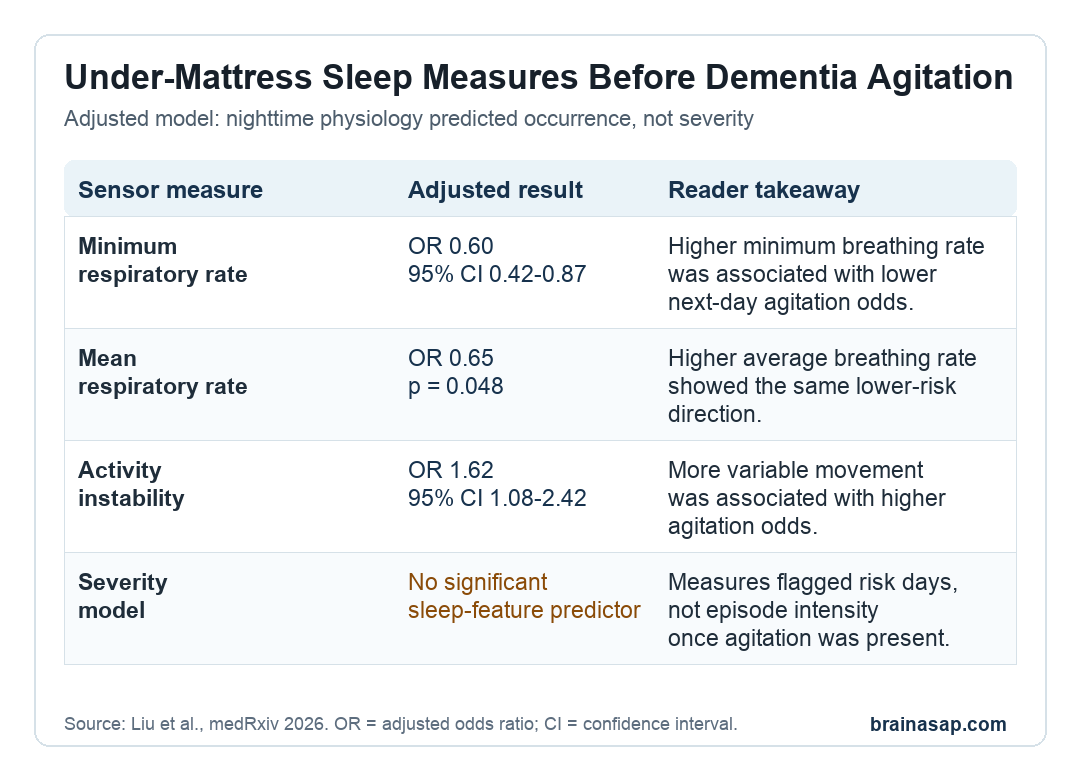
The strongest independent predictor was minimum nighttime respiratory rate. Each one-unit increase in the robust Z-score was associated with an odds ratio of 0.60, with a 95% confidence interval from 0.42 to 0.87.
Put plainly, higher minimum respiratory rate corresponded to 40% lower adjusted odds of agitation the next day. Mean respiratory rate also remained significant, with an odds ratio of 0.65.
The authors interpret this as a possible autonomic-regulation marker, not as a diagnostic rule. Breathing rhythm is tied to autonomic nervous system activity, and autonomic dysregulation has been discussed in agitation and related behavioral symptoms.
Unstable Nighttime Movement Raised the Agitation Signal
The second main measure was activity standard deviation, a marker of how unstable or variable movement was during the night. Higher variability can reflect restless sleep, fragmented sleep continuity, or repeated shifts in bed.
After adjustment for age, sex, cohort, and other selected sleep features, higher nighttime activity instability was associated with 62% higher odds of next-day agitation. The adjusted odds ratio was 1.62, with a 95% confidence interval from 1.08 to 2.42.
The model also tested presence time, or time spent in bed. That measure was associated with agitation in the univariate screen, but it did not remain significant in the multivariable model.
- Minimum respiratory rate: Higher values were linked to lower next-day agitation odds.
- Mean respiratory rate: Higher values also remained protective in the adjusted model.
- Activity instability: More variable nighttime movement was linked to higher next-day agitation odds.
- Presence time: Time in bed looked less specific after the physiological measures were modeled together.
Motor Agitation Fit the Sleep Signal Better Than Verbal Agitation
The study did not treat all agitation as one behavior. Researchers used the Pittsburgh Agitation Scale, which rates several behavioral subtypes, and then focused on overall agitation, motor agitation, and verbal agitation.
Motor agitation includes behaviors such as pacing, restlessness, and excessive movement. This subtype showed a sleep-linked pattern similar to overall agitation: lower respiratory-rate measures and higher movement instability were tied to higher next-day risk.
Verbal agitation showed weaker physiological coupling. Except for minimum heart rate in the subtype screen, respiratory and activity features did not remain significant for verbal agitation after false-discovery-rate correction.
- Overall agitation: Lower respiratory rate and higher activity instability were the main adjusted measures.
- Motor agitation: Respiratory and movement features showed the strongest subtype pattern.
- Verbal agitation: Sleep-sensor measures were weaker, suggesting different triggers may dominate.
Care teams may need to separate these agitation types. Motor agitation may be more closely tied to sleep disruption and nighttime physiological regulation, while verbal agitation may depend more on pain, distress, unmet needs, or environmental triggers.
Sleep Signals Predicted Occurrence, Not Episode Severity
The researchers used a two-part model. First, they asked whether agitation occurred the next day. Second, among days with agitation, they asked whether nighttime signals predicted how severe the agitation was.
The occurrence and severity models diverged. Nocturnal physiology was associated with the occurrence of agitation, but it did not significantly explain severity among agitation-positive days after correction for multiple testing.
Among 234 agitation-positive days from 52 patients, the baseline severity model showed that fixed demographic and cohort variables explained little variance. Patient-specific differences accounted for more of the severity pattern.
A passive sleep monitor might help flag a higher-risk day. The intensity of an episode may still depend on person-level traits, disease stage, medication timing, pain, care routines, and the immediate environment.
The Preprint Is Useful but Still Provisional
This is a medRxiv preprint, so it has not been certified by peer review and should not guide clinical care on its own. The study also modeled associations, not proof that changing sleep physiology would prevent agitation.
The data were promising but limited. The main long-term care dataset was small, the external validation dataset lacked activity metrics, and the cohorts differed in devices, settings, and annotation density.
- Sample limit: The main model used 55 patients, so larger studies are needed.
- Validation limit: TIHM could validate respiration-related features but not movement instability.
- Measurement limit: Under-mattress sensors estimate physiology indirectly and may vary by device.
- Clinical limit: Medication timing, pain, lighting, noise, and daytime context were not fully captured.
In this dataset, lower nighttime respiratory rate and more unstable nighttime movement marked higher next-day agitation risk in dementia, especially for motor agitation.
Severity remained a separate problem.
Citation: DOI: 10.64898/2026.02.27.26346707. Liu et al. Dissociating the Nocturnal Physiological Drivers of Agitation Occurrence and Severity in Dementia: An Explanatory Study Using Contactless Sleep Sensing. medRxiv. 2026.
Study Design: Observational night-to-next-day modeling study using contactless under-mattress sleep sensors and agitation ratings in dementia cohorts.
Sample Size: 55 dementia patients and 333 nights in the main long-term care analysis, plus 17 people and 801 nights in the external TIHM validation subset.
Key Statistic: Higher activity instability was associated with higher next-day agitation odds (OR = 1.62; 95% CI, 1.08-2.42), while higher minimum respiratory rate was associated with lower odds (OR = 0.60; 95% CI, 0.42-0.87).
Caveat: This is a non-peer-reviewed preprint with small cohorts, observational modeling, and incomplete external validation for movement-based features.