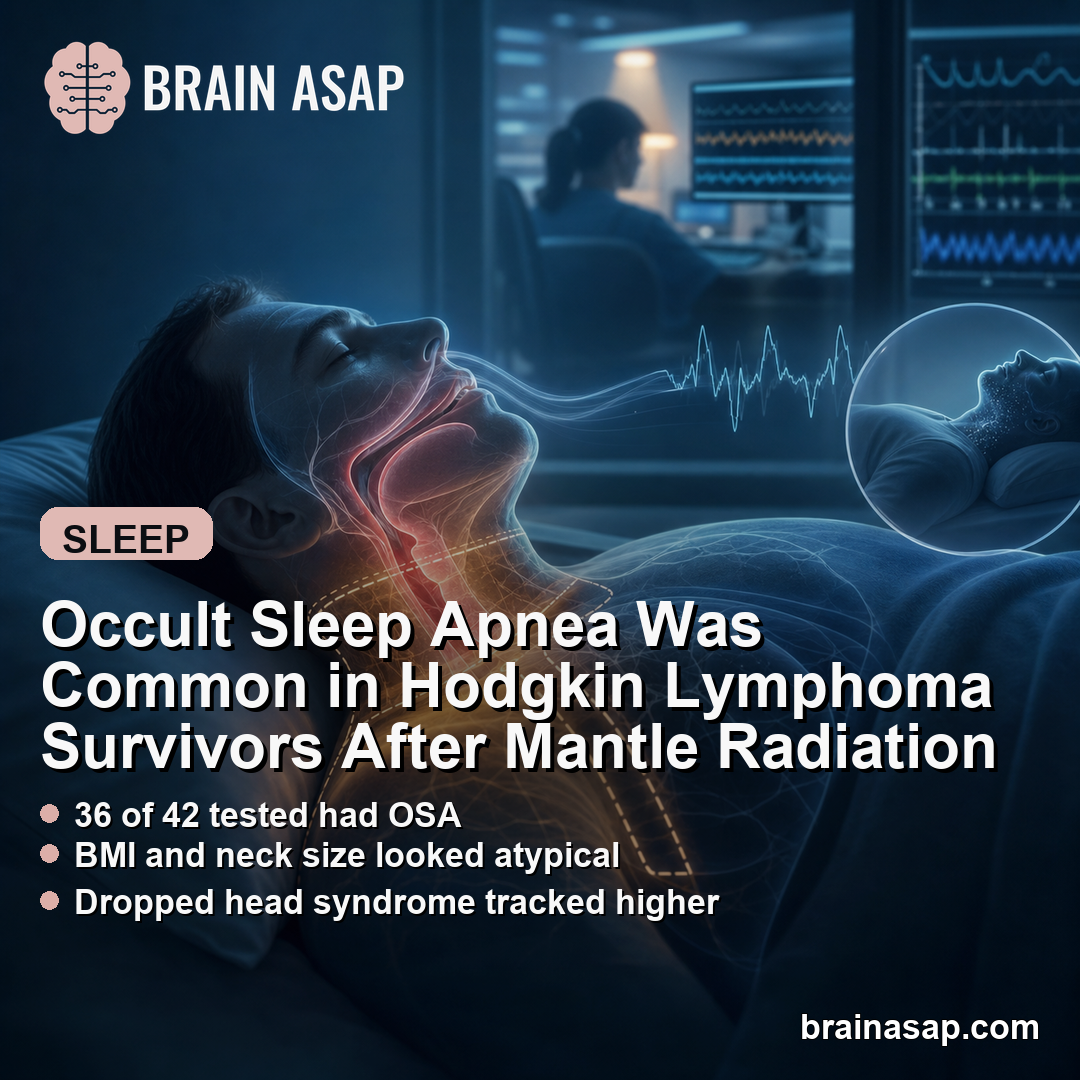
TL;DR: A 2026 study in Journal of Clinical Sleep Medicine found that 36 of 42 Hodgkin lymphoma survivors tested after mantle radiation therapy had obstructive sleep apnea (OSA), despite mostly normal BMIs and slender necks — an under-recognized phenotype linked to dropped head syndrome.
Key Findings
- 182 long-term HL survivors: All had received mantle radiation therapy — a treatment standard from the 1970s into the late 1990s that delivered radiation across the chest, neck, and upper torso. Median follow-up after radiation was about 17 years.
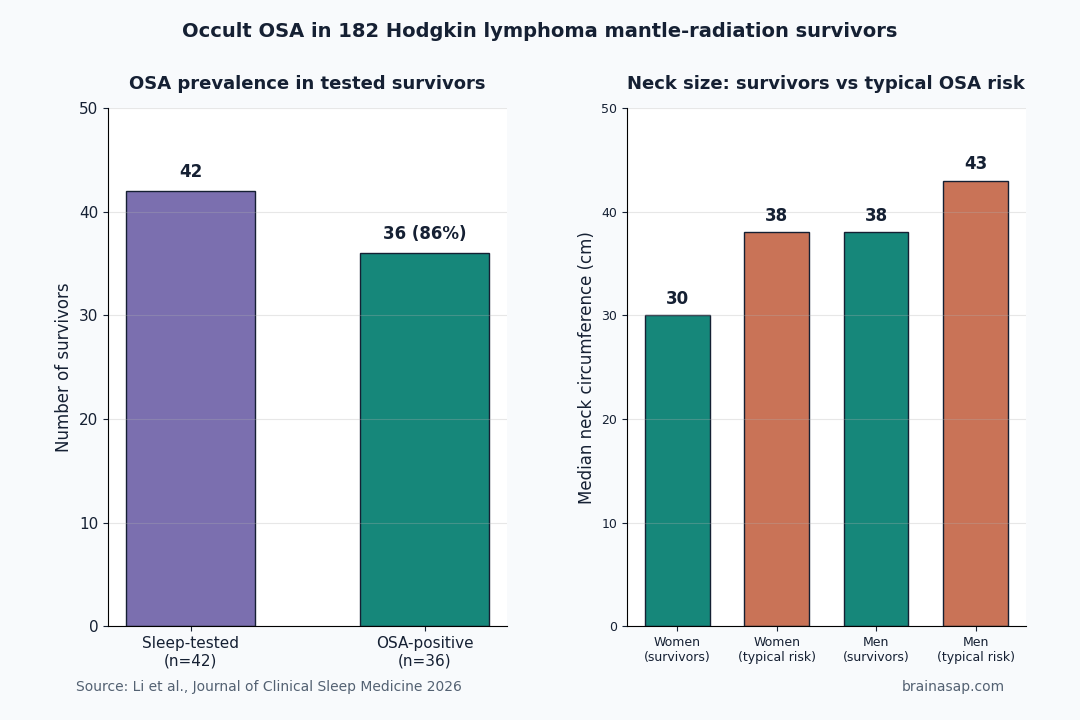
- OSA rate was high in those tested: Across prospective sleep referrals and 20-year retrospective chart review, 36 of 42 survivors who underwent sleep testing had OSA on polysomnography — about 86% of those tested.
- The phenotype did not match standard OSA risk: Median BMI at sleep study was 27.5 kg/m² — overweight but not obese. Median neck circumference was 30 cm in women and 38 cm in men, smaller than the 38 cm and 43 cm typically associated with OSA risk in the general population.
- Hypopneas and positional OSA dominated: Patients had far more hypopneas (partial airway collapse) than full apneas. About 64% had positional OSA, meaning their supine apnea-hypopnea index was more than twice their non-supine index.
- OSA tracked with dropped head syndrome: Over a median 17.5 years of chart review, OSA-positive survivors had a higher rate of dropped head syndrome — a severe weakness of the neck extensor muscles — with a sex- and BMI-adjusted rate ratio of 1.97 (p = 0.012).
Source: Journal of Clinical Sleep Medicine (2026) | Li et al.
Hodgkin lymphoma (HL) survivors often live with chronic fatigue decades after curative treatment. The fatigue has many candidate causes, including thyroid damage, cardiac dysfunction, and pulmonary scarring from the radiation field, but one obvious driver has rarely been tested directly: sleep-disordered breathing from the radiation itself.
Mantle Radiation Crosses the Neck, So Sleep Apnea Is a Reasonable Suspect
Mantle radiation therapy was a cornerstone of HL treatment for about three decades. It delivered radiation in a wide field covering the chest and neck.
That field cured most patients but also damaged surrounding tissues that researchers are still cataloging today: thyroid, heart, lungs, vasculature, and the soft tissues of the upper airway.
Radiation for other head and neck cancers is already known to raise OSA risk, likely through anatomic changes in the pharyngeal soft tissue and neural changes that affect upper-airway muscle tone during sleep.
Mantle radiation crosses the same region, so researchers hypothesized that HL survivors might carry the same anatomic risk without anyone noticing.
The Boston-led team analyzed 182 HL survivors who had received mantle radiation, were at least 15 years old at diagnosis, were more than 5 years post-treatment, and were participating in a multi-center cardiac screening protocol between 2004 and 2008.
Two-Part Study Combined Symptom Screening With Long-Term Chart Review
The analysis had two complementary phases:
- Prospective part (2004 to 2008): All 182 survivors completed the Functional Assessment of Chronic Illness Therapy-Fatigue (FACIT-F), a chronic-fatigue questionnaire where lower scores mean worse fatigue. Patients reporting at least two sleep symptoms (daytime sleepiness, trouble falling or staying asleep, snoring, or observed apneas) were all referred for clinical overnight polysomnography.
- Retrospective part (~20 years later): Systematic chart review identified additional patients in the cohort who had been clinically diagnosed with OSA outside the original protocol, plus records of dropped head syndrome, atrial fibrillation/flutter, heart failure, and all-cause mortality.
Of the 182 survivors, 45 screened positive for at least 2 sleep symptoms, and they had significantly lower FACIT-F scores than the rest of the cohort (median 44 versus 48, p < 0.001), confirming that sleep-symptomatic survivors were also the more fatigued ones.
Of those 45, only 25 chose to attend the in-lab sleep study. An additional 17 patients underwent sleep testing later as part of routine care.
Almost Every Tested Survivor Had OSA
In the prospective phase, 21 of 25 patients tested positive for OSA. In the retrospective phase, 15 of 17 patients tested positive.
Of 6 OSA-negative patients, 3 had an elevated respiratory disturbance index, between 14 and 31 events per hour, suggesting that even some “negative” cases had abnormal sleep breathing.
What made the result unusual was how the OSA-positive patients did not look like textbook OSA cases. Standard OSA risk factors are obesity and a thick neck, and these survivors mostly had neither:
- BMI: Median 27.5 kg/m² at sleep study — overweight but well under the 30 kg/m² obesity threshold.
- Neck circumference: Median 30 cm in women and 38 cm in men, around 5 to 8 cm under typical OSA-risk thresholds.
- Breathing pattern: Hypopneas (partial collapse) far outnumbered full obstructive apneas, suggesting partial soft-tissue narrowing rather than full upper-airway closure.
- Positional dependence: About 64% of patients with recorded supine/non-supine data had positional OSA, with sleep-disordered breathing dramatically worse on their back.
OSA Was Linked to Dropped Head Syndrome and a Higher Heart Failure Rate
The retrospective chart review followed survivors for a median of 17.5 years after the original protocol. OSA diagnosis (n = 36) compared with no documented OSA (n = 146) was significantly associated with dropped head syndrome.
Dropped head syndrome is a condition in which weakness of the neck extensor muscles makes the chin drop toward the chest. The sex- and BMI-adjusted rate ratio was 1.97 (p = 0.012).
Heart failure rate was also higher in the OSA-positive group after adjustment for sex and BMI. Atrial fibrillation or flutter showed an elevated rate ratio in unadjusted analysis but not after adjustment.
All-cause mortality was numerically higher in the OSA group but did not reach statistical significance, likely because the cohort was small.
The dropped head syndrome association is biologically plausible: radiation damages neck musculature over decades, and the muscles that hold the head upright also help keep the upper airway open during sleep.
Chronic OSA can in turn worsen neck-muscle deconditioning. The study cannot tell which direction is primary, but the link between airway collapse and neck-extensor failure deserves prospective testing.
HL Survivors Should Be Screened for OSA Even When They Look Atypical
The clinical translation is narrow but actionable. HL survivors who received mantle radiation should be screened for sleep-disordered breathing even when they do not look like typical OSA candidates:
- Symptom screening: Daytime sleepiness, snoring, observed apneas, and chronic fatigue should trigger sleep referral in this population, not be attributed by default to deconditioning or post-cancer fatigue.
- Phenotype expectation: Clinicians should not require obesity or thick necks before considering OSA. The post-radiation phenotype runs through partial pharyngeal narrowing in non-obese patients.
- Position dependence: Because most cases were positional, sleep position guidance and positional therapy may be unusually relevant for these patients.
- Neck-related comorbidity: A new dropped-head finding in this population should prompt sleep evaluation in parallel with neuromuscular workup.
Cohort Size, Selection Bias, and Single-Center Design Limit Generalizability
The research letter has several limits that should constrain its reach:
- Self-selected sleep testing: Only 25 of 45 symptom-positive patients actually attended the in-lab sleep study. The 86% OSA rate is among those who agreed to test, not among all symptomatic survivors.
- No symptom-negative comparison: Most of the cohort never underwent sleep testing, so the true population prevalence of OSA among all 182 survivors is uncertain.
- Single multi-site academic cohort: The findings come from a specific Dana-Farber/Harvard screening protocol that started two decades ago. Replication in newer HL survivor cohorts and at different centers is needed.
- Observational design: Associations with dropped head syndrome, heart failure, and mortality come from chart review and cannot establish causation, only that OSA-diagnosed patients had higher event rates.
None of those caveats erase the practical point. Mantle radiation is no longer first-line treatment, but tens of thousands of HL survivors received it during its era of use, and many are now decades past treatment.
If this paper is right that OSA is common, atypical, and clinically connected to dropped head syndrome and cardiac risk in that population, current sleep screening practices are probably under-catching it.
Citation: DOI: 10.1007/s44470-026-00075-x. Li et al. Occult obstructive sleep apnea in survivors of Hodgkin lymphoma following radiation therapy: an atypical and under-recognized phenotype. Journal of Clinical Sleep Medicine. 2026;22:59.
Study Design: Combined prospective sleep-symptom screening cohort plus retrospective long-term chart review at three teaching hospitals.
Sample Size: 182 Hodgkin lymphoma survivors treated with mantle radiation therapy, including 42 who underwent polysomnography across the prospective and retrospective phases.
Key Statistic: 36 of 42 sleep-tested survivors had OSA (about 86%), and OSA diagnosis was associated with dropped head syndrome at an adjusted rate ratio of 1.97 (p = 0.012).
Caveat: Self-selected sleep testing in symptom-positive patients; population-level OSA prevalence in all 182 survivors cannot be inferred from this design.