TL;DR: A 2026 study in iScience found that migraine patients with patent foramen ovale had altered plasma metabolic profiles, with lower indoleacrylic acid and an IA-plus-hs-CRP marker pair showing exploratory discrimination in a validation cohort.
Key Findings
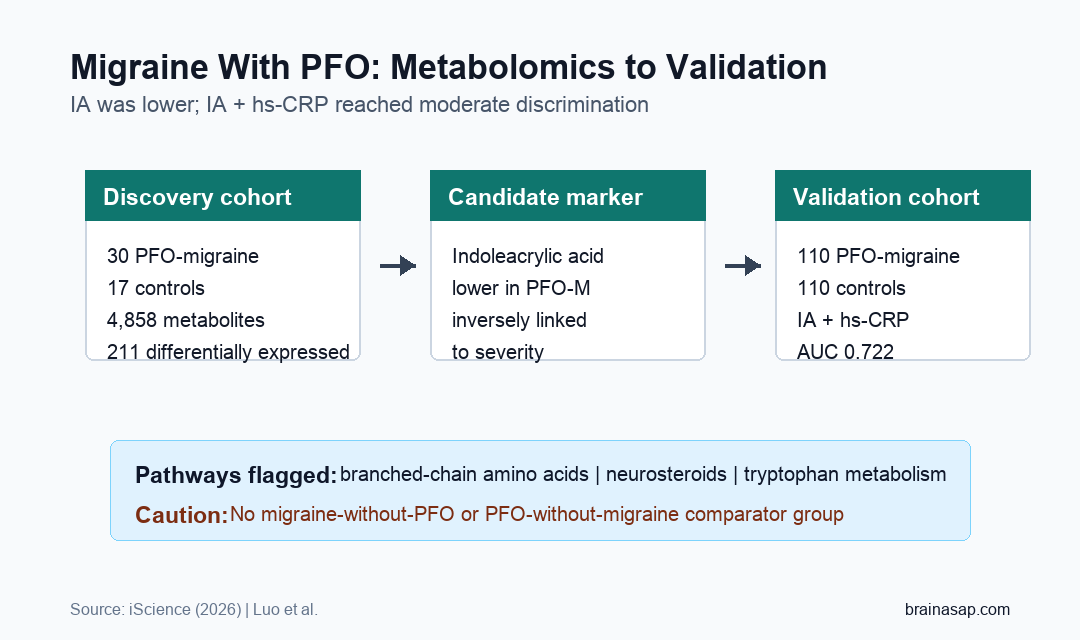
- 30 discovery patients: Untargeted metabolomics compared 30 migraine patients with patent foramen ovale against 17 matched controls.
- 4,858 metabolites detected: The discovery analysis identified 211 differentially expressed metabolites after filtering.
- IA was lower: Indoleacrylic acid, a gut microbiota-derived tryptophan metabolite, was lower in the PFO-migraine group and inversely associated with migraine severity.
- 220-person validation: A separate ELISA cohort included 110 PFO-migraine patients and 110 matched controls.
- AUC 0.722: Combining IA with high-sensitivity C-reactive protein improved discrimination compared with either marker alone.
Source: iScience (2026) | Luo et al.
Patent foramen ovale (PFO) is a small persistent opening between the upper chambers of the heart. It is common in the general population, but it has also been linked to migraine, especially migraine with aura.
This study did not test whether closing a PFO treats migraine. It asked whether people with both PFO and migraine show a measurable blood-metabolite pattern that could help explain the subtype.
PFO-Migraine Metabolomics Compared Arterial and Venous Plasma
The discovery cohort included 30 migraine patients with PFO, called PFO-M in the paper, and 17 age- and sex-matched controls without migraine history or PFO on screening.
Researchers used liquid and gas chromatography with tandem mass spectrometry to profile arterial and venous plasma. The dataset contained 4,858 detectable metabolites.
The arterial and venous comparison was specific to the PFO-M group. That design let the researchers ask whether right-to-left shunting was accompanied by a systemic metabolic profile, while the control group supplied venous plasma for the healthy comparison.
- Eligibility: PFO-M patients were 18-65 years old and had at least 2 migraine attacks per month in the prior 3 months.
- PFO confirmation: Transesophageal echocardiography and contrast transthoracic echocardiography confirmed right-to-left shunting.
- Control screening: Controls had no migraine or primary-headache history and tested negative for PFO.
The metabolomics analysis identified 211 differentially expressed metabolites: 133 upregulated and 78 downregulated in the PFO-M comparison.
Indoleacrylic Acid Was Lower and Tracked Migraine Severity
The paper highlighted indoleacrylic acid (IA), a gut microbiota-derived metabolite linked to tryptophan metabolism. IA was lower in the PFO-M group and showed inverse associations with migraine severity measures.
The IA result fits the broader pathway analysis. Differential metabolites involved branched-chain amino acids, neurosteroids, and tryptophan metabolism, all pathways that can connect systemic metabolism with neurovascular inflammation or excitability.
IA was not chosen only because it appeared in a metabolite list. The paper prioritized it because it had adjusted discovery significance, biological relevance, and a consistent relationship with headache-related measures.
- Tryptophan pathway: IA was the main validated candidate metabolite.
- Inflammation marker: High-sensitivity C-reactive protein (hs-CRP) was used with IA in the validation model.
- Severity link: IA was inversely associated with migraine-severity measures rather than simply listed as a group difference.
IA Plus hs-CRP Reached AUC 0.722 in Validation
The validation cohort was larger and more focused. Researchers measured IA by enzyme-linked immunosorbent assay in 110 PFO-M patients and 110 matched controls.
Lower IA remained negatively associated with the PFO-M phenotype, with an odds ratio of 0.97 and a 95% confidence interval of 0.96-0.98. hs-CRP, an inflammation marker, was also higher in the model.
The combined IA-plus-hs-CRP model had an area under the curve of 0.722. That is a moderate discrimination result, not a clinical diagnostic threshold.
- IA alone: Captured a gut-microbiota-linked tryptophan-metabolism feature.
- hs-CRP alone: Captured systemic inflammatory context.
- Combined model: Improved discrimination compared with either marker alone.
Aura and Sex Analyses Were Exploratory
The discovery cohort also split PFO-M patients by migraine aura status. Patients with aura included 10 people, while those without aura included 20 people.
Aura-related metabolite differences involved branched-chain amino acid catabolism and fatty acid oxidation. Sex-stratified analyses suggested different patterns in female and male patients, but the subgroup sizes were small.
The subgroup findings were treated cautiously. Female-specific and male-specific metabolic patterns may be useful leads, but they need larger sex-balanced cohorts before they can guide patient stratification.
That caution is especially important for the aura split. Ten aura patients can generate candidate hypotheses, but the group is too small to define a stable metabolic subtype by itself.
PFO-Migraine Marker Findings Need Stronger Comparators
The main limitation is the comparator design. The study compared PFO-M patients with healthy controls, but it did not include migraine patients without PFO or people with PFO but no migraine.
This design makes the biology harder to assign. The metabolic differences could reflect migraine, PFO-related shunting, their interaction, or another feature of the single-center sample.
The cross-sectional design adds another boundary. Blood metabolites and migraine severity were measured in relation to the same clinical state, so the study cannot determine whether lower IA came before symptoms, followed symptoms, or moved with another inflammatory process.
- Supported claim: PFO-M patients showed altered plasma metabolomics, with IA standing out as a validated candidate feature.
- Unsupported claim: The study does not prove IA causes migraine or that IA testing can select patients for PFO closure.
- Next study: Future work needs migraine-without-PFO and PFO-without-migraine comparator groups.
The useful read is narrow: IA and hs-CRP may help characterize a PFO-comorbid migraine phenotype, but the finding remains exploratory until tested in broader comparator cohorts.
Citation: DOI: 10.1016/j.isci.2026.115587. Luo et al. Exploratory metabolomic profiling in migraine with PFO reveals dysregulated pathways and highlights indoleacrylic acid. iScience. 2026;29:115587.
Study Design: Single-center plasma metabolomics study with an independent ELISA validation cohort.
Sample Size: Discovery cohort of 30 PFO-migraine patients and 17 controls, plus validation cohort of 110 PFO-migraine patients and 110 controls.
Key Statistic: IA plus hs-CRP reached AUC 0.722 for discriminating PFO-migraine patients from controls.
Caveat: The study lacked migraine-without-PFO and PFO-without-migraine comparator groups, so mechanisms and clinical use remain exploratory.