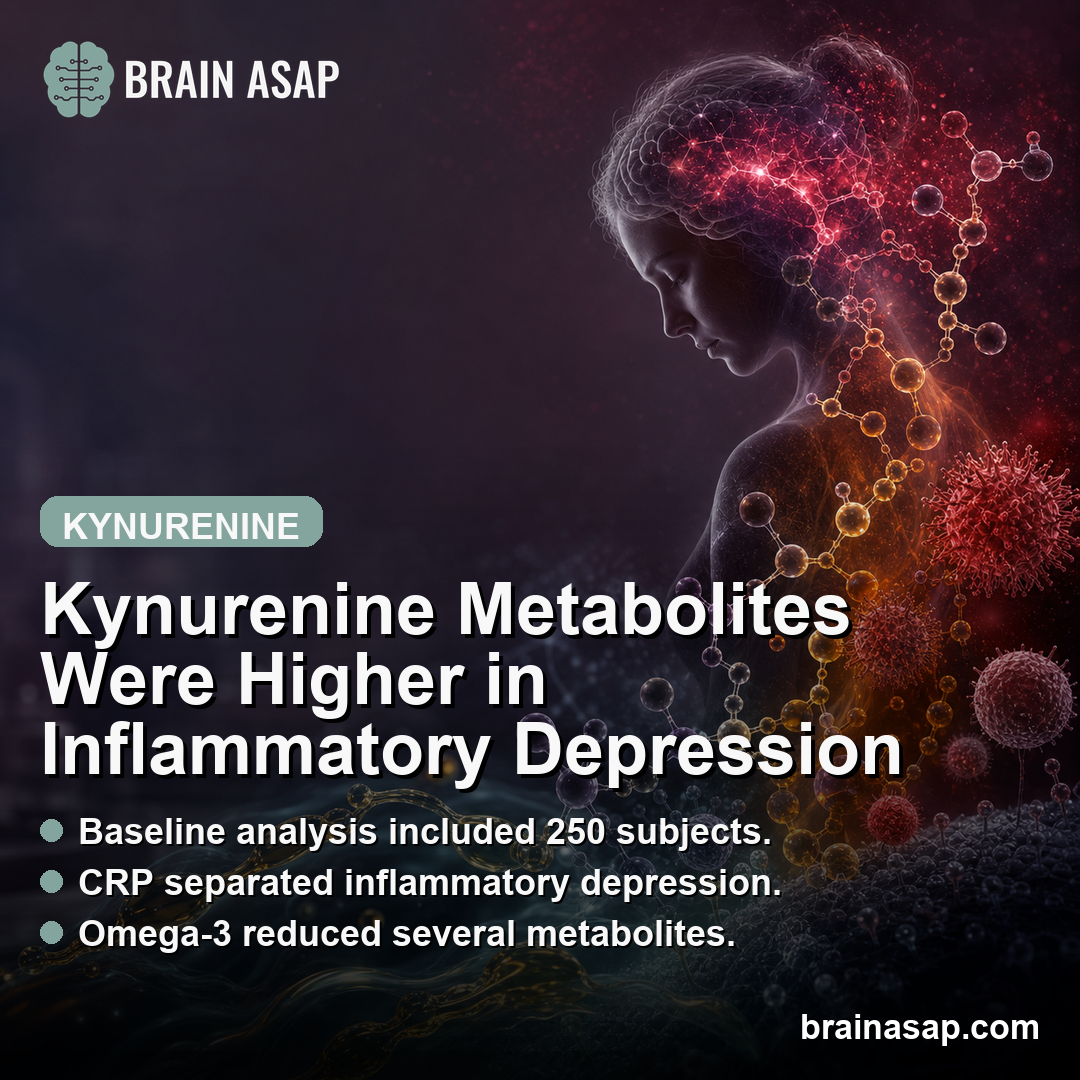
TL;DR: A 2026 biomarker analysis in Brain, Behavior, & Immunity – Health across antidepressant trials found that kynurenine pathway metabolites were elevated in inflammatory depression compared with non-inflammatory depression and healthy controls, while omega-3 polyunsaturated fatty acid treatment reduced several kynurenine pathway metabolites.
Key Findings
- Study type: a combined analysis of two depression trials testing kynurenine pathway metabolites and nutraceutical interventions.
- People studied: 250 subjects at baseline, including 127 with inflammatory depression, 43 with non-inflammatory depression, and 80 healthy controls.
- Main result: Kynurenine pathway metabolites were elevated in inflammatory depression compared with non-inflammatory depression and healthy controls.
- Second result: Omega-3 polyunsaturated fatty acid treatment reduced several kynurenine pathway metabolites.
- Caution: The biomarker changes do not prove that omega-3 is a general antidepressant treatment for all depression.
Source: Brain, Behavior, & Immunity – Health (2026) | Lindahl et al.
Inflammatory depression is a proposed subtype in which immune activation may alter tryptophan metabolism through the kynurenine pathway.
The study combined data from two antidepressant clinical trials to compare kynurenine metabolites across inflammatory depression, non-inflammatory depression, and healthy controls.
Core result: this is a subtype signal: kynurenine pathway metabolites were elevated in inflammatory depression compared with non-inflammatory depression and healthy controls. That keeps the claim focused on CRP-defined inflammatory depression instead of turning it into a broad omega-3 story.
CRP Split Depression Into Inflammatory and Non-Inflammatory Groups
Design: a combined analysis of two depression trials testing kynurenine pathway metabolites and nutraceutical interventions. People studied: 250 subjects at baseline, including 127 with inflammatory depression, 43 with non-inflammatory depression, and 80 healthy controls.
The analysis combined two antidepressant trials and separated depression groups by C-reactive protein, or CRP. This keeps the inflammatory subgroup central to the result.
- Inflammatory depression: Patients had CRP at or above 1 mg/L.
- Non-inflammatory depression: Patients had CRP below 1 mg/L.
- Healthy controls: Controls provided a non-depression comparison.
- Interventions: Trials tested omega-3 fatty acids and a probiotic supplement.
Kynurenine Pathway Metabolites Were Higher With Inflammation
Main finding: the baseline biomarker difference is kynurenine pathway metabolites were higher in inflammatory depression. That fits the idea that immune activation can redirect tryptophan metabolism.
Omega-3 treatment reducing several kynurenine metabolites is biologically notable. It should not be read as omega-3 is a general antidepressant or that every depression case has the same inflammatory chemistry.
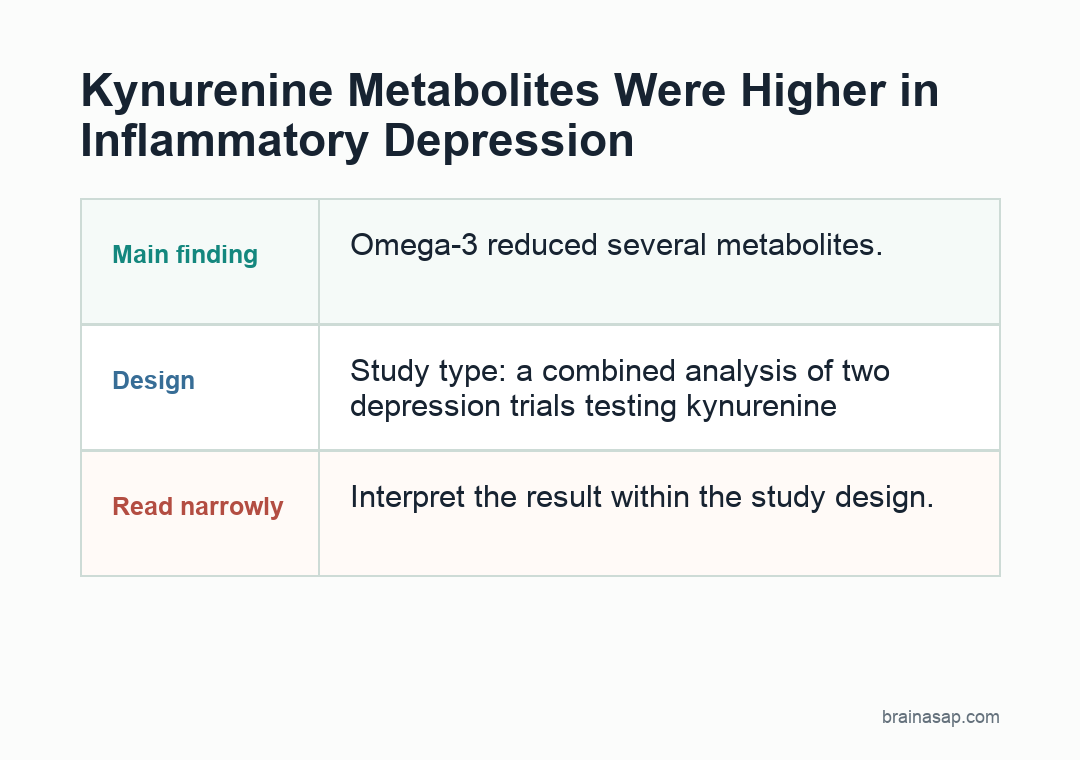
Interpret the biomarker difference alongside the study groups, trial design, measurements, and treatment limits.
- Population or model: 250 subjects at baseline, including 127 with inflammatory depression, 43 with non-inflammatory depression, and 80 healthy controls.
- Design: a combined analysis of two depression trials testing kynurenine pathway metabolites and nutraceutical interventions.
- Primary anchor: Kynurenine pathway metabolites were elevated in inflammatory depression compared with non-inflammatory depression and healthy controls.
- Second layer: Omega-3 polyunsaturated fatty acid treatment reduced several kynurenine pathway metabolites.
- Boundary: The biomarker changes do not prove that omega-3 is a general antidepressant treatment for all depression.
Measurement detail: CRP is a practical inflammation marker, and kynurenine metabolites sit downstream of tryptophan metabolism. Both are useful, but neither fully defines a patient’s depression biology.
Follow-up: Test whether baseline kynurenine activity predicts clinical response to anti-inflammatory or nutraceutical strategies. This would show whether the finding holds when the sample, method, or setting changes.
Interpretation: CRP-defined inflammatory depression had a different kynurenine-pathway profile from non-inflammatory depression and healthy controls.
Omega-3 added a treatment clue because several kynurenine metabolites decreased after omega-3 polyunsaturated fatty acid treatment.
Terms like inflammatory depression, kynurenine pathway, omega-3 get fuzzy when separated from the evidence. Here, they stay tied to the reported sample, the measurement strategy, and the specific outcome being described.
Broader treatment claims need trials that connect baseline inflammation, kynurenine activity, symptom change, and treatment response.
The current biomarker changes do not prove omega-3 is a general antidepressant treatment.
Clinical context: CRP-defined inflammatory depression is a stratification idea, not a diagnosis that automatically selects one supplement or medication. The value is in testing whether immune-metabolism measures can guide treatment selection more precisely.
Use the result to separate CRP-defined inflammatory depression from other depression presentations.
Next studies should test whether baseline kynurenine activity predicts response to anti-inflammatory or nutraceutical strategies.
Omega-3 Reduced Several Kynurenine Metabolites
CRP is a practical inflammation marker, and kynurenine metabolites sit downstream of tryptophan metabolism. Both are useful, but neither fully defines a patient’s depression biology.
Best reading: inflammatory depression had a different kynurenine-pathway profile. Treatment implications need subgroup-specific testing.
The weaker probiotic result matters because it prevents a broad anti-inflammatory-treatment claim.
Probiotic Effects Were Less Clear Than Omega-3 Effects
Main limitation: the biomarker changes do not prove that omega-3 is a general antidepressant treatment for all depression.
- Subtype definition: CRP cutoffs are practical but imperfect.
- Combined trials: The analysis pooled data from two intervention contexts.
- Mechanism: Metabolite changes may be downstream markers rather than direct causes.
- Treatment scope: Results should not be generalized to every patient with depression.
The main caveat is treatment scope. Biomarker movement is not the same thing as proven clinical improvement for all patients with depression.
Inflammatory Depression Biomarkers Need Treatment-Specific Testing
A practical read is that inflammatory depression may need biomarker-specific treatment studies.
- Best use: Use the result to separate CRP-defined inflammatory depression from non-inflammatory depression.
- Do not overread: Do not turn omega-3 metabolite changes into blanket supplement advice.
- Next question: Test whether baseline kynurenine activity predicts clinical response to anti-inflammatory or nutraceutical strategies.
That keeps the result readable: a specific immune-metabolism pattern, with treatment claims still unfinished.
Citation: DOI: 10.1016/j.bbih.2026.101221. Lindahl et al. Kynurenine pathway metabolites are increased in inflammatory depression and decrease with omega-3 treatment. Brain, Behavior, & Immunity – Health. 2026.
Study Design: A combined analysis of two depression trials testing kynurenine pathway metabolites and nutraceutical interventions.
Sample Size: 250 subjects at baseline, including 127 with inflammatory depression, 43 with non-inflammatory depression, and 80 healthy controls.
Key Statistic: Kynurenine pathway metabolites were elevated in inflammatory depression compared with non-inflammatory depression and healthy controls.
Caveat: Biomarker changes do not prove omega-3 is a general antidepressant treatment for all depression.