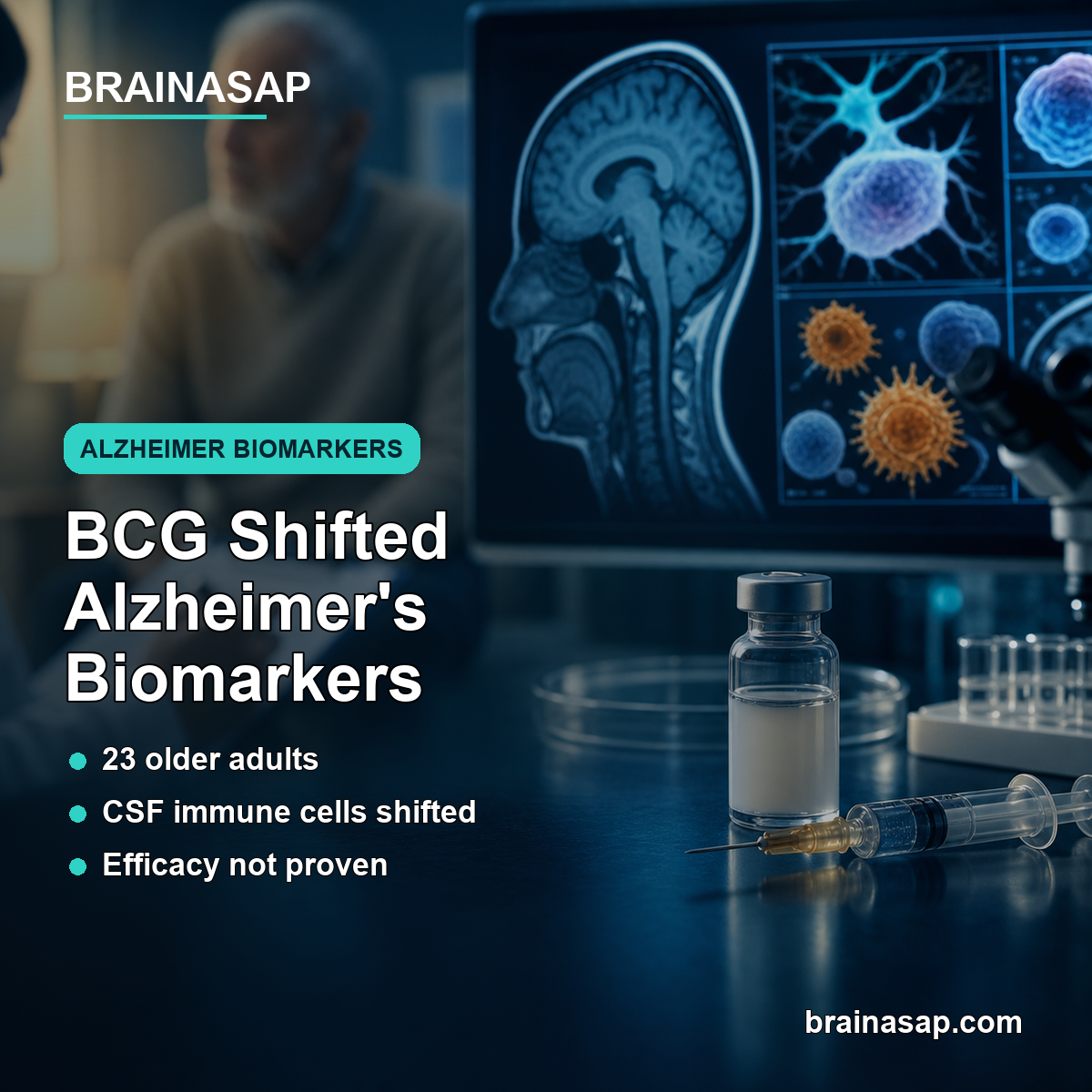
TL;DR: A 2026 open-label study in Communications Medicine found that Bacillus Calmette-Guerin (BCG) immunotherapy changed cerebrospinal-fluid immune-cell responses and Alzheimer-related biomarkers in 23 older adults.
Key Findings
- Small trial context: 2 related 1-year open-label trials enrolled 23 adults aged 55 or older at one academic medical center.
- BCG dosing was simple: Participants received 2 intradermal BCG vaccinations, 1 at baseline and 1 at 1 month.
- Brain-fluid immunity shifted: Cerebrospinal-fluid immune cells showed trained-immunity-like changes after BCG, including stronger innate responsiveness.
- Biomarkers moved by compartment: In participants without Alzheimer-related pathology, amyloid-beta decreased in cerebrospinal fluid and increased in blood.
- Efficacy is not proven: The study was exploratory, open-label, single-center, and not designed to show that BCG prevents or treats Alzheimer’s disease.
Source: Communications Medicine (2026) | Weinberg et al.
BCG Shifted Brain-Fluid Immune Responses in Older Adults
Bacillus Calmette-Guerin (BCG) is best known as a tuberculosis vaccine, but it also has a separate research history in trained immunity. That means it can leave innate immune cells more responsive to later challenges.
The new study tested whether that immune training could be detected in the central nervous system, not just in blood. Researchers followed 23 older adults in 2 related 1-year open-label trials at Massachusetts General Hospital.
The trial design was deliberately biomarker-heavy:
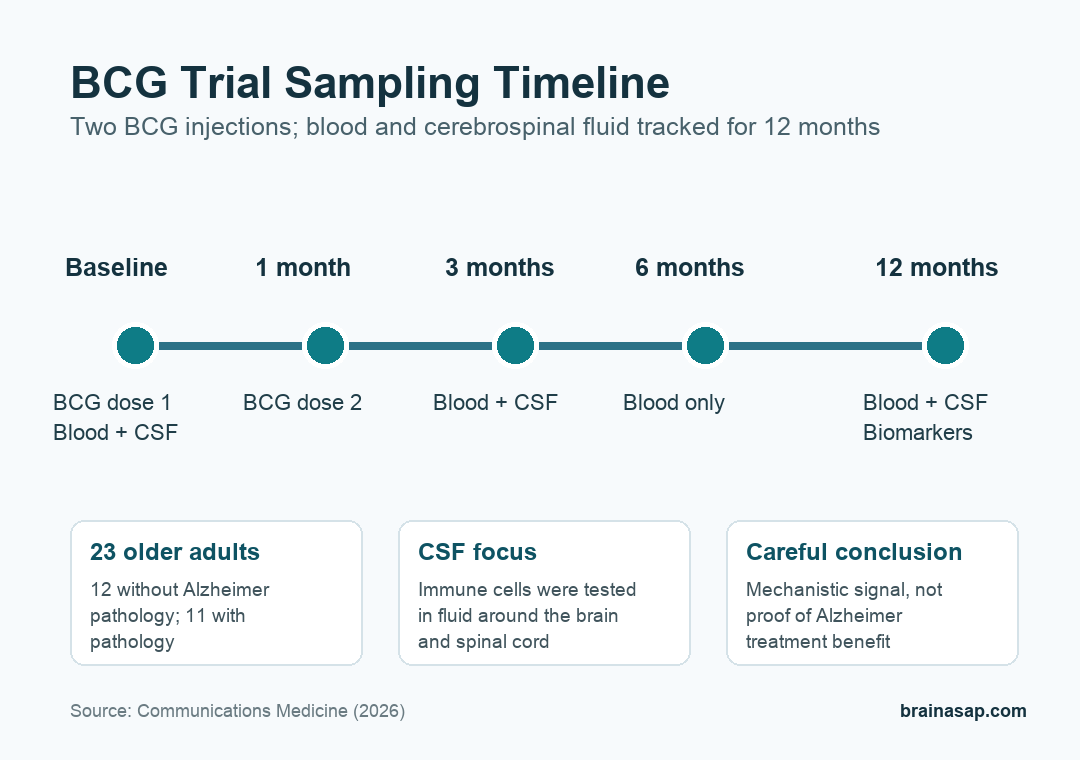
- 2 BCG injections: Participants received intradermal BCG at baseline and again 1 month later.
- Repeated samples: Blood and cerebrospinal fluid were collected at baseline, 3 months, and 12 months, with an additional blood draw at 6 months.
- Immune testing: Researchers used cytokine stimulation assays and single-cell profiling to examine immune-cell behavior.
- Alzheimer markers: The team measured Alzheimer-related biomarkers in blood and cerebrospinal fluid.
The important point is scope. This was not a dementia-outcome trial.
It was a small mechanistic study asking whether BCG could leave measurable immune and biomarker changes in compartments relevant to brain aging.
The Study Included Alzheimer-Pathology and Non-Pathology Groups
The participants were all at least 55 years old, but they were not a single uniform clinical group. The paper separated people by Alzheimer-related pathology using baseline cerebrospinal-fluid biomarkers.
12 participants were classified as not having Alzheimer-related pathology. 11 were classified as having Alzheimer-related pathology.
The paper noted that this biomarker label was not the same as a formal clinical Alzheimer’s diagnosis.
Eligibility also differed across the 2 linked trials. The first trial enrolled cognitively unimpaired or mildly impaired older adults.
The second trial enrolled people with mild cognitive impairment or mild-to-moderate Alzheimer’s disease and biomarker-confirmed Alzheimer pathology.
The mixed enrollment makes the study more informative for biology than for a clean clinical conclusion.
A trial this small can show whether immune signals move in a consistent direction, but it cannot settle who should receive BCG or whether cognition would improve.
Cerebrospinal-Fluid Cells Showed Trained-Immunity-Like Changes
The strongest result was the immune-compartment finding. After BCG, cerebrospinal-fluid immune cells showed changes consistent with trained immunity, including enhanced innate responsiveness and related transcriptional programs.
Cerebrospinal fluid, or CSF, is the fluid around the brain and spinal cord. It is not the same compartment as blood.
That distinction is central because the paper found that BCG-related immune patterns differed between blood and CSF.
In blood immune cells, stimulation assays showed cytokine changes after BCG. Interferon-gamma responses to heat-killed BCG increased at post-baseline timepoints in both groups.
Responses involving IL-1 beta, IL-6, and TNF-alpha varied by stimulus, group, and timepoint.
The paper treated these as exploratory immune readouts. Many p values were nominal and not adjusted for multiple comparisons, which is appropriate to keep in mind when interpreting a small multi-measure study.
Amyloid-Beta Moved in Opposite Directions Across Compartments
The Alzheimer-biomarker result was also compartment-specific. In participants without Alzheimer-related pathology, BCG-related immune shifts were accompanied by lower amyloid-beta in CSF and higher amyloid-beta in blood.
Amyloid-beta is a protein involved in Alzheimer disease biology. In this study, the finding did not show amyloid clearance from the brain or reduced disease risk.
It means the measured biomarker pattern changed differently in blood and CSF after BCG.
The paper’s interpretation is cautious: immune reprogramming may influence Alzheimer-relevant pathways. That is weaker than saying BCG is a treatment, and it is the right level of caution for this design.
- Blood alone was insufficient: The CSF and blood patterns did not simply mirror each other.
- Pathology status mattered: The amyloid-beta compartment shift was described in participants without Alzheimer-related pathology.
- Mechanism stayed unresolved: The study could not prove whether the biomarker shift reflected altered production, clearance, transport, or assay-level compartment dynamics.
The finding is mechanistically relevant but clinically unfinished. Larger controlled studies still need to test whether these biomarker changes are reliable.
Those studies would also need to show whether the immune and biomarker shifts relate to cognition or disease progression.
Safety Looked Acceptable, but the Evidence Remained Early
BCG was reported as well tolerated, with no unexpected safety signals observed. This supports further testing in older adults.
The trial also included lumbar punctures, repeated immune testing, and older adults with differing cognitive and biomarker profiles.
The safety finding still has limits. A 23-person open-label trial can miss uncommon adverse events, and it does not answer whether the risk-benefit profile would hold in a broader Alzheimer population.
The main limitations are straightforward:
- No placebo control: Participants and researchers knew BCG was given, so clinical interpretation is limited.
- Very small sample: The non-pathology group had 12 participants, and the pathology group had 11.
- Single center: The study came from one academic medical center and needs independent replication.
- Exploratory statistics: Many immune and biomarker outcomes were tested, and p values were not adjusted for multiple comparisons.
The practical takeaway is narrow: BCG appeared to reprogram immune responses in blood and cerebrospinal fluid, and some Alzheimer-related biomarkers changed over 12 months.
The study gives researchers a human signal to test, not a reason for patients to seek BCG for Alzheimer prevention or treatment.
Citation: DOI: 10.1038/s43856-026-01691-7. Weinberg et al. Bacillus Calmette-Guerin (BCG) immunotherapy reprograms CNS immunity and alters Alzheimer’s biomarkers: results from 2 open-label clinical trials. Communications Medicine. 2026;6:358.
Study Design: 2 related 1-year, single-center, open-label clinical trials of intradermal BCG in older adults with and without Alzheimer-related pathology.
Sample Size: 23 adults aged 55 or older: 12 without Alzheimer-related pathology and 11 with Alzheimer-related pathology.
Key Statistic: BCG was associated with trained-immunity-like changes in cerebrospinal-fluid immune cells and compartment-specific amyloid-beta changes in the non-pathology group.
Caveat: The trial was small, open-label, exploratory, and not designed to prove Alzheimer prevention, treatment, or cognitive benefit.