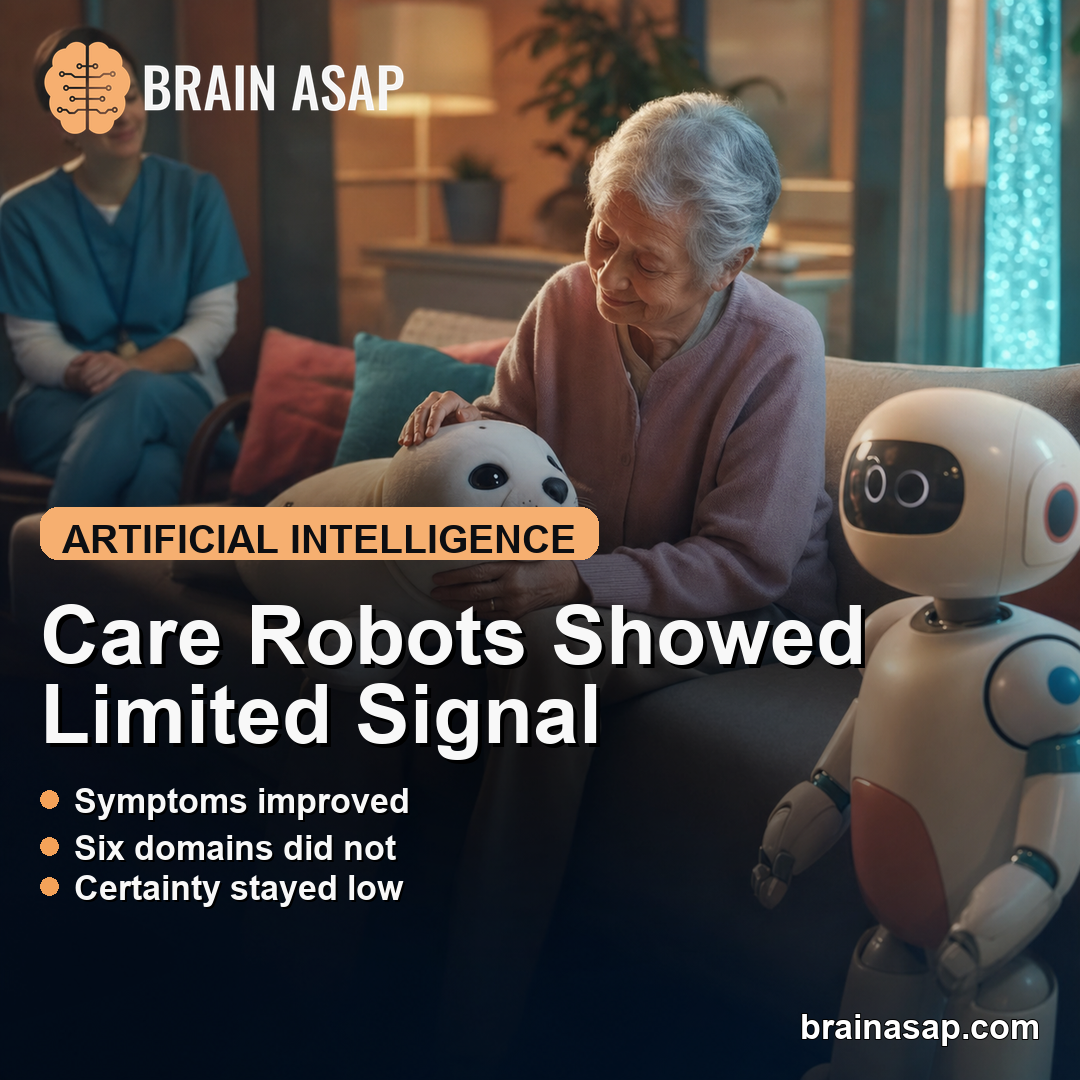
TL;DR: A 2026 systematic review and meta-analysis in Journal of Medical Internet Research found that care robots showed a low-certainty reduction in neuropsychiatric symptoms, but six other pooled outcome domains did not reach statistical significance.
Key Findings
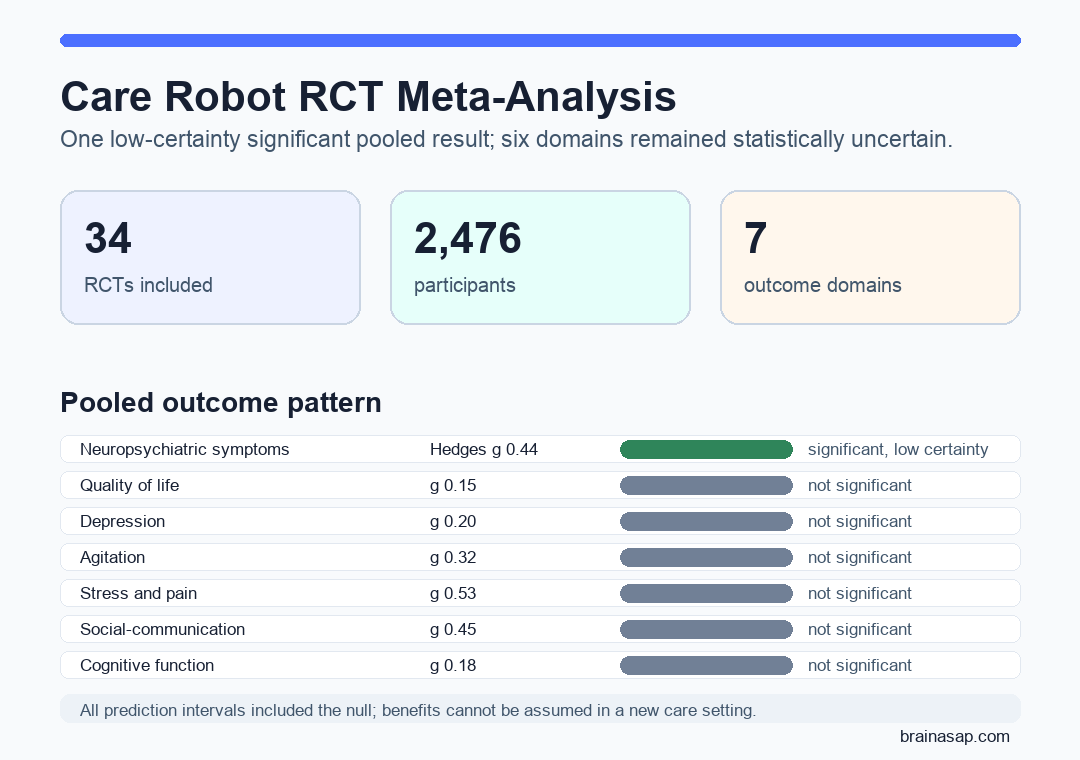
- 34 randomized trials: The review included 34 randomized controlled studies across 17 countries, with 2,476 participants.
- 20 meta-analyzed studies: Twenty trials contributed to at least one pooled analysis, while 14 were summarized narratively.
- NPS Hedges g 0.44: Neuropsychiatric symptoms improved with care robots (95% CI, 0.03-0.84), but certainty was rated low.
- Six nonsignificant domains: Quality of life, depression, agitation, stress and pain, social-communication, and cognition did not show statistically significant pooled effects.
- Fragile main result: The neuropsychiatric symptom effect lost significance in five of six leave-one-out sensitivity checks.
Source: Journal of Medical Internet Research (2026) | Kim and Jeon
Care robots are embodied devices designed to interact directly with patients. In this review, the category included socially assistive robots, companion pet robots, and therapeutic humanoids such as PARO, NAO, Pepper, Kaspar, Kabochan, CommU, Joy for All, MiRo, and iRobiQ.
The clinical question was not whether robots can attract attention. The review asked whether randomized trials show measurable benefits across older adults, dementia care, autism therapy, pediatric procedures, rehabilitation, and mixed clinical settings.
Care Robot Trials Covered Dementia, Autism, Pediatrics, and Rehabilitation
The researchers searched five databases and two trial registries through April 29, 2026. Eligible studies had to be randomized controlled trials of physically embodied care robots with a social or interactive component.
The final evidence base included 34 randomized controlled studies published from 2015 through 2024. Together, those trials included 2,476 participants from 17 countries.
- Older adults with dementia or mild cognitive impairment: 14 of 34 studies, or 41.2%, focused on this group.
- Children or adolescents with autism spectrum disorder: Nine studies, or 26.5%, tested social-communication or therapy-related outcomes.
- Hospitalized or procedural pediatric patients: Four studies, or 11.8%, evaluated acute care or procedure-related contexts.
- Other adults: Seven studies, or 20.6%, covered mixed or poststroke populations.
Robot platforms also varied. PARO accounted for 32.4% of studies, humanoid robots for 47.1%, and other companion or pet platforms for 20.6%.
That breadth is useful for comparing the field, but it also creates a challenge. A seal-shaped dementia-care companion, a humanoid autism-practice robot, and a pediatric procedure-distraction robot are not interchangeable interventions.
Only Neuropsychiatric Symptoms Reached Statistical Significance
The review pooled outcomes across seven prespecified domains using random-effects meta-analysis with Hartung-Knapp-Sidik-Jonkman correction, a conservative method for small and heterogeneous evidence bases.
Only neuropsychiatric symptoms reached statistical significance. Six studies with 650 participants contributed to that pool, using instruments such as the Neuropsychiatric Inventory, Behavioral Activity Rating Scale, Cohen-Mansfield Agitation Inventory, and Rating Anxiety in Dementia scale.
- Neuropsychiatric symptoms: Hedges g 0.44; 95% CI, 0.03-0.84; k=6; low-certainty evidence.
- Quality of life: Hedges g 0.15; 95% CI, -0.41 to 0.71; k=5; very-low-certainty evidence.
- Depression: Hedges g 0.20; 95% CI, -0.08 to 0.49; k=7; very-low-certainty evidence.
- Agitation: Hedges g 0.32; 95% CI, -0.07 to 0.71; k=4; very-low-certainty evidence.
The positive neuropsychiatric-symptom result means the average effect across existing trials favored care robots. A new nursing home, clinic, or pediatric unit should not assume the same benefit.
All seven 95% prediction intervals included the null. Prediction intervals matter because they estimate the plausible effect in a new setting, not just the average effect across the studies already published.
Depression, Cognition, Pain, and Social-Communication Effects Were Uncertain
The nonsignificant results were not all identical. Some domains had favorable point estimates, but confidence intervals were wide, samples were small, or the measured outcomes differed too much across trials.
Stress and pain had a higher pooled estimate than several other domains, but heterogeneity was extreme. The pool mixed procedural pain in children, chronic distress in older adults, healthy-child stress tasks, and social-affective regulation in autism.
- Stress and pain: Hedges g 0.53; 95% CI, -0.48 to 1.53; I-squared 90%, which signals very high between-study heterogeneity.
- Social-communicative skills: Hedges g 0.45; 95% CI, -0.52 to 1.42; based on five small autism studies using humanoid platforms.
- Cognitive function: Hedges g 0.18; 95% CI, -0.62 to 0.98; mixed dementia cognitive screening and a poststroke hemineglect measure.
For autism-related social-communication outcomes, individual studies sometimes reported positive findings, including joint attention or gesture-production measures. Under the conservative pooled model, the combined estimate did not reach statistical significance.
For cognition, the review separated a narrow poststroke improvement finding from the broader dementia evidence. Global cognitive screens such as MMSE and MoCA did not provide convincing pooled evidence that care robots improve cognition.
The Main Neuropsychiatric Symptom Result Was Sensitive to Study Choice
The researchers treated the neuropsychiatric-symptom result cautiously because sensitivity analyses weakened it. In leave-one-out testing, the pooled effect stayed statistically significant in only one of six iterations.
The result also lost significance when Petersen 2016 was excluded. That study had a directional ambiguity in published change-score reporting for anxiety and depression measures, so excluding it was a reasonable stress test.
- Leave-one-out fragility: Removing any one of five contributing studies made the neuropsychiatric-symptom confidence interval cross the null.
- Petersen exclusion: Removing the ambiguous study shifted the neuropsychiatric-symptom pool to Hedges g 0.40 with P=.095.
- GRADE certainty: Neuropsychiatric symptoms were rated low certainty; all six other domains were rated very low certainty.
Risk of bias also limited confidence. None of the 34 trials was rated overall low risk of bias; 30 had some concerns, and four were rated high risk.
Blinding is especially difficult in robot trials. Patients and staff usually know whether an interaction involves a robot, a plush control, a tablet, usual care, or a therapist-led activity.
Care Robots Look Most Plausible as Facilitator-Supported Adjuncts
The review did not support routine clinical adoption across the whole category. The more practical reading is that care robots may deserve targeted testing in settings where they are supported by staff and matched to a narrow purpose.
- Dementia care: PARO-style facilitated sessions may help neuropsychiatric symptoms in some long-term-care residents, especially when sessions are scheduled and staff-supported.
- Pediatric procedures: Humanoid robots may work as time-limited distraction tools during anxiety-provoking procedures, but the pooled stress and pain evidence is still very uncertain.
- Autism practice tasks: Humanoid robots may support structured social-communication practice, but transfer to human social interaction remains unresolved.
The strongest implementation warning is simple: robots should not be framed as substitutes for human care. The included evidence fit an adjunct model, where a trained facilitator uses the robot to support engagement, calming, distraction, or practice.
Cost-effectiveness, staffing burden, long-term adherence, and durable outcomes remain underdeveloped. Future trials need attention-matched controls, blinded outcome assessment where possible, longer follow-up, and sample sizes large enough to handle realistic effect estimates.
Citation: DOI: 10.2196/95232. Kim and Jeon. Care Robots as Emerging Health Technologies: Systematic Review and Meta-Analysis of Randomized Controlled Trials. Journal of Medical Internet Research. 2026;28:e95232.
Study Design: Systematic review and random-effects meta-analysis of randomized controlled trials.
Sample Size: 34 randomized controlled studies with 2,476 participants; 20 studies contributed to at least one meta-analysis.
Key Statistic: Neuropsychiatric symptoms improved with care robots (Hedges g 0.44; 95% CI, 0.03-0.84), but the effect was low certainty and sensitive to leave-one-out checks.
Caveat: Six other outcome domains were nonsignificant, all prediction intervals included the null, and overall evidence certainty was low or very low.