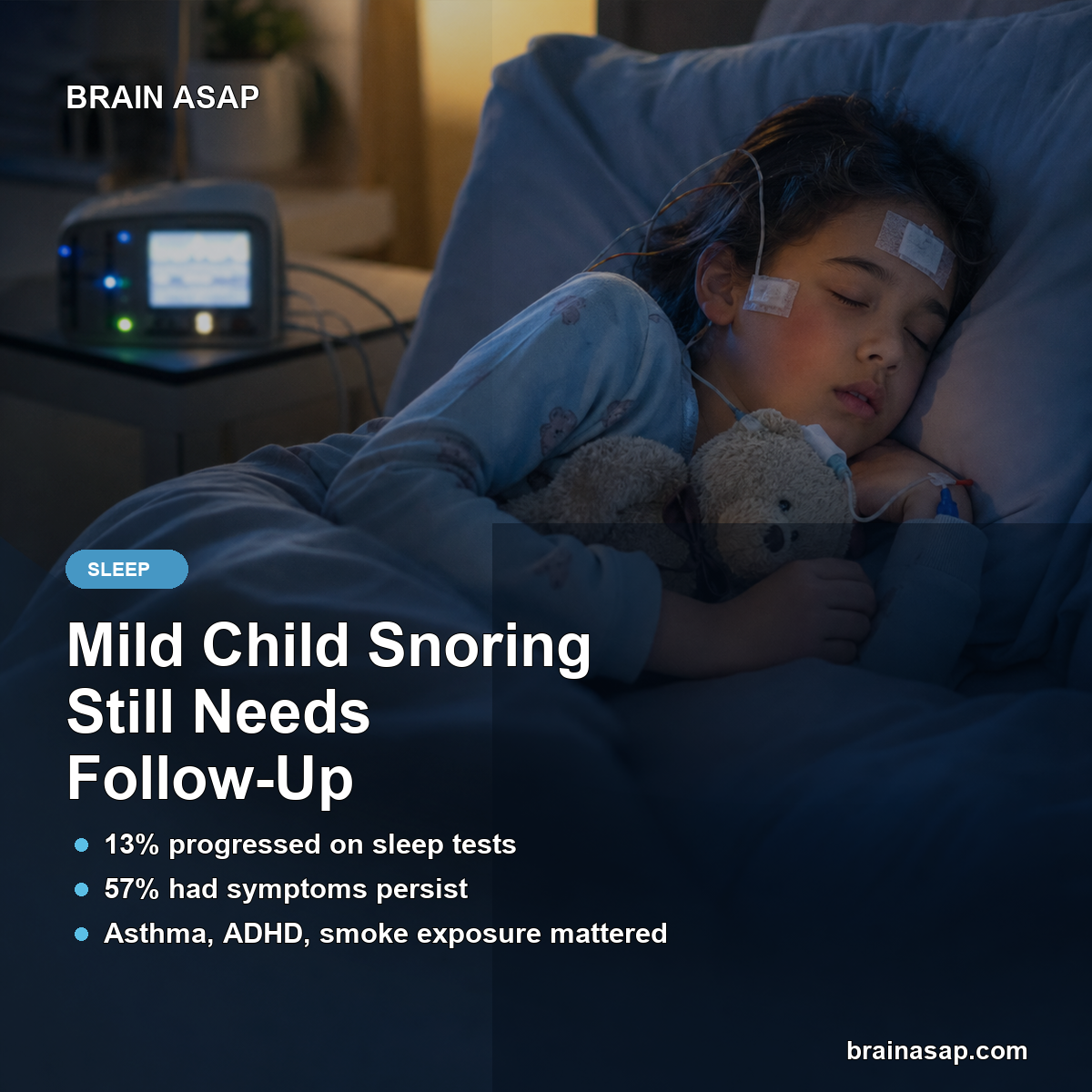
TL;DR: A 2026 study in Journal of Clinical Sleep Medicine found that after 12 months of watchful waiting for mild pediatric sleep-disordered breathing, only 13% of children progressed on polysomnography (PSG), an overnight sleep study, but 57% had persistent or worsening caregiver-reported symptoms.
Key Findings
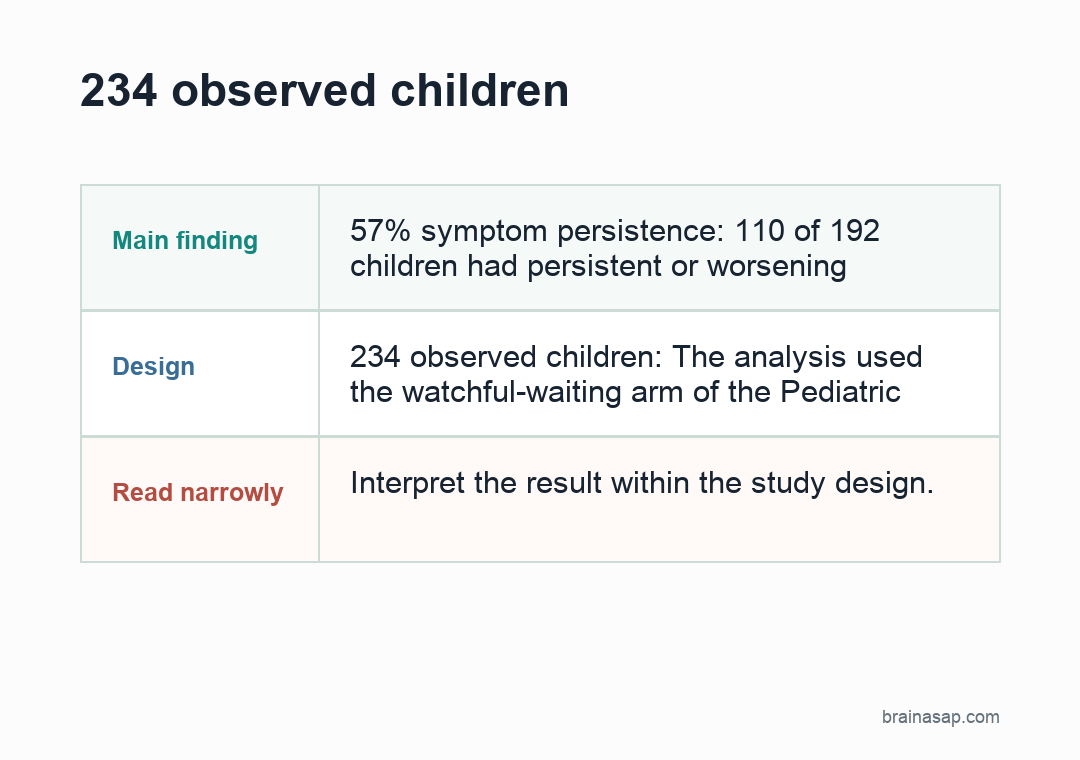
- 234 observed children: The analysis used the watchful-waiting arm of the Pediatric Adenotonsillectomy Trial for Snoring.
- 13% PSG progression: 20 of 150 children with repeat PSG progressed to obstructive apnea-hypopnea index (oAHI) ≥ 3 events/hour.
- 57% symptom persistence: 110 of 192 children had persistent or worsening Pediatric Sleep Questionnaire-Sleep-Related Breathing Disorder (PSQ-SRBD) scores.
- 18% overlap: Among symptomatic children with repeat PSG, 16 of 103 also progressed to oAHI ≥ 3.
- Clinical markers: Asthma, ADHD, tobacco smoke exposure, and higher symptom burden were associated with persistent or worsening symptoms.
Source: Journal of Clinical Sleep Medicine (2026) | Kirkham et al.
Snoring in children can look minor on a sleep study while still affecting attention, behavior, daytime sleepiness, and family quality of life. That mismatch is why mild pediatric sleep-disordered breathing is hard to manage.
This analysis focused on children whose families deferred adenotonsillectomy and used watchful waiting with supportive care for 12 months.
Watchful Waiting Rarely Led to PSG Progression
The study was a secondary analysis of the Pediatric Adenotonsillectomy Trial for Snoring (PATS). PATS randomized children aged 3.0 to 12.9 years with mild SDB to early adenotonsillectomy or watchful waiting with supportive care.
Mild SDB meant snoring at least three nights per week with an obstructive apnea-hypopnea index, or oAHI, below 3 events per hour. oAHI counts obstructive apneas and hypopneas per hour of sleep.
- Observed group: 234 children were followed in the watchful-waiting arm.
- Mean age: Children averaged 6.2 years at baseline.
- Sex distribution: 111 children, or 47%, were female.
- Race/ethnicity: 65 children were Black or African American, and 37 were Hispanic.
The primary objective measure was PSG progression. Only 20 of 150 children with repeat PSG reached oAHI ≥ 3 at 12 months, or 13%.
Symptoms Persisted More Often Than Sleep-Study Progression
The symptom measure told a different story. The PSQ-SRBD is a caregiver questionnaire scored from 0 to 1, with higher values indicating more sleep-related breathing symptom impact and scores ≥ 0.33 suggesting clinically meaningful burden.
At 12 months, 110 of 192 children, or 57%, had persistent or worsening symptom burden. Most of those children already had high symptom scores at baseline.
- Persistent symptoms: 103 of 110 symptomatic children had already been above the PSQ-SRBD threshold at baseline.
- New symptom progression: 7 of 110 moved from below the threshold to high symptom burden.
- Overlap with PSG: Among symptomatic children who also had repeat PSG, 18% progressed to oAHI ≥ 3.
This split is clinically important. A child can continue to have snoring, daytime sleepiness, behavior concerns, or quality-of-life burden even when the PSG number does not cross the obstructive sleep apnea threshold.
Asthma, ADHD, Smoke Exposure, and Symptom Scores Marked Higher Symptom Risk
Several baseline characteristics were associated with persistent or worsening symptoms during watchful waiting. Asthma was associated with higher odds (OR 2.70), attention-deficit/hyperactivity disorder, or ADHD, had OR 3.73, and environmental tobacco smoke exposure had OR 2.41.
For objective PSG progression, Black race was associated with higher odds (OR 2.71), and higher baseline PSQ-SRBD score was also associated with progression (OR 1.74 per standard-deviation increase). These race findings should be read as markers that may include social, environmental, access, and health-system factors, not as biological explanations.
- Symptom model: A model using caregiver-reported inventories had better discrimination than a clinical-only model.
- Tonsil grade: Larger tonsils were linked to lower symptom persistence or progression odds, a result the authors described as surprising.
- Clinical use: Baseline symptom burden remained one of the most useful counseling signals.
The findings support a practical counseling point: watchful waiting may be reasonable for some children with mild PSG findings, but families should not assume symptoms will resolve just because the baseline sleep study looks mild.
They also separate two follow-up questions that can be blurred in clinic. One question is whether the oAHI crosses a PSG threshold for obstructive sleep apnea.
The other is whether the child still has enough snoring, sleepiness, behavior burden, or family concern to justify a treatment discussion.
Exploratory Watchful-Waiting Data Cannot Decide Surgery Alone
The analysis was exploratory and not designed to produce a final prediction equation. Follow-up was incomplete for both endpoints, with 64% having PSG follow-up and 82% having PSQ follow-up, although baseline characteristics did not differ clearly by follow-up completion.
Another limitation is measurement mismatch. PSG captures breathing events during a sleep study, while the PSQ-SRBD captures caregiver-observed symptoms and behavior. Both can matter, but they do not measure the same thing.
That mismatch cuts both ways. PSG can miss night-to-night symptom burden, while questionnaires can capture sleep disruption that comes from asthma, allergies, ADHD, household smoke exposure, or other problems that overlap with SDB.
- Objective endpoint: PSG progression to oAHI ≥ 3 was uncommon.
- Symptom endpoint: Caregiver-reported burden was common after 12 months.
- Clinical boundary: Surgery decisions still require symptoms, exam findings, comorbidities, family preference, and clinician judgment.
The main result is not that every child with mild SDB needs early surgery. It is that watchful waiting has two different outcomes: breathing-event progression is uncommon, but persistent symptom burden is common enough to require planned follow-up.
Citation: DOI: 10.1007/s44470-026-00082-y. Kirkham et al. Progression of mild sleep-disordered breathing in children managed with watchful waiting. Journal of Clinical Sleep Medicine. 2026;22:106.
Study Design: Exploratory secondary analysis of the watchful-waiting arm of the PATS randomized trial.
Sample Size: 234 observed children aged 3.0 to 12.9 years with mild sleep-disordered breathing.
Key Statistic: 13% progressed on PSG, while 57% had persistent or worsening PSQ-SRBD symptom burden.
Caveat: Symptom and PSG endpoints diverged, and the exploratory analysis was not powered to create a definitive surgical decision rule.