TL;DR: A 2026 post-hoc reanalysis in Molecular Psychiatry found that women assigned davunetide in a prior 52-week progressive supranuclear palsy trial had more favorable scores on the 10-item PSP Rating Scale (PSPRS-10), daily-living measures, and several cognitive outcomes than women assigned placebo, but the subgroup result needs confirmation in a prospective trial designed to test sex differences.
Key Findings
- 313-participant original trial: The underlying randomized, double-blind, placebo-controlled trial tested intranasal davunetide for 52 weeks in PSP and was previously reported as safe and well tolerated but not effective overall.
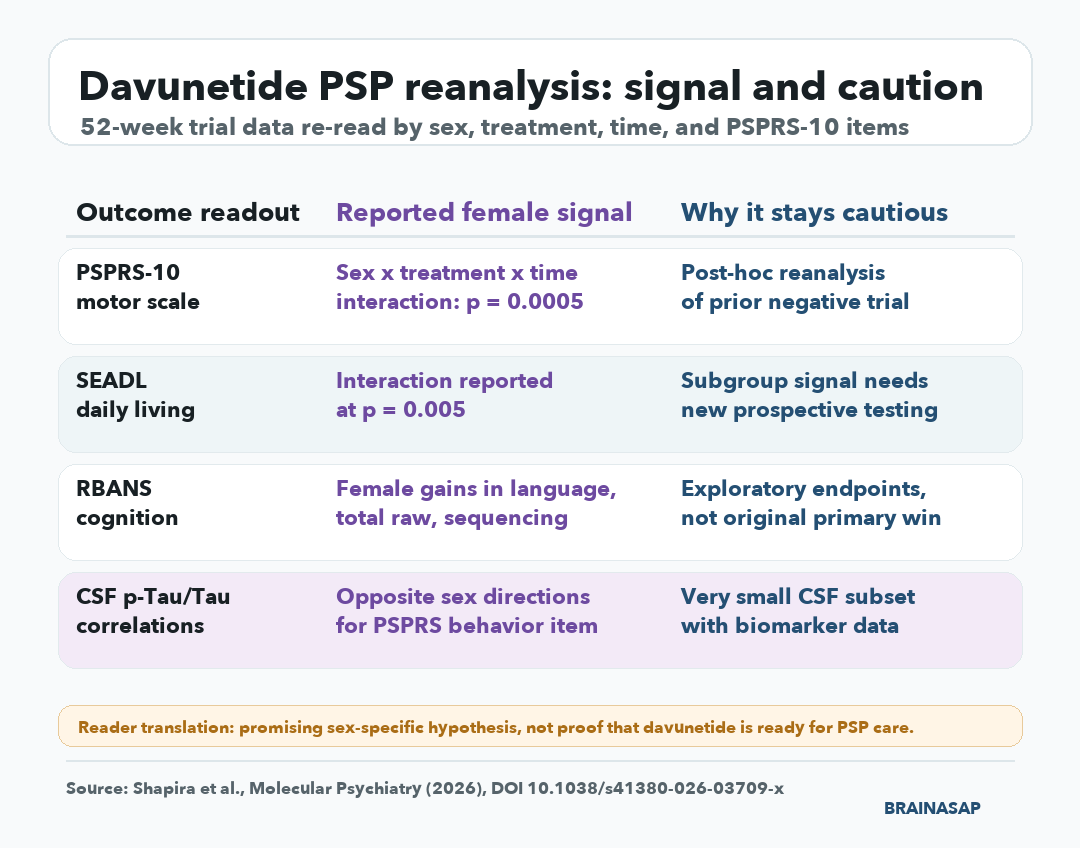
- PSPRS-10 favored women: Reanalysis using the FDA-recommended 10-item PSP Rating Scale found a sex-by-treatment-by-time interaction favoring davunetide-treated women (p = 0.0005).
- Daily-living pattern repeated: Schwab and England Activities of Daily Living scores also showed a time-by-sex-by-treatment interaction (p = 0.005); the authors interpreted the week-52 pattern as efficacy in women, but this came from a post-hoc reanalysis of an overall negative trial.
- Cognitive endpoints pointed the same way: RBANS language, total raw score, and letter-number sequencing analyses showed female-specific davunetide differences across several comparisons.
- Biomarker subset was small: CSF p-Tau/Tau correlations with functional outcomes ran in opposite directions by sex, but the available CSF subset was tiny and should not be treated as definitive.
Source: Molecular Psychiatry (2026) | Shapira et al.
Progressive supranuclear palsy (PSP) is a rare and fatal tauopathy that affects movement, balance, eye movements, speech, swallowing, and cognition. It remains an area of major unmet treatment need.
Davunetide is an investigational peptide derived from activity-dependent neuroprotective protein biology. The drug had already been tested in PSP, and the original trial did not show overall efficacy.
The new paper does not erase that history. It reopens the data with a narrower question: did the treatment response look different in women?
The Reanalysis Came From a Prior Negative PSP Trial
The original study was a 52-week phase 2/3 randomized, double-blind, placebo-controlled trial. Participants received either intranasal davunetide 30 mg twice daily or placebo.
The trial randomized 313 participants, with 157 assigned to davunetide and 156 to placebo. A total of 241 participants completed the study.
The original published conclusion was important: davunetide was described as safe and well tolerated, but it did not show efficacy for PSP in the overall trial population.
That means this new paper is not a standard positive trial report. It is a reanalysis built around sex, treatment, time, and newer PSPRS-10 scoring.
PSPRS-10 Produced the Strongest Female-Favoring Signal
The main reanalysis used the 10-item PSP Rating Scale (PSPRS-10), described in the paper as the FDA-recommended version of the scale. The older 28-item PSPRS was also analyzed.
In the PSPRS-10 model, the reanalysis reported a significant sex-by-treatment-by-time interaction. The reported p-value was 0.0005, favoring davunetide-treated women over the pattern seen in men.
The paper says the female advantage became clearer by week 52 and was visible in motor-related measurements, including postural-instability and PSPRS item-level patterns.
The 28-item PSPRS analysis pointed in a similar direction. It also showed a significant sex-treatment interaction over time, with p = 0.000018 in the GLMM analysis.
That consistency makes the finding worth following, but it still comes from a re-read of existing data rather than a trial prospectively designed around female PSP patients.
Daily-Living and Cognition Measures Pointed in the Same Direction
The paper also revisited the Schwab and England Activities of Daily Living (SEADL) scale. This measure tracks practical daily function rather than only neurological exam items.
For SEADL, the reported time-by-sex-by-treatment interaction was p = 0.005. The paper says the week-52 pattern showed davunetide efficacy in women.
Several exploratory cognitive endpoints also leaned toward female-specific benefit:
- RBANS language: Women receiving davunetide showed a week-52 advantage over female placebo in the reported comparisons.
- Total raw RBANS score: Female placebo-versus-davunetide week-52 numeric change from baseline was reported as significant (p = 0.018).
- Letter-number sequencing: The davunetide group showed a sex difference at week 52 and a female placebo-versus-davunetide finding.
- GLMM interaction terms: Raw RBANS and language scores were reported as significant under the timepoint-by-sex-by-treatment interaction.
Those results make the story broader than a single motor score. Still, exploratory cognitive measures are not the same as a pre-specified primary endpoint win.
CSF Tau Correlations Were Opposite by Sex
The biomarker section looked at cerebrospinal fluid measures, including phosphorylated tau and total tau. The analysis correlated the CSF p-Tau/Tau ratio with functional outcomes.
The most striking reported correlation involved a PSPRS-28 behavioral item: grasping, imitative, or utilizing behavior. The direction was opposite by sex.
- Females: r = 0.77, p = 0.006.
- Males: r = -0.62, p = 0.075.
- Sex-difference test: p = 0.0002.
The paper reports similar sex-opposite patterns for language. That supports the broader argument that PSP biology and treatment response should be analyzed by sex.
The caveat is direct: the CSF subset was very small. The methods describe CSF biomarker correlations in 11 females and 13 males with available data.
That sample can generate a hypothesis, but it is not enough for final biomarker rules.
The Clinical Message Is Trial Design, Not Self-Contained Proof
The careful clinical reading is not “davunetide works in PSP.” The better claim is that sex-stratified PSP trials may be necessary when the biology and clinical trajectories differ by sex.
The caution is not a formality. Several details matter:
- Post-hoc frame: The original davunetide PSP trial was not a clear overall efficacy success.
- Subgroup risk: Sex-stratified analyses can find real biological effects, but they can also overfit an existing dataset.
- Small biomarker subset: The CSF correlation findings are especially underpowered.
- Drug-development ties: The paper itself notes author and institutional links to davunetide technology and licensing, which readers should keep in view.
These post-hoc findings support one specific next study rather than a treatment claim: a prospective trial of davunetide, or related ADNP/tau-targeting approaches, designed and powered in advance to estimate sex-specific effects.
For patients and clinicians, the immediate interpretation should stay conservative. This is not a new PSP treatment recommendation.
It is a clue that the old trial may have hidden a sex-specific pattern worth testing properly.
Citation: DOI: 10.1038/s41380-026-03709-x. Shapira et al. Opposite molecular sex correlations in tauopathy paralleled by motor and cognitive efficacy of davunetide in women. Molecular Psychiatry. 2026.
Study Design: Post-hoc sex-stratified reanalysis of a 52-week randomized, double-blind, placebo-controlled davunetide trial in PSP, using PSPRS-10, PSPRS-28, SEADL, RBANS, and biomarker correlation analyses.
Sample Size: Original trial randomized 313 participants; 241 completed the study. Some PSPRS-10 analyses used smaller per-timepoint groups, and CSF correlations used 11 females and 13 males with available biomarker data.
Key Statistic: PSPRS-10 showed a sex-by-treatment-by-time interaction favoring davunetide-treated women (p = 0.0005).
Caveat: This is a reanalysis of a previously negative overall trial; the sex-specific pattern needs prospective confirmation before clinical use.