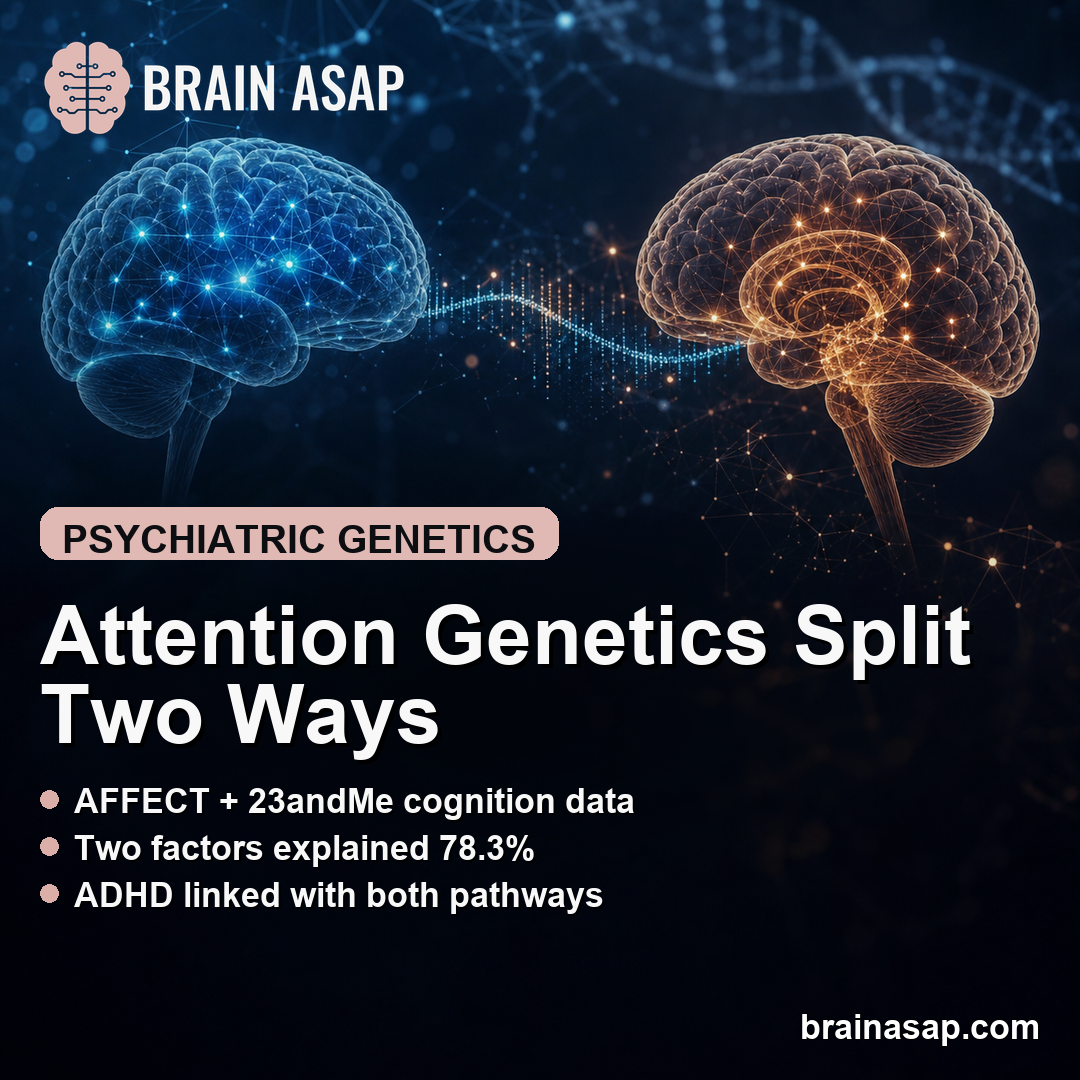
TL;DR: A 2026 Molecular Psychiatry study found that common genetic influences on sustained attention were partly separable from genetic influences on executive function, using task-based cognition data from the AFFECT study and 23andMe participants.
Key Findings
- More than 20,000 participants contributed task-based cognition data: Final GWAS sample sizes ranged from 10,129 people for lapse recovery cost to 23,318 for processing speed.
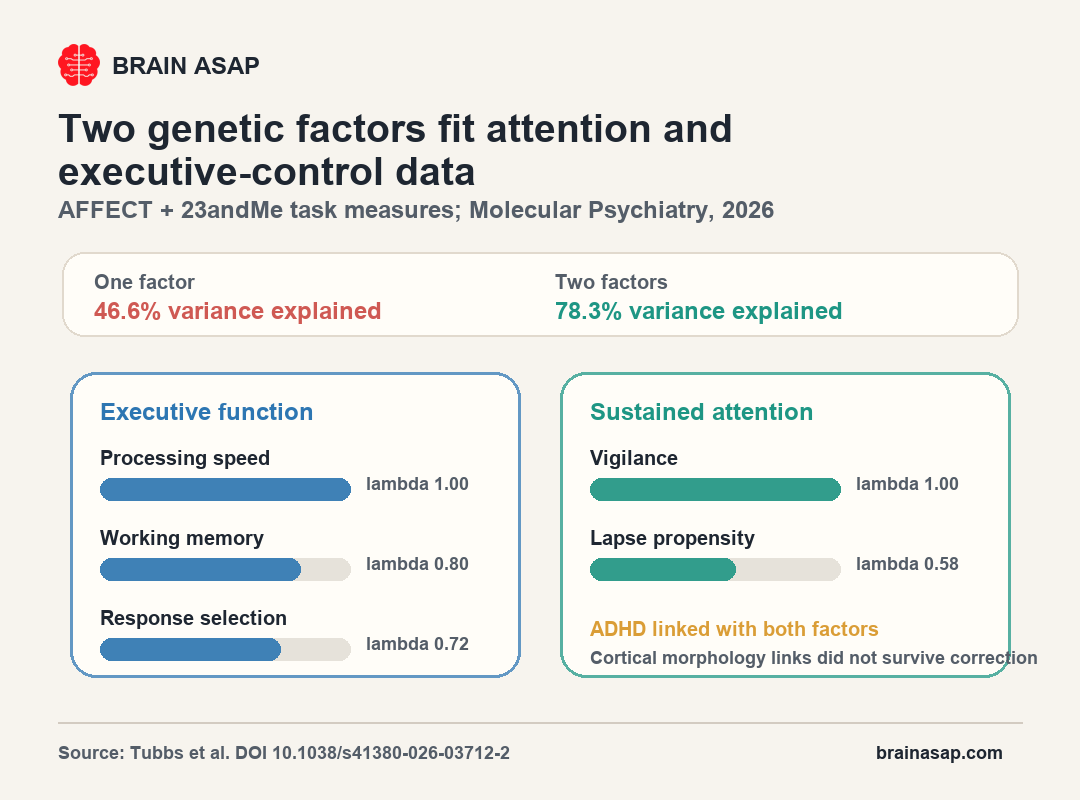
- Two genetic factors fit better than one: A single factor explained 46.6% of genetic variance, while two correlated factors explained 78.3%.
- Executive function grouped with speed, response selection, and working memory: The executive-function factor loaded strongly on processing speed, response selection, and working memory.
- Sustained attention grouped with vigilance and lapse propensity: The sustained-attention factor loaded most clearly on vigilance and more moderately on lapse propensity.
- Psychiatric overlap differed by factor: Executive function showed broad negative genetic correlations with several psychiatric disorders, while sustained attention was significantly linked mainly with ADHD and alcohol use disorder.
Sustained attention and executive function often appear together clinically: poor attention can coincide with slow task performance, working-memory difficulty, and executive-control problems.
But this study suggests they should not automatically be treated as one genetic liability.
Researchers used the Affective disorders, Environment, and Cognitive Trait (AFFECT) study, run in collaboration with 23andMe, to examine common genetic influences on task-based cognitive measures. The cohort was enriched for people reporting major depressive disorder or bipolar disorder, with non-psychiatric controls used as a comparison group.
The main question was specific: do the same common genetic variants explain both sustained attention and executive function, or do these domains split into partly distinct genetic dimensions?
AFFECT Measured Attention and Executive Control Separately
The study focused on online cognitive tasks collected across a nine-month protocol. Researchers selected seven measures that mapped onto related but separable cognitive processes.
- Executive-function measures: processing speed from the Digit-Symbol Substitution Test, response selection from a choice reaction-time task, working memory from a 1-back task, and cognitive flexibility from a trails-making task.
- Sustained-attention measures: vigilance, lapse recovery cost, and lapse propensity from the gradual-onset continuous performance task.
All measures were oriented so that higher values meant better performance. After quality control, the researchers estimated SNP-based heritability, genetic correlations, and latent genetic factors using Genomic Structural Equation Modeling.
Cognitive flexibility was excluded from the main genetic factor analysis because the GWAS had low statistical power and created problems for the genetic covariance matrix. That left six task measures for the main two-factor model.
Two Genetic Clusters Explained the Cognitive Data Better
The first important result was that the six cognitive measures did not collapse cleanly into one genetic dimension.
Genetic correlations formed two broad clusters. Vigilance, lapse propensity, and lapse recovery cost were genetically interrelated.
Processing speed, working memory, and response selection were also genetically interrelated. Those executive measures had genetic correlations with one another ranging from 0.58 to 0.83.
Factor modeling sharpened that split. One genetic factor explained 46.6% of the total genetic variance.
A two-factor solution explained 78.3%, and the third factor added little interpretability. The two-factor confirmatory model had acceptable fit, with CFI 0.96 and SRMR 0.11.
Executive Function Was the Broader Psychiatric Signal
The first factor, labeled executive function, loaded strongly on processing speed, response selection, and working memory. It also loaded negatively on lapse recovery cost, meaning people genetically tilted toward better executive performance tended to show lower recovery cost after attention lapses.
That factor showed broad negative genetic correlations with psychiatric liability. After false-discovery-rate correction, executive function was significantly genetically correlated with several disorders.
- Broad executive-function overlap: ADHD, alcohol use disorder, anxiety disorder, bipolar disorder, cannabis use disorder, major depressive disorder, obsessive-compulsive disorder, opioid use disorder, and schizophrenia.
- Narrower sustained-attention overlap: ADHD and alcohol use disorder survived correction.
- Conditional ADHD result: ADHD retained partly independent genetic links with both executive function and sustained attention.
Those negative correlations do not mean poor executive function causes those disorders. They mean common genetic influences associated with lower executive-function performance overlapped with common genetic liability for multiple psychiatric conditions.
Sustained Attention Was Narrower but Still Clinically Relevant
The second factor, labeled sustained attention, loaded strongly on vigilance and moderately on lapse propensity. Lapse recovery cost was allowed to load on this factor, but that loading was not statistically significant.
Sustained attention had a narrower psychiatric profile. After correction for multiple testing, it was significantly genetically correlated with ADHD and alcohol use disorder.
Conditional models suggested that ADHD had partly independent genetic links with both executive function and sustained attention.
That distinction matters for ADHD research. A person can have difficulty with working memory, goal maintenance, response selection, or processing speed.
Another person can mainly struggle with staying consistently on task over time. The AFFECT result supports treating those as related but not identical genetic pathways.
Brain-Structure Links Were Modest and Did Not Survive Correction
The study also tested whether the two genetic cognitive factors overlapped with cortical thickness or surface-area measures. No regional cortical association survived correction for multiple comparisons.
That negative result is not surprising. Brain-imaging genetics often needs very large samples to detect small brain-behavior relationships.
The researchers noted that even much larger general-cognition GWAS work has found only modest genetic correlations with cortical surface area and non-significant links with average cortical thickness.
The AFFECT results separate cognitive genetic dimensions more clearly than they map those dimensions onto specific cortical regions.
The Main Limit Is Generalizability
The study has several boundaries. All GWAS analyses were restricted to individuals with European-like genomes to reduce population-stratification confounding.
The AFFECT sample was recruited through a consumer genetics research setting and was enriched for self-reported major depressive disorder and bipolar disorder, which may limit generalization to broader populations.
The cognitive tasks were also administered online across multiple sessions. That design made large task-based phenotyping possible, but it can introduce participation, attrition, and measurement-noise problems that differ from in-person testing.
The results do not establish that sustained attention and executive function are genetically independent. Their estimated latent-factor correlation was modest and statistically non-significant, but its uncertainty still allowed modest overlap.
The stronger conclusion is narrower and more useful: common genetic influences on sustained-attention stability were not adequately explained by a single executive-function factor. For psychiatry, that argues for measuring attention more granularly instead of using broad executive dysfunction as a catch-all.
Citation: DOI: 10.1038/s41380-026-03712-2. Tubbs et al. Molecular genetic influences on sustained attention and executive processes and their links with psychopathology in the AFFECT study. Molecular Psychiatry. 2026.
Study Design: Genome-wide association and Genomic Structural Equation Modeling study of task-based cognitive measures.
Sample Size: Final GWAS sample sizes ranged from 10,129 to 23,318 participants depending on the cognitive phenotype.
Key Statistic: Two correlated genetic factors explained 78.3% of total genetic variance, compared with 46.6% for a single factor.
Caveat: Analyses were restricted to European-like genomes and need replication in larger, more diverse samples.