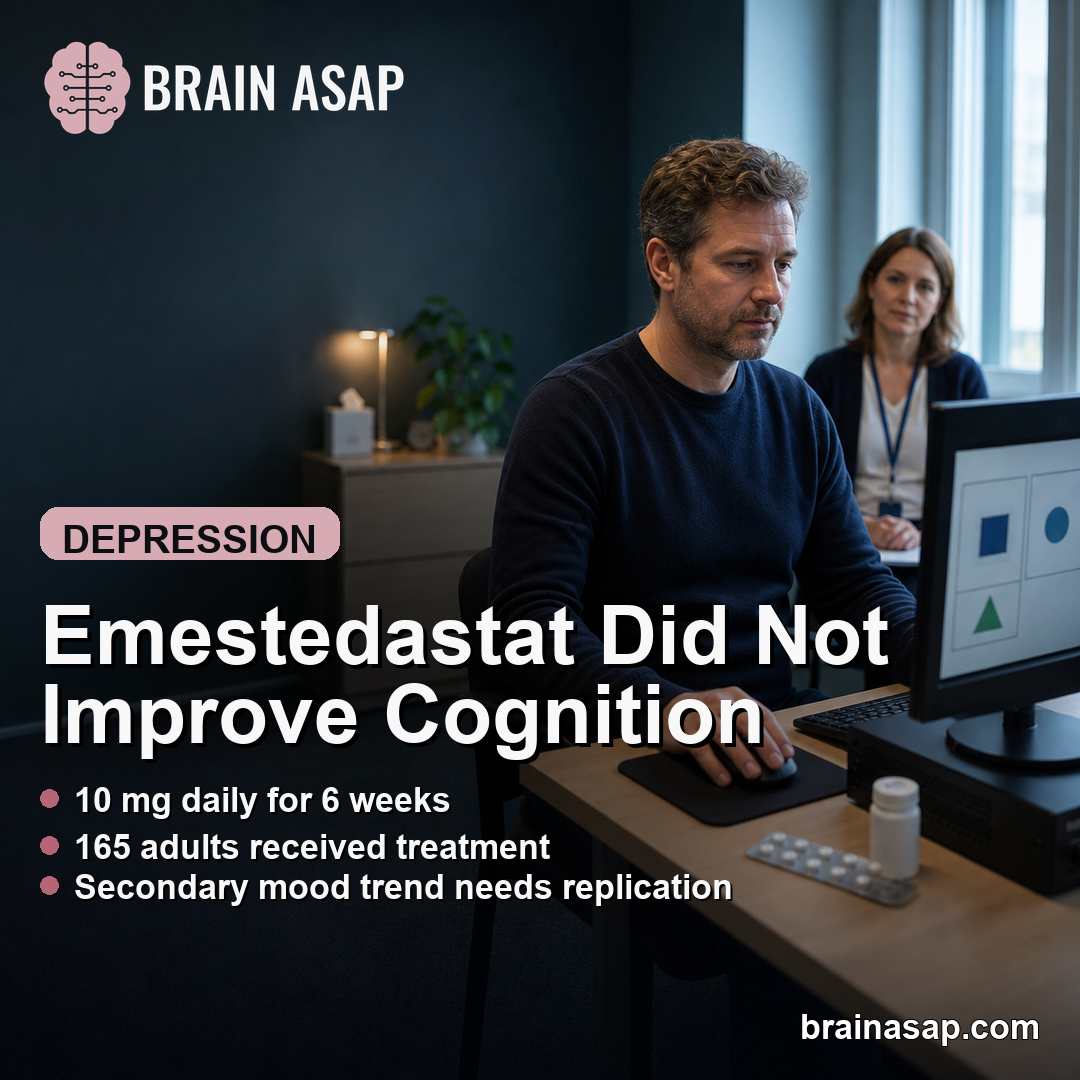
TL;DR: A 2026 Phase 2 trial in The British Journal of Psychiatry found that 10 mg emestedastat did not improve attention and working memory after six weeks in adults with major depressive disorder and objectively measured cognitive impairment. A nominal depression-score difference appeared four weeks after treatment ended, but it was secondary, unadjusted for multiple comparisons, and needs confirmation.
Key Findings
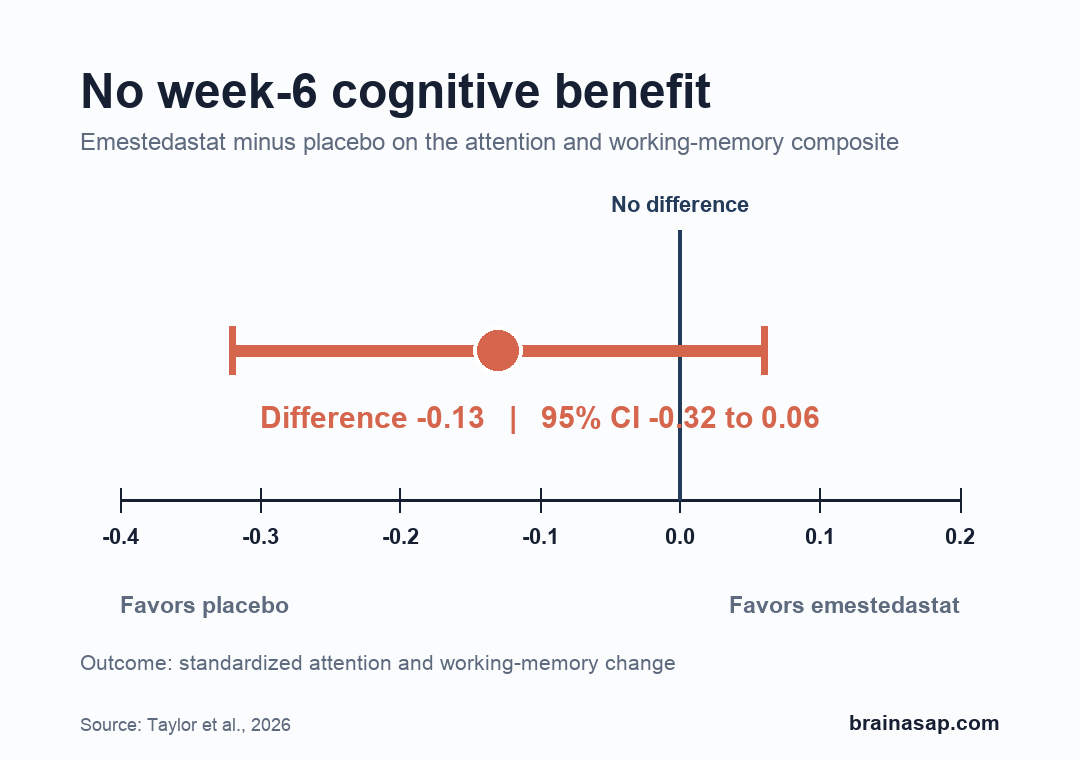
- The primary cognitive endpoint was negative: The attention and working-memory composite improved by 0.32 z-score units with emestedastat and 0.46 with placebo at week 6, a between-group difference of -0.13 (95% CI -0.32 to 0.06).
- The treated population included 165 adults: Participants had a current major depressive episode, persistent symptoms, subjective cognitive problems, and symbol-coding performance at least 0.5 standard deviations below age and education norms.
- A secondary mood difference appeared after dosing stopped: Four weeks after the six-week treatment period, Montgomery-Asberg Depression Rating Scale scores favored emestedastat by 2.72 points, but the nominal result was not corrected for the study’s many comparisons.
- Liver enzyme elevations were more common with emestedastat: They occurred in 8 of 82 treated participants versus 1 of 83 placebo participants; one emestedastat participant discontinued treatment.
- Short exposure and sponsor involvement narrow the conclusions: The trial lasted six treatment weeks, 81% of participants used background antidepressants, and the manufacturer funded the study and employed or paid several authors.
Source: Taylor et al., The British Journal of Psychiatry (2026).
Cognitive symptoms can persist during major depression even when treatment improves mood. Emestedastat, also known as Xanamem, was developed to inhibit 11-beta-hydroxysteroid dehydrogenase type 1 (11β-HSD1), an enzyme that converts inactive cortisone into cortisol inside cells.
The proposed mechanism is lower cortisol production inside brain cells without suppressing adrenal cortisol production throughout the body. This trial measured cognition, depression symptoms, and safety; it did not report a direct measure of brain cortisol reduction or target engagement in these participants.
Emestedastat Missed the Week-6 Attention and Working-Memory Endpoint
The primary outcome combined speed on three computerized Cogstate tasks involving detection, identification, and one-back working memory. Scores were standardized as z-scores, so a larger positive change represented greater improvement from baseline.
After six weeks, the least-squares mean change was 0.32 with 10 mg emestedastat and 0.46 with placebo. The adjusted difference was -0.13 z-score units (95% CI -0.32 to 0.06; reported p=0.17; Cohen’s d=-0.15), numerically favoring placebo.
Both groups improved substantially on repeated testing. At week 10, the mean change was 0.38 in each group, with an adjusted difference of 0.00 (95% CI -0.18 to 0.18).
Cognitive change did not track improvement in clinician-rated depression or participants’ own severity ratings. Expectation, familiarity with the tests, and regression toward the mean are possible explanations for the large improvement in both groups, but the trial did not establish which explanation was responsible.
The Trial Randomized 167 Adults and Treated 165
Researchers ran the double-blind, placebo-controlled Phase 2a trial at 16 sites in Australia and the United Kingdom. Participants were randomly assigned to 10 mg emestedastat or matching placebo once each morning for six weeks, followed by four weeks of blinded observation without the study drug.
- Screening: 720 people were assessed; 167 were randomized, including 84 assigned to emestedastat and 83 to placebo.
- Analysis population: Two people assigned to emestedastat withdrew before dosing. The treated and modified intention-to-treat population was 82 on emestedastat and 83 on placebo.
- Completion: 147 of the 167 randomized participants completed the trial as specified. The main report did not provide the number observed in each arm at every visit.
- Background treatment: 134 of 165 treated participants remained on a stable antidepressant during the trial.
Eligibility required a current DSM-5 major depressive episode, a Hamilton Depression Rating Scale score of at least 17, self-reported cognitive symptoms, and objective impairment on a symbol-coding task. The average participant was 49 years old, 62% were women, and 92% were White.
The cohort had recurrent illness, with a median of four previous depressive episodes and a mean of 10. Formal treatment-resistant depression was not required, so the manufacturer’s description of the group as “difficult to treat” should not be treated as a diagnostic eligibility category.
A Secondary Depression Difference Appeared at Week 10
The Montgomery-Asberg Depression Rating Scale (MADRS) is a clinician-rated measure of depression severity. At the end of treatment, scores had fallen by 8.30 points with emestedastat and 6.89 with placebo; the adjusted week-6 difference was -1.40 points (95% CI -3.88 to 1.07; reported p=0.26).
At week 10, four weeks after dosing ended, the reductions were 8.55 and 5.8 points. The adjusted difference was -2.72 points (95% CI -5.41 to -0.03; nominal p=0.048; Cohen’s d=0.43 in magnitude), favoring emestedastat.
That result was prespecified, but it was a secondary endpoint among many tests and received no multiplicity adjustment. Its confidence interval barely excluded zero, while Participant Global Impression of Severity scores did not show a supported difference at week 6 or week 10.
Response and remission percentages were higher with emestedastat at week 10, but their reported p-values were 0.08 and 0.25. A favorable post hoc result in the subgroup using selective serotonin reuptake inhibitors was exploratory and uncorrected, so these findings do not establish antidepressant efficacy.
Liver Enzyme Elevations Were More Common With Emestedastat
At least one treatment-emergent adverse event occurred in 70 of 82 emestedastat participants and 67 of 83 placebo participants. No treatment-related serious adverse event was reported during the six-week dosing period.
Asymptomatic liver enzyme elevations occurred in 8 of 82 participants receiving emestedastat and 1 of 83 receiving placebo. Seven emestedastat cases stayed at or below twice the upper limit of normal; one reached 3.3 times the upper limit, led to discontinuation, and returned to normal within five days.
Gastrointestinal disorders and infections were also more frequent in the emestedastat group. The small sample and brief exposure cannot define uncommon or longer-term harms, so later trials would need continued liver monitoring and more safety follow-up.
Statistical Inconsistencies and Sponsor Involvement Limit the Mood Signal
The methods specify one-sided tests for the primary cognitive outcome and week-6 MADRS comparison, but the primary p-value cannot represent one-sided superiority because the estimate favored placebo. The null result remains clear: its confidence interval includes zero, and the observed direction favored placebo.
The response and remission table reports odds ratios and confidence intervals that do not match its displayed participant counts or p-values, so those estimates are not used here. Visit-specific denominators were not shown, and the repeated-measures model depends on assumptions about missing observations.
Actinogen Medical funded the trial. Two authors were employees, two received consulting fees, sponsor-associated authors analyzed and verified the data, and a company employee provided editorial assistance; data and code access is controlled through requests considered by Actinogen.
Emestedastat did not improve the cognitive outcome the trial was designed to test. The week-10 depression difference and liver-enzyme imbalance support further research and monitoring, not a claim that the drug is an effective antidepressant.
Citation: DOI: 10.1192/bjp.2026.10689. Taylor et al. A Phase 2 randomised, double-blind, placebo-controlled trial of emestedastat in patients with major depressive disorder and cognitive impairment. The British Journal of Psychiatry. 2026.
Study Design: Phase 2a randomized, double-blind, placebo-controlled trial with six weeks of treatment and four weeks of blinded off-treatment follow-up.
Sample Size: 167 adults were randomized; 165 received treatment and entered the modified intention-to-treat population.
Key Statistic: The week-6 attention and working-memory difference was -0.13 z-score units (95% CI -0.32 to 0.06), numerically favoring placebo.
Caveat: The primary outcome failed, secondary analyses were not adjusted for multiple comparisons, safety exposure was brief, and the manufacturer funded the trial and had substantial involvement.