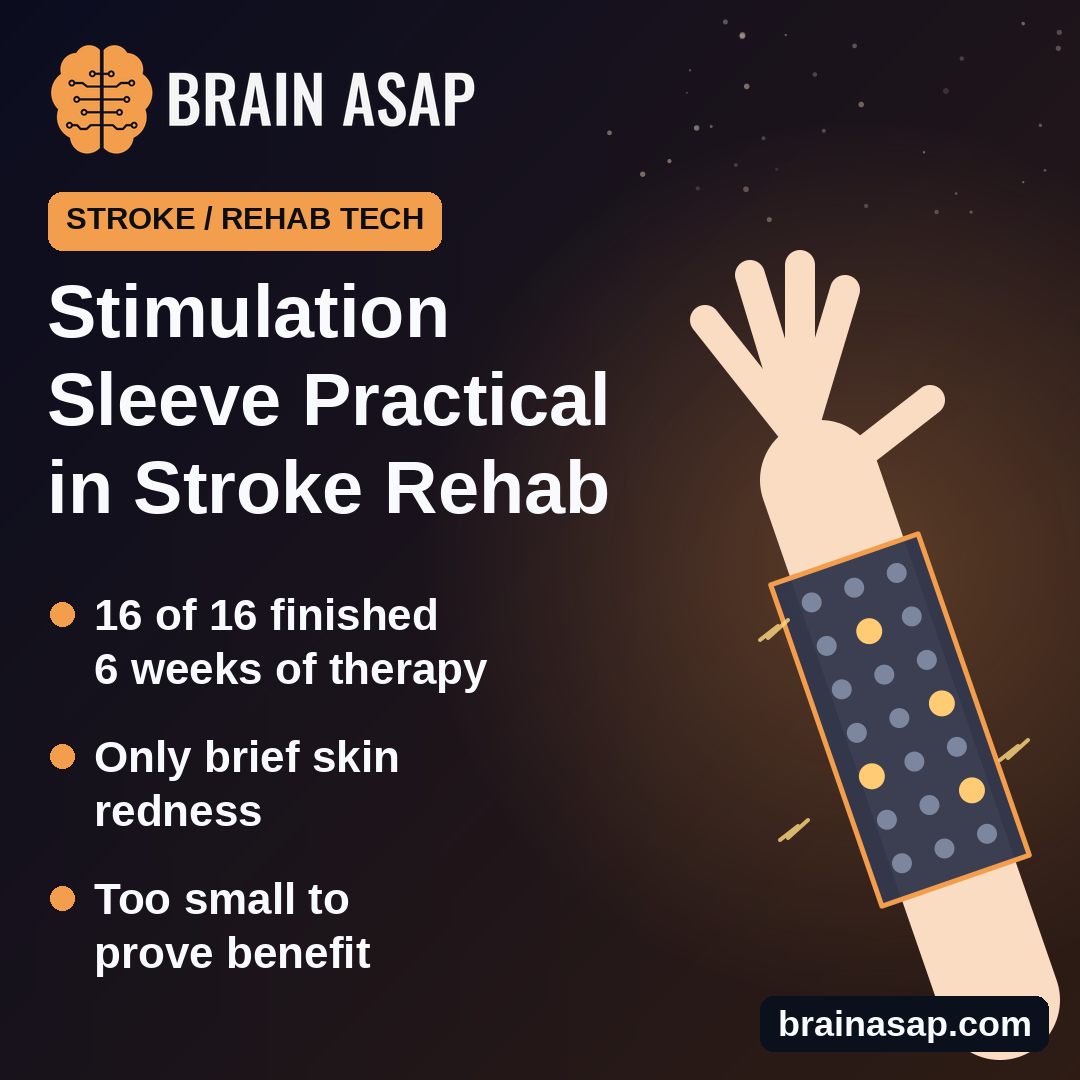
TL;DR: In a 16-person trial, stroke survivors using a forearm stimulation sleeve during hand therapy all finished the 6-week program and rated it highly. Early arm-movement scores favored the sleeve, but the trial was too small to show that it works.
Key Findings
- 16 of 16 finished: All 12 sessions over 6 weeks, in both groups.
- Well liked: Usefulness rated 6.7 out of 7 by sleeve users.
- Minor side effects: 2 people had brief skin redness; no serious problems.
- Arm scores leaned toward the sleeve: About 10 points higher on a 66-point scale, with a wide range.
Source: Frontiers in Rehabilitation Sciences (2026) | Guillén-Climent et al.
Electrical stimulation that makes weak muscles contract is recommended for arm rehab after stroke, yet few clinics use it routinely. Setting it up is fiddly: therapists must place pads by hand, and the forearm has many small muscles packed close together.
A newer approach wraps the forearm in a sleeve with many small electrodes, so the device can pick which spots to fire. A team in Córdoba, Spain, tested whether this fits into everyday hospital rehab.
A Small Trial in Everyday Rehab
The researchers randomly assigned 16 adults who had a stroke within the past 6 months to one of two groups of 8:
- Sleeve group: Hand and wrist therapy using the Fesia Grasp stimulation sleeve.
- Standard group: The same amount of conventional hand and arm therapy, without stimulation.
Both groups had two 40-minute sessions a week for 6 weeks, delivered by the hospital’s own physiotherapists. The people who measured arm function did not know which group each person was in.
Everyone Stayed the Course
All 16 participants completed all 12 sessions. That is encouraging, though with so few people, the true completion rate could be as low as about 79%.
Sleeve users rated the treatment highly on a 1-to-7 scale:
- Useful: 6.7
- Interesting and enjoyable: 7.0
- Felt competent using it: 6.2
Two people had short-lived skin redness where the electrodes sat. No serious side effects occurred.
Early Hints of Better Hand Movement
Both groups improved, as is normal in the months after a stroke. On the Fugl-Meyer arm scale (0 to 66), the sleeve group went from about 19.5 to 32.4 points, while the standard group went from 22.0 to 25.0.
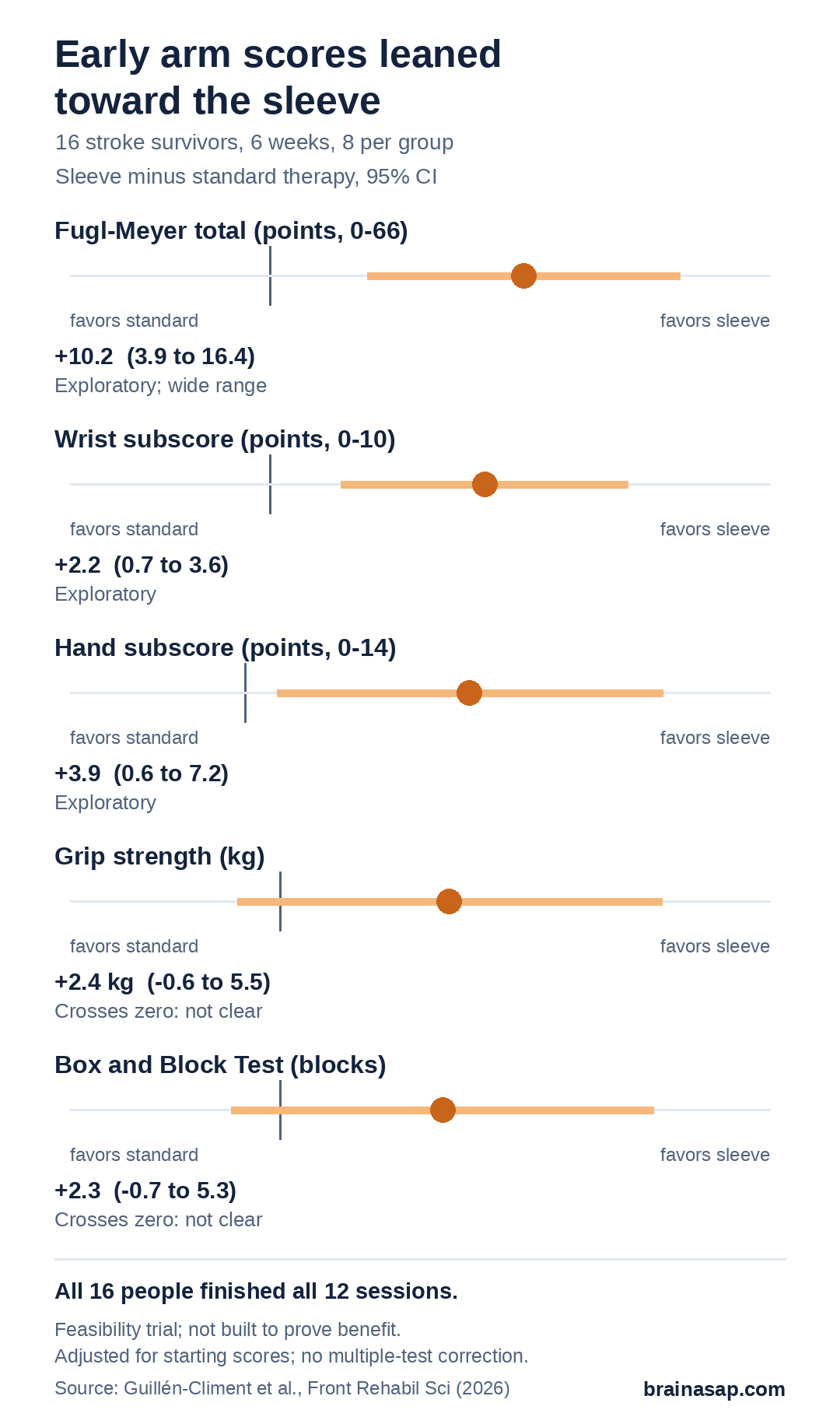
After adjusting for starting scores, the sleeve group was about 10 points ahead on the full scale, with gains in wrist and hand subscores. Grip strength and a block-moving test also leaned toward the sleeve, but those ranges crossed zero. Coordination and speed showed almost no difference.
Why the Motor Results Are Only a Hint
- 8 people per group: One person can swing the averages; the 10-point gap had a range of about 4 to 16.
- Exploratory outcomes: Arm scores were secondary, with no correction for multiple tests.
- Uneven starts: Age differed between groups, and one 90-year-old in the standard group added variability.
- One hospital, selected patients: Results may not carry over to other clinics.
- Company involvement: Two authors worked for the sleeve’s maker; the paper says they had no access to outcome data or role in analysis.
Ready for a Bigger Test
The trial did its job: it showed that the sleeve fits into routine rehab, patients stick with it, and side effects are minor. It did not show that the sleeve improves recovery.
The question for a larger trial is whether a 10-point-sized head start on the arm scale holds up with enough people to trust it, and whether it lasts after therapy ends.
Citation: DOI: 10.3389/fresc.2026.1920617. Guillén-Climent S, Casado-Adam P, Mejías-Ruiz M, et al. Feasibility and safety of multi-field functional electrical stimulation for distal upper-limb rehabilitation after subacute stroke: a randomised controlled feasibility trial. Front Rehabil Sci. 2026.
Study Design: Single-centre, parallel-group randomised controlled feasibility trial with blinded outcome assessment (NCT04992910).
Sample Size: 16 adults with subacute stroke (8 per group).
Key Statistic: Retention and adherence 16/16 (95% CI 79.4% to 100%); exploratory Fugl-Meyer total adjusted difference +10.15 (3.91 to 16.40).
Caveat: Feasibility study, not an efficacy trial; tiny groups; motor outcomes exploratory.