TL;DR: Among older adults who walked on their own before breaking a hip, those with dementia or a low blood-based nutrition score a week after surgery were less likely to be walking independently when they left the hospital. The nutrition score alone was only a rough predictor.
Key Findings
- Half lost independence: 88 of 173 were not walking on their own at discharge.
- Dementia: About 6 times higher odds of not walking independently.
- Nutrition score: Each 1-point higher score was linked to about 14% lower odds.
- Rough predictor: The score alone sorted people correctly about two-thirds of the time.
- Leg tests did not add much: Balance and weight-bearing were not independently linked.
Source: Progress in Rehabilitation Medicine (2026) | Kuwabara et al.
A broken hip can end an older person’s independence almost overnight. Some people are walking again within weeks; others leave the hospital needing help or move into care. Can doctors tell early who will struggle?
A team in Chiba, Japan, checked two things that are easy to know a week after surgery: whether the patient has dementia, and a simple nutrition score from routine blood tests.
Older Adults Who Walked on Their Own Before the Fall
The study looked back at 173 patients aged 65 or older, average age about 80 and 91% women, treated at three hospitals between 2023 and 2025. All had walked independently before breaking their hip, and all had surgery.
The researchers compared two groups at discharge:
- Walking independently: Able to walk at least 50 meters without supervision or help, with a cane allowed (85 people).
- Not walking independently: Needed supervision or help (88 people).
The Prognostic Nutritional Index (PNI) combines albumin, a blood protein, with the count of lymphocytes, a type of immune cell. It was measured about 7 days after surgery. Lower scores suggest poorer nutrition or more stress on the body.
Dementia Was the Strongest Warning Sign
About a quarter of patients had dementia recorded in their charts. After adjusting for age, sex, type of surgery, anemia, bone density and early leg tests, dementia was linked to about 6 times higher odds of not walking independently at discharge (odds ratio 6.32, 95% CI 2.75 to 15.87).
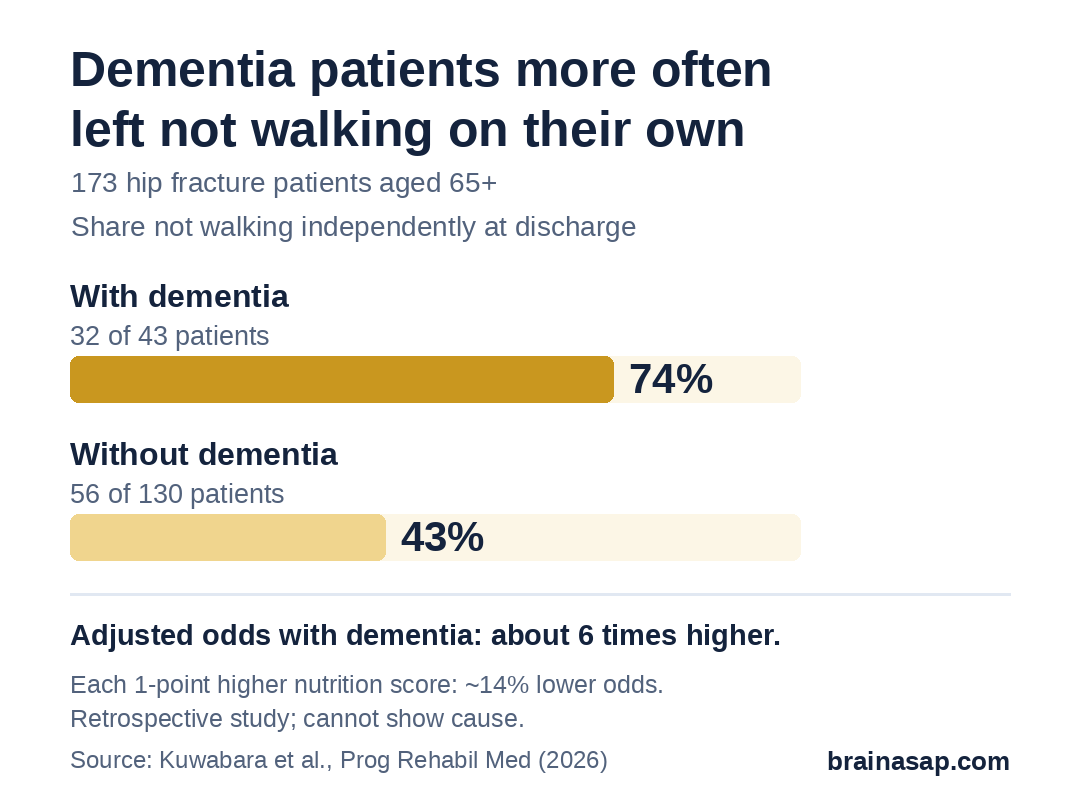
Those who did not walk on their own were also much more likely to go to a rehabilitation hospital or long-term care facility instead of home: only 11% went home, compared with 49% of independent walkers.
A Simple Blood Score Added Information
The average nutrition score was 37.4 in independent walkers and 33.2 in those who needed help. Each 1-point higher score was linked to about 14% lower odds of not walking on their own (odds ratio 0.86, 95% CI 0.80 to 0.92). The link held after also adjusting for CRP, a marker of inflammation.
On its own, though, the score was a modest predictor. With a cutoff of 33.2, it correctly flagged about 68% of people who would need help and about 68% of those who would not.
A Snapshot With Selection Limits
- Looking back: Chart review; cannot show that better nutrition would improve walking.
- One measurement: PNI taken once, at 1 week.
- Not just nutrition: Albumin and lymphocytes also shift with inflammation and illness.
- Selected patients: People with severe complications were excluded.
- Dementia from records: Severity was not graded.
Dementia Patients May Need Extra Rehab Planning
For families and care teams, the practical message is that people with dementia face a much harder road back to independent walking after a hip fracture, and plans for extra rehabilitation or support can start early. A routine blood score may help flag others at risk, but it is not accurate enough to decide care on its own.
The question this study cannot answer is whether boosting nutrition in the first weeks after surgery actually helps people walk again, which would need a trial.
Citation: DOI: 10.2490/prm.20260053. Kuwabara A, Yamashita M, Okuyama K, et al. Early postoperative prognostic nutritional index, dementia, and walking independence at discharge in patients with hip fracture: a multicenter observational study. Prog Rehabil Med. 2026;11:20260053.
Study Design: Multicenter retrospective observational study, three hospitals in Japan.
Sample Size: 173 patients aged 65 or older who walked independently before the fracture.
Key Statistic: Dementia OR 6.32 (95% CI 2.75 to 15.87); PNI OR 0.86 per point (0.80 to 0.92); PNI AUC 0.66.
Caveat: Retrospective, single time point, selected population; cannot show cause.