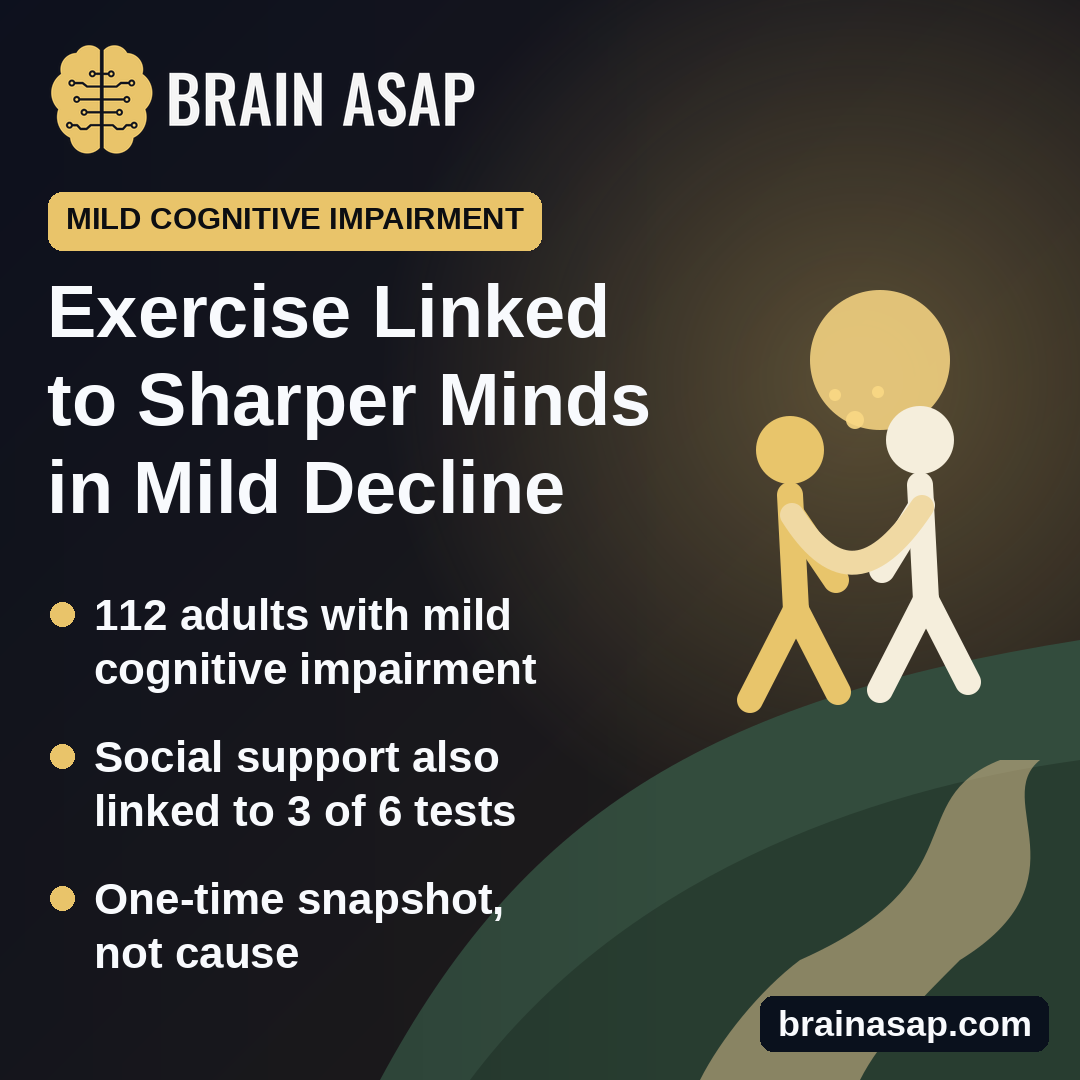
TL;DR: Among 112 older adults in Spain with mild cognitive impairment, those who reported more physical activity and felt more supported by family and friends scored better on several thinking tests. The study took one snapshot, so it cannot show that activity or support protects thinking.
Key Findings
- 112 adults, average age 71: All had a clinical diagnosis of mild cognitive impairment.
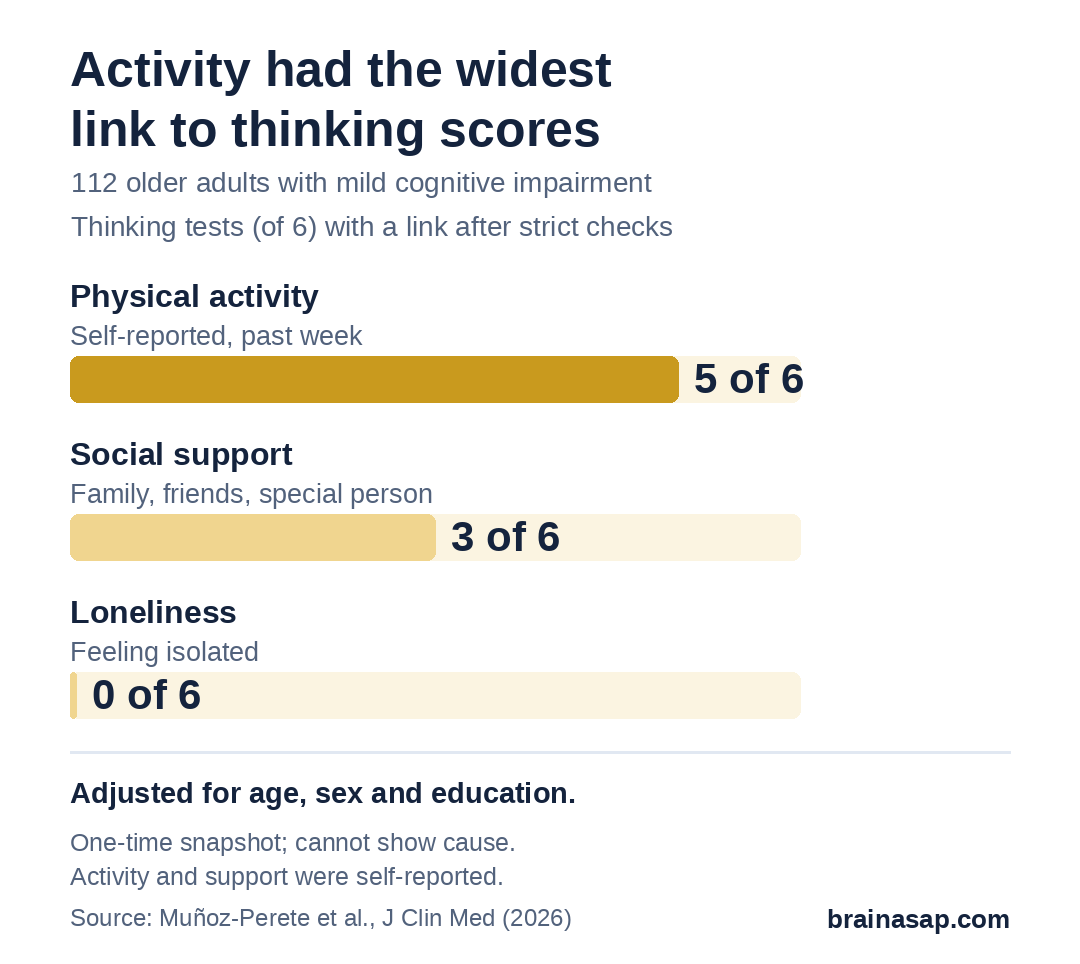
- Physical activity had the widest link: Linked to better scores on 5 of 6 thinking tests after strict checks.
- Social support linked to 3 of 6: Overall thinking, visual attention and mental flexibility.
- Loneliness faded out: Its links to lower scores did not survive correction for many tests.
- Snapshot only: No follow-up, and activity was self-reported.
Source: Journal of Clinical Medicine (2026) | Muñoz-Perete et al.
Mild cognitive impairment sits between normal aging and dementia. People with it notice slips in memory or thinking, but still manage daily life on their own. Because it raises the chance of later dementia, researchers want to know which everyday habits travel with better thinking.
A team at the University of Jaén in Spain looked at three: how active people are, how supported they feel, and how lonely they are.
Who Took Part
Of 135 older adults recruited, 112 were included. All were 65 or older, lived in the community, and already had a clinician’s diagnosis of mild cognitive impairment. Their average age was 71, about 63% were women, and most had only primary schooling.
Each person filled out three questionnaires:
- Physical activity: Walking and moderate or vigorous exercise over the past week.
- Social support: How much they felt they could count on family, friends and a special person.
- Loneliness: Feelings of isolation and lack of companionship.
They also took six thinking tests covering overall thinking, word recall by category, visual attention, mental flexibility, processing speed and concentration.
Activity Showed the Broadest Link
The researchers adjusted for age, sex and education and then applied a strict correction for running many comparisons. After that, more physical activity was linked to better scores on 5 of the 6 tests. The one exception was word fluency, which was only borderline.
On the overall thinking screen, physical activity had the strongest link of the three factors (standardized coefficient 0.34), larger than age.
Feeling Supported Mattered for Some Tests
Higher perceived social support was linked to better overall thinking scores (coefficient 0.23) and faster times on two trail-drawing tests of visual attention and mental flexibility. Its links to concentration and processing speed did not hold up after correction.
Loneliness Did Not Hold Up
On its own, loneliness tracked with worse scores on every test. But once activity, support and background factors were in the model, its link to overall thinking (coefficient −0.19) and to mental flexibility only reached borderline significance and disappeared after the multiple-testing correction.
The researchers also tested whether activity or support softened the link between loneliness and thinking. Adding those terms explained a bit more of the scores, but no single interaction survived correction, so they call these results exploratory.
Why a Snapshot Can’t Show Protection
- One point in time: Sharper thinking could make people more active and social, not the reverse.
- Self-reported activity: People with memory problems may recall their past week poorly.
- One region: All from southern Spain, with mostly low formal education.
- Healthier group: People with serious heart, lung, joint or psychiatric conditions were excluded.
Do More Active Seniors Decline More Slowly?
The pattern fits a wider body of research pointing to exercise and social ties as allies of the aging brain. Staying active and connected is reasonable advice on its own merits. What this study cannot answer is the key question: whether people with mild cognitive impairment who move more and feel supported actually lose thinking ability more slowly. That needs follow-up over years, ideally with activity trackers instead of questionnaires.
Citation: DOI: 10.3390/jcm15187207. Muñoz-Perete JM, Castellote-Caballero Y, Carcelén-Fraile MC, Castro-Sánchez JJ. Associations of social support, loneliness, and physical activity with cognitive function in older adults with mild cognitive impairment. J Clin Med. 2026;15:7207.
Study Design: Cross-sectional observational study with multivariable regression and FDR correction.
Sample Size: 112 community-dwelling adults aged 65+ with diagnosed MCI (135 recruited).
Key Statistic: MoCA model: physical activity β = 0.342 (p < 0.001), social support β = 0.229 (p = 0.006), loneliness β = −0.190 (p = 0.022, not significant after FDR).
Caveat: Cross-sectional and self-reported; cannot show cause or protection.