TL;DR: A 2026 BJPsych Open study found clinically significant anxiety in about 18% of non-demented ALS patients for state anxiety and 14% for trait anxiety, with anxiety scores driven mainly by cognitive-affective depression symptoms rather than motor severity.
Key Findings
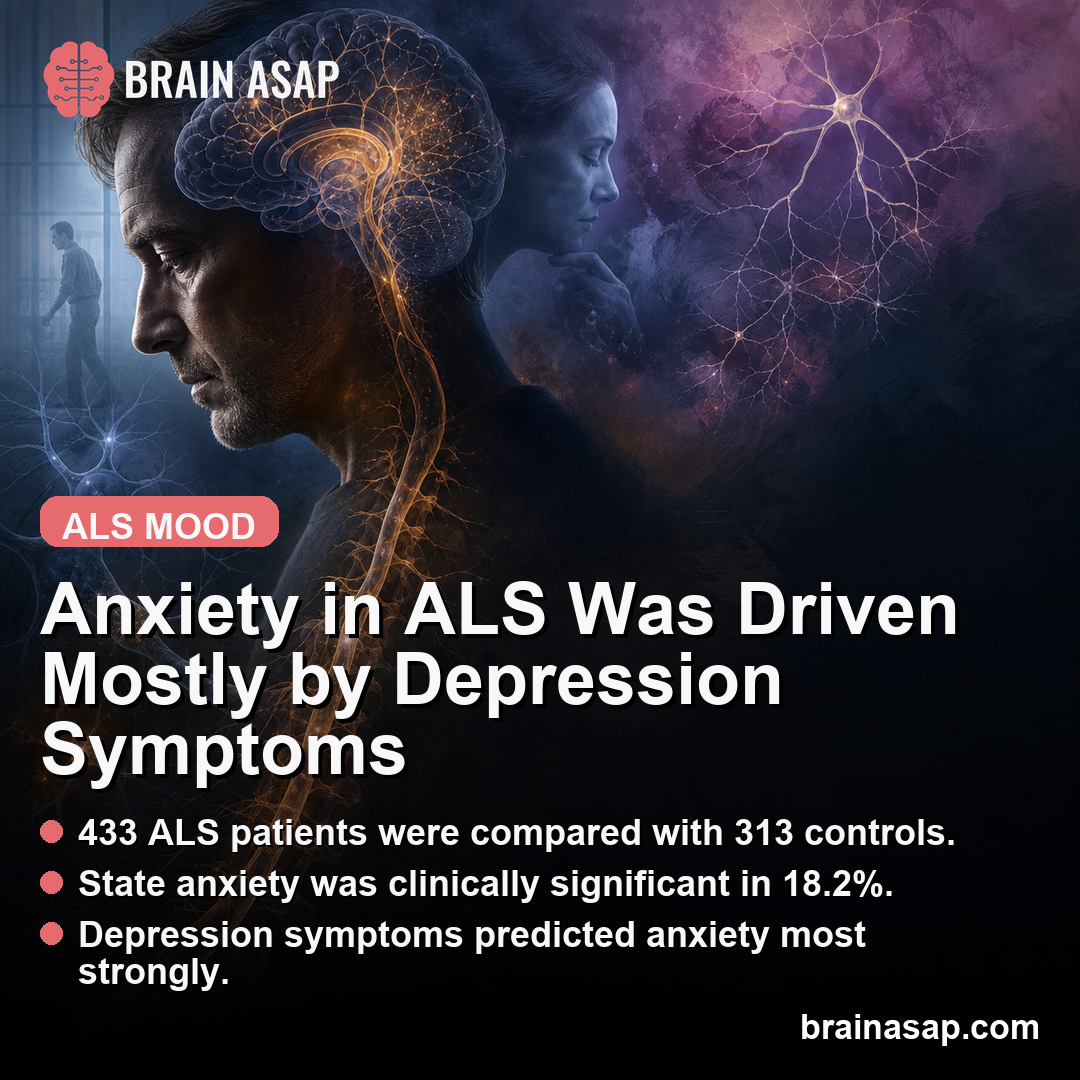
- ALS cohort: The study compared 433 non-demented ALS patients with 313 healthy controls.
- State anxiety: 18.2% of ALS patients scored above the clinically significant cut-off, compared with 1.6% of controls.
- Trait anxiety: 13.9% of ALS patients scored above cut-off, compared with 7% of controls.
- Main predictor: Cognitive-affective depression symptoms predicted both state and trait anxiety.
- Caution: The cohort excluded patients with comorbid frontotemporal dementia, so the findings do not cover all ALS presentations.
Source: BJPsych Open (2026) | Aiello et al.
Amyotrophic lateral sclerosis, or ALS, is usually discussed through motor decline: weakness, speech changes, swallowing problems, breathing support, and disease progression. Mental health symptoms can be harder to separate because anxiety can reflect disease adjustment, depression, frontotemporal involvement, or the practical fear of losing function.
Researchers studied anxiety in a large non-demented ALS cohort. Their main finding was specific: clinically significant anxiety was more common in ALS than controls, but anxiety was most strongly tied to cognitive-affective depression symptoms, not motor severity or cognitive-behavioral impairment.
The clinical point is direct: if anxiety in ALS often travels with depressive thinking and mood symptoms, screening should not treat anxiety as a purely motor-stage reaction. A patient with relatively preserved motor function may still have intense fear, sadness, guilt, hopelessness, or worry that needs care.
ALS Patients Had Higher State and Trait Anxiety Than Controls
The study included 433 non-demented ALS patients and 313 healthy controls. Participants completed the State-Trait Anxiety Inventory Form Y, with STAI-Y1 measuring state anxiety and STAI-Y2 measuring trait anxiety.
State anxiety refers to anxiety in the current moment or situation. Trait anxiety refers to a more stable tendency to feel anxious across time.
ALS patients had higher continuous anxiety scores than controls.
They also crossed clinical cut-offs more often.
State anxiety was above cut-off in 18.2% of ALS patients, compared with 1.6% of controls.
Trait anxiety was above cut-off in 13.9% of ALS patients, compared with 7% of controls. The state-anxiety difference was especially large, which fits the idea that diagnosis, prognosis, and changing function can raise immediate distress.
The odds difference was large after age, education, and gender adjustment. ALS patients had higher odds of abnormal state anxiety and trait anxiety than controls.
The control comparison matters because anxiety is common in the general population too.
The study was not simply asking whether some ALS patients felt anxious. It tested whether clinically significant anxiety appeared more often than expected against a healthy comparison group.
Cognitive-Affective Depression Symptoms Predicted ALS Anxiety
The strongest predictor was not motor decline. In regression models, the cognitive-affective part of the Beck Depression Inventory predicted both anxiety scores and above-cut-off anxiety status.
The pattern was consistent:
- State anxiety score: BDI cognitive-affective symptoms were the only significant predictor at the corrected threshold.
- Trait anxiety score: Cognitive-affective depression symptoms were again the strongest predictor.
- Clinical cut-offs: Higher cognitive-affective depression scores increased the odds of abnormal state and trait anxiety.
For state anxiety, the model explained 26.5% of variance. For trait anxiety, it explained 45.4% of variance.
The cognitive-affective BDI subscale predicted above-cut-off state anxiety with an odds ratio of 1.19 and trait anxiety with an odds ratio of 1.17.
Cognitive-affective depression symptoms include the emotional and thinking-related side of depression, rather than only physical symptoms such as fatigue or sleep disruption. That distinction is especially important in ALS, because physical symptoms can overlap with the neurological disease itself.
In plain terms, the anxiety pattern was not a direct measurement of muscle weakness. It fit a broader mood-and-coping profile. That does not make anxiety less real.
The clinical implication is combined anxiety-depression screening. If the two symptom clusters are tightly connected, separating them too aggressively can make care less accurate.
Motor Severity and Cognitive-Behavioral ALS Features Were Not the Main Drivers
The study also measured cognition with the Edinburgh Cognitive and Behavioural ALS Screen and behavior with the Frontal Behavioural Inventory. Motor status included disease duration, ALS Functional Rating Scale-Revised score, and progression rate.
Those variables did not explain anxiety as strongly as depression symptoms. There was a marginal association suggesting better motor function related to higher state anxiety, which the researchers interpreted as possibly reflecting the emotional adjustment phase early in disease.
That finding should be read carefully. Later-stage ALS patients are not protected from anxiety.
The narrower point is that in this cohort and model, anxiety was not simply a direct readout of motor disability.
Several possible explanations can coexist:
- Early disease: sharper uncertainty, new decisions, and urgent planning can raise distress.
- Later disease: communication limits can make self-report harder.
- Depression symptoms: mood and thinking symptoms can capture a different layer of distress than motor scales do.
ALS Mental Health Screening Should Pair Anxiety and Depression
The paper supports routine screening for both anxiety and depression in ALS care. Anxiety may be missed if clinicians focus only on motor symptoms, and depression may be missed if distress is assumed to be an understandable but untreated reaction to diagnosis.
In practice, this argues for a paired screen. Asking only about anxiety could miss the depression symptoms that are helping drive it.
Asking only about depression could miss panic, fear, and anticipatory worry that affect care planning.
Screening also has to be adapted to ALS. A scale that treats fatigue, sleep disruption, or reduced activity as depression can accidentally count neurological disability as mood disorder.
The paper’s emphasis on cognitive-affective symptoms helps avoid that trap.
A clean clinical workflow would ask about mood, worry, coping, communication needs, respiratory symptoms, pain, sleep, caregiver strain, and suicidal thinking. Those domains are not substitutes for neurological care, but they can change how care is delivered.
There are practical reasons to screen both:
- Overlap: Depression and anxiety were closely connected in the data.
- Treatment planning: Cognitive-behavioral and mindfulness-based interventions may target both symptom clusters.
- Disease context: ALS-specific scales may be needed because some standard depression items overlap with motor disability.
The ALS Anxiety Study Excluded Comorbid FTD
The study has limits. It did not include ALS patients with comorbid frontotemporal dementia, so it cannot estimate anxiety patterns in that important subgroup.
Depression was measured with the Beck Depression Inventory, which contains some somatic-performance items that may overlap with disability.
The study also lacked coping-strategy measures. Coping style, social support, diagnostic timing, respiratory symptoms, pain, sleep, and uncertainty can all affect anxiety.
The useful conclusion is still clear: anxiety in non-demented ALS was common enough to warrant attention, and it was most strongly tied to cognitive-affective depression symptoms. ALS care should treat mental health as part of neurological care, not as a side issue.
The study should not be read as saying anxiety has only one source in ALS. It says that in this large non-demented cohort, the clearest measurable driver was the cognitive-affective side of depression.
For clinics, the next step is practical rather than abstract: identify distress early, use ALS-appropriate screening tools, and make sure patients can access mental health care while neurological care continues.
Citation: DOI: 10.1192/bjo.2026.11025. Aiello et al. Prevalence and determinants of anxiety in amyotrophic lateral sclerosis. BJPsych Open. 2026;12:e114
Study Design: Retrospective cohort comparison of non-demented ALS patients and healthy controls with anxiety, depression, cognition, behavior, and motor measures.
Sample Size: 433 ALS patients and 313 healthy controls.
Key Statistic: Clinically significant state anxiety was detected in 18.2% of ALS patients versus 1.6% of controls.
Caveat: The cohort excluded ALS patients with comorbid frontotemporal dementia, and standard mood scales can overlap with neurological disability.