TL;DR: A 2026 review in International Journal of Nanomedicine argued that depression nanomedicine should move beyond blood-brain-barrier delivery alone and be judged by target engagement, neuroimmune-barrier-plasticity effects, safety, manufacturability, and p…
Read article ↗
TL;DR: A 2026 study in European Archives of Psychiatry and Clinical Neuroscience linked sustained quetiapine treatment with better high-working-memory cognitive performance in schizophrenia spectrum disorder, but the genetic tests did not support the proposed…
Read article ↗
TL;DR: A 2026 real-world cohort study in The Journal of Prevention of Alzheimer’s Disease found that lecanemab-treated Alzheimer’s patients had lower Neuropsychiatric Inventory scores over follow-up, and 6-month symptom reductions were associated with regional…
Read article ↗
TL;DR: A 2026 case study in Biomedical Reports described a 28-year-old woman with bipolar II disorder whose stable subclinical counting compulsion worsened and expanded into new obsessive-compulsive symptoms within 3 days of starting cariprazine, then returned…
Read article ↗
TL;DR: A 2026 study in Translational Psychiatry found that ketamine changed EEG-derived high-order brain interactions in late-life treatment-resistant depression, and a 24-hour increase in alpha-band redundancy tracked greater depression improvement by Day 7.…
Read article ↗
TL;DR: A 2026 study published in BMC Medicine used lesion network mapping to identify a somatic-symptom brain network centered on the right insula and putamen, then linked atrophy inside that network to somatic symptom severity across 399 psychiatric patients.…
Read article ↗
TL;DR: A 2026 medRxiv preprint linked greater attention-deficit/hyperactivity disorder (ADHD) symptom scores in college students to reduced stop-signal functional MRI (fMRI) activation in cannabinoid receptor 1 (CB1R)-rich brain regions, and that reduced activ…
Read article ↗
TL;DR: A 2026 narrative review in Molecular Psychiatry argues that depression in Alzheimer’s disease and Parkinson’s disease follows disease-specific brain mechanisms, while standard antidepressant evidence remains weak in these neurodegenerative populations.…
Read article ↗
TL;DR: A 2026 meta-analysis in Journal of Medical Internet Research did not find a statistically significant reduction in Patient Health Questionnaire-9 (PHQ-9) depression scores with AI-driven chatbots, but emotionally responsive, structured, and frequent int…
Read article ↗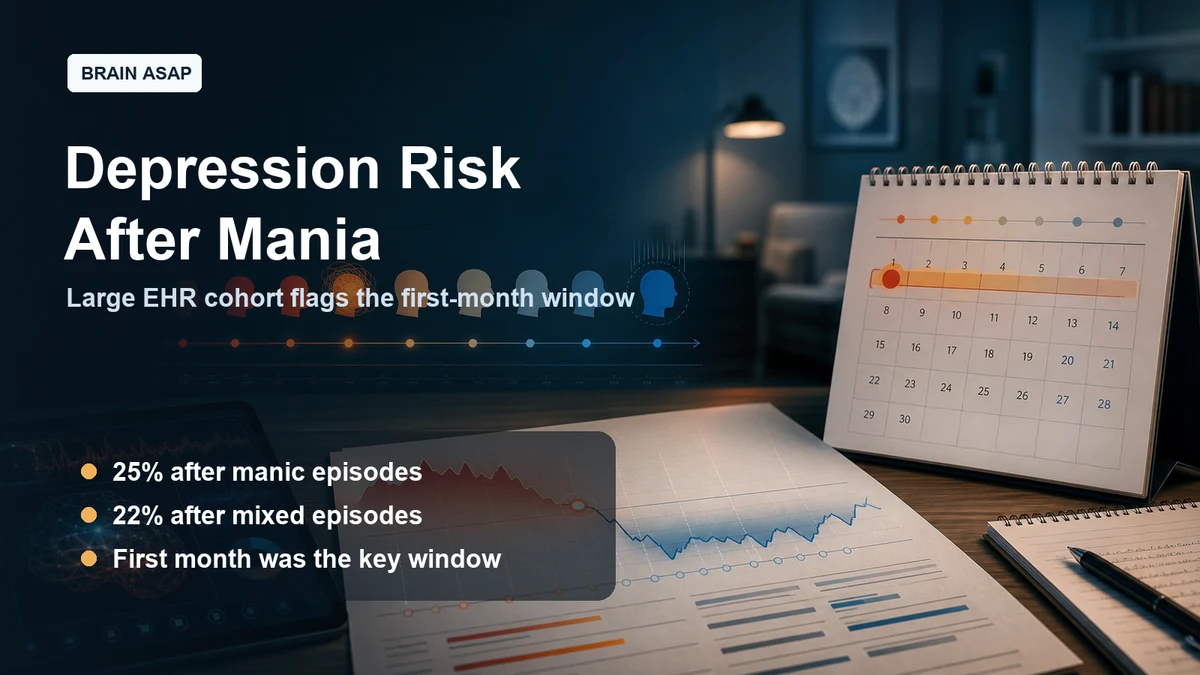
TL;DR: A 2026 medRxiv retrospective cohort study found that depression often followed bipolar manic or mixed episodes quickly, with 25% of manic episodes and 22% of mixed episodes transitioning to depression within 1 month. Key Findings First-month risk window…
Read article ↗