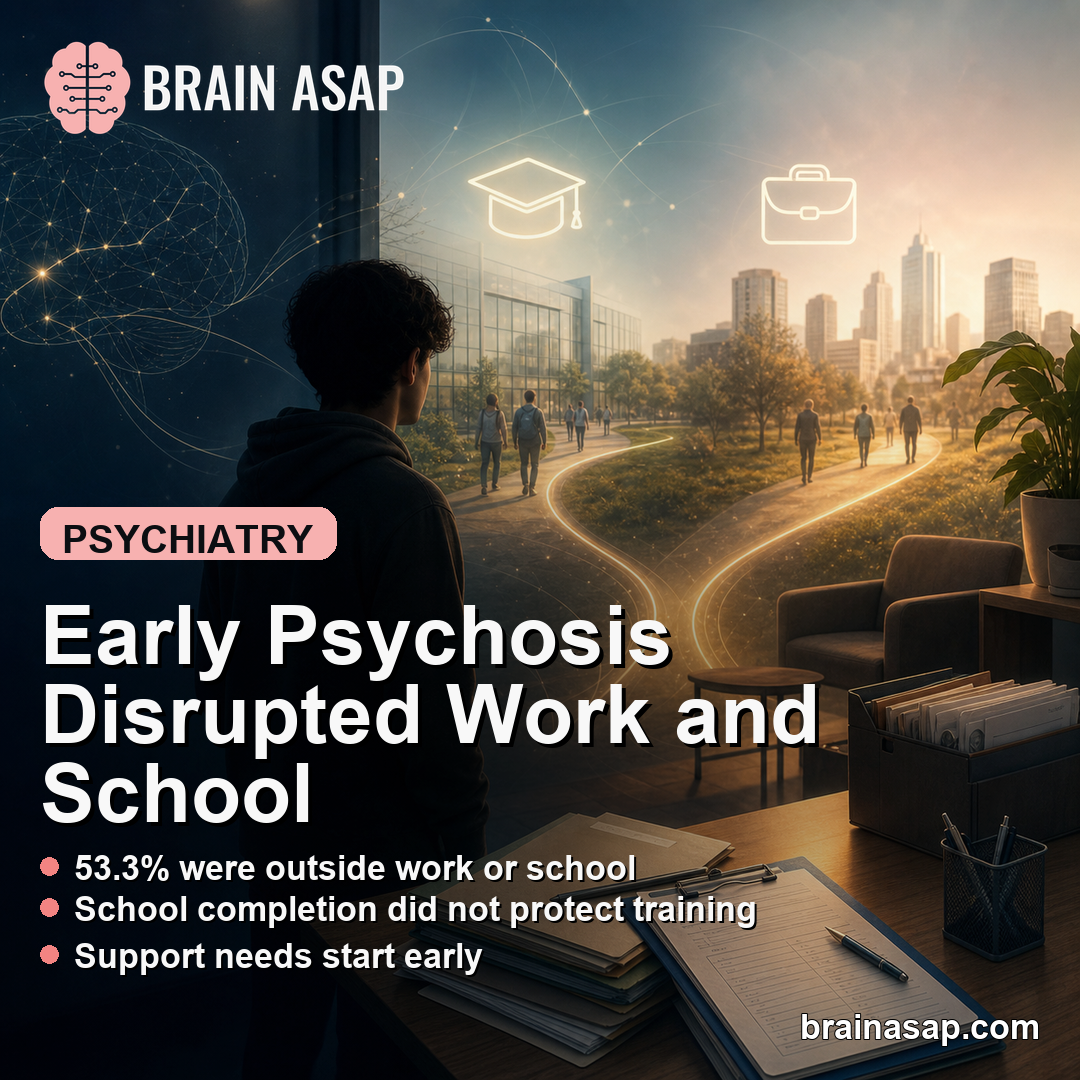
TL;DR: A 2026 study in European Archives of Psychiatry and Clinical Neuroscience found that more than half of 184 young adults entering an early-psychosis supported employment and education trial were not in work, school, or training, even though nearly all had finished at least lower- or upper-secondary schooling.
Key Findings
- The SEEearly cohort included 184 people: Participants were 16 to 35 years old, recruited across six German sites, and all had a schizophrenia spectrum diagnosis.
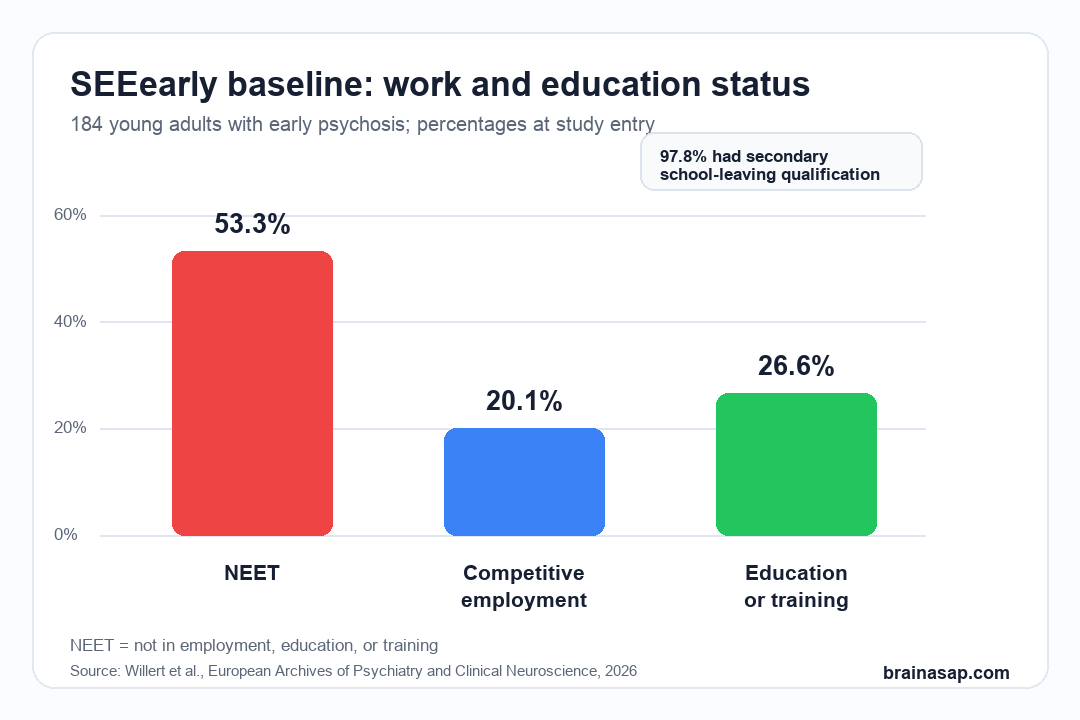
- NEET status was common: At baseline, 53.3% were not in employment, education, or training, a status often shortened to NEET.
- Education disruption was visible despite school completion: 97.8% had a second- or third-level school-leaving qualification, but only 39.1% had completed vocational training or higher education.
- Employment was uncommon at study entry: Only 20.1% were competitively employed, while 26.6% were enrolled in education or training.
- These are baseline needs, not treatment effects: The data support early work-and-school intervention but do not show whether the SEEearly program improved outcomes.
Source: Willert et al. European Archives of Psychiatry and Clinical Neuroscience. 2026.
Early psychosis often arrives during the same years when people are finishing school, starting training, entering college, or building first jobs.
Symptom control is necessary, but the timing also creates a functional problem: a mental-health episode can interrupt the steps that usually lead into adult work and education.
Researchers reported baseline data from SEEearly, a multi-site randomized controlled trial testing supported employment and education in young adults with early psychosis. Supported employment and education, or SEE, is a service model that helps people pursue ordinary work, training, or school goals while treatment is still active.
The baseline data show why that target is practical rather than optional. Before the intervention results were known, the cohort already showed a large gap between school-leaving qualifications and later vocational progress.
Early Psychosis Hit Work and Education Pathways
The trial enrolled 184 participants from October 2022 to December 2024. All participants had a schizophrenia spectrum disorder under DSM-5 diagnostic criteria, and recruitment occurred across six German sites.
That diagnostic focus is useful. Earlier supported employment trials in young people often included mixed psychosis and mood-disorder samples.
SEEearly was narrower, which makes the baseline picture more specific to early schizophrenia spectrum disorders.
The central employment and education split was stark:
- 53.3% were NEET: not in employment, education, or training at baseline.
- 20.1% were competitively employed: fewer than one in four had ordinary paid employment.
- 26.6% were in education or training: about one in four were still connected to school or training.
- 43.5% had at least one dropout: the cohort carried evidence of disrupted educational or vocational steps.
NEET status is not a diagnosis. It is a functional marker.
In this study, it marked a group that had already moved away from the usual school-to-training-to-work pathway during an age window when those transitions strongly shape later independence.
School Completion Did Not Mean Vocational Stability
The most important nuance is that this was not a cohort with broadly absent schooling. Researchers reported that 97.8% had a second- or third-level school-leaving qualification, roughly lower- or upper-secondary education.
That high school-completion rate did not translate into comparable post-secondary progress. Only 39.1% had completed vocational training or higher education.
The authors compared that figure with a general-population benchmark: 81% of young adults aged 20 to 34 had completed post-secondary qualification. The gap suggests that early psychosis may interrupt the step after secondary school, not only the step of finishing school itself.
Three baseline patterns make that interpretation stronger:
- Age gap: participants with a completed degree were older on average than those without one, at 29.2 years versus 23.5 years.
- Dropout history: 80 participants had at least one dropout from school, training, or related vocational pathways.
- Financial strain: 67.8% had less than 1000 euros available per month, and 25.7% reported debts.
Those figures describe delayed or disrupted trajectories rather than a simple absence of ability or ambition. Many participants had reached the threshold that usually opens the next education or training stage, but the later pathway had stalled.
The Cohort Had Moderate Symptoms and Functional Strain
The psychiatric profile was also specific. The most common diagnosis was schizophrenia at 52.7%, followed by brief psychotic disorder at 16.8% and schizoaffective disorder at 14.7%.
Nearly 44.6% had comorbid substance misuse. Almost all had received treatment before study entry, including inpatient, outpatient, day-clinic, or home-treatment settings.
Clinical ratings showed moderate symptom burden. The Positive and Negative Syndrome Scale, or PANSS, had a mean total score of 57.4.
PANSS is a clinician-rated scale used to measure positive symptoms such as hallucinations or delusions, negative symptoms such as reduced motivation or social withdrawal, and general psychiatric symptoms.
The cohort’s mean Global Assessment of Functioning, or GAF, was 57.8. GAF is an older broad functioning scale in which lower scores indicate more impairment.
Mini-ICF, a disability and functioning measure based on the International Classification of Functioning framework, averaged 1.2 on a 0-to-4 scale.
The useful point is not that symptoms alone explain work and school disruption. The baseline profile combines psychiatric symptoms, substance-use comorbidity, financial strain, and interrupted vocational steps.
Supported Education Belongs Beside Supported Employment
The findings support viewing recovery as a vocational trajectory, not only as a final employment status. For a 22-year-old, returning to training or completing a qualification may be as important as holding a job today.
That distinction changes the service target because many early-intervention programs emphasize symptom stabilization, relapse prevention, and clinical follow-up.
Those are necessary, but they may miss the work-and-school pathway unless the service deliberately tracks it.
Supported employment and education can target several steps at once:
- Returning to school: helping someone re-enter classes or exams after acute treatment.
- Completing qualifications: protecting the transition from secondary school into vocational training, college, or higher education.
- Finding ordinary work: using individual placement and support, or IPS, to pursue competitive employment rather than sheltered-only options.
- Keeping the placement: treating job or school maintenance as part of recovery, not as a separate social-service problem.
IPS stands for individual placement and support. It is a supported-employment model built around rapid pursuit of ordinary jobs, attention to the person’s preferences, and integration with mental-health care.
SEEearly extends that logic to education and training, which is important for a young cohort whose vocational path may still be forming.
The Baseline Data Do Not Prove the Intervention Works
The study is a baseline report. It describes who entered the trial and how disrupted their work and education pathways were before intervention effects were measured.
That boundary is important. The data support the need for targeted vocational and educational services, but they do not yet show that SEEearly improves employment, education, symptoms, quality of life, or long-term independence.
The researchers also named limits that affect interpretation:
- Trial sample: participants agreed to join a randomized trial, so they may not represent every young person with early psychosis.
- Geography: metropolitan study sites were overrepresented, rural regions were underrepresented, and no site was located in eastern Germany.
- Self-selection: participants reported limitations in mainstream education or competitive employment, so the cohort was selected for vocational need.
- Symptom comparability: some cross-study comparisons converted PANSS values to Brief Psychiatric Rating Scale estimates, which adds measurement uncertainty.
The practical takeaway is still direct. In this cohort, early psychosis was already tied to missed or delayed work-and-school milestones by the time trial treatment began.
For services, that means symptom remission is not the only outcome to protect. Education, training, competitive work, and financial stability need to be measured early enough that support can arrive before a temporary disruption becomes a long-term vocational gap.
Citation: DOI: 10.1007/s00406-026-02236-8. Study authors et al. Baseline characteristics of a diagnostically defined early psychosis cohort entering supported employment and education: findings from the SEEearly trial. European Archives of Psychiatry and Clinical Neuroscience. 2026.
Study Design: Baseline cohort report from a multi-site randomized controlled trial of supported employment and education for young adults with early psychosis.
Sample Size: 184 participants aged 16 to 35 with schizophrenia spectrum disorders recruited across six German sites.
Key Statistic: At baseline, 53.3% were not in employment, education, or training; 20.1% were competitively employed; and 26.6% were enrolled in education or training.
Caveat: The report describes baseline disruption and trial eligibility, not the eventual effectiveness of the supported employment and education intervention.