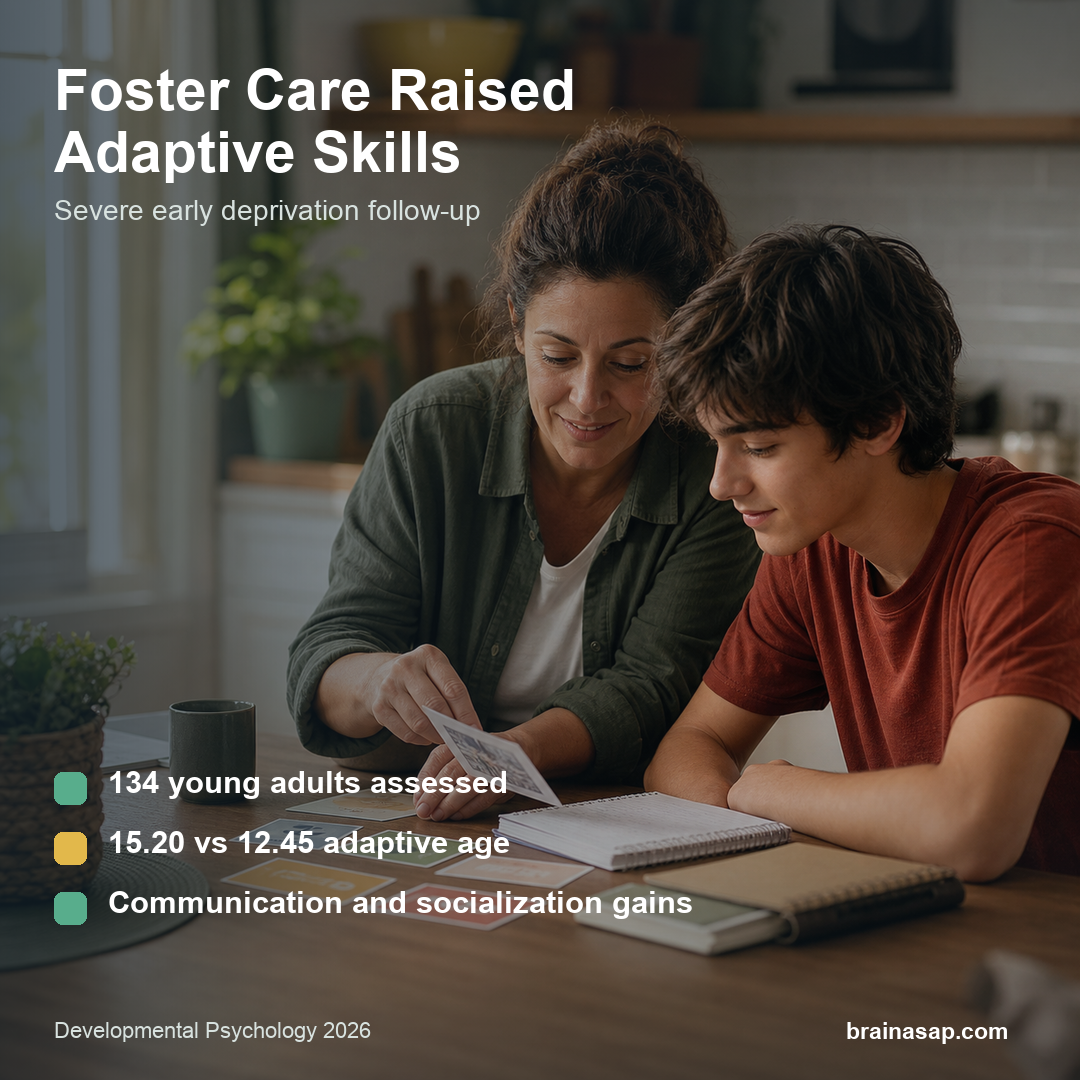
TL;DR: A 2026 Developmental Psychology randomized-trial follow-up found that children assigned to high-quality foster care after severe early deprivation had better adaptive functioning at age 18, especially in communication and socialization, than children who remained in care as usual.
Key Findings
- Trial follow-up: The analysis used the Bucharest Early Intervention Project, a randomized trial comparing foster care with care as usual after early institutional care.
- Age-18 cohort: Researchers assessed 134 young adults at a mean age of 18.9 years, including care-as-usual, foster-care, and never-institutionalized comparison groups.
- Main result: The foster-care group scored higher on overall adaptive functioning, communication, and socialization than the care-as-usual group.
- Age-equivalence gap: Overall adaptive functioning averaged 15.20 years in the foster-care group versus 12.45 years in the care-as-usual group.
- Important limit: Daily living standard scores did not significantly differ between the randomized groups, and many young adults still showed practical support needs.
Severe early deprivation can leave a young person with more than lower test scores. It can affect whether everyday tasks, social exchanges, and independent-living skills keep pace with age.
The new follow-up from the Bucharest Early Intervention Project looked at those real-world skills in early adulthood. The researchers focused on adaptive functioning, meaning practical abilities such as communication, daily living, and socialization.
Foster Care Was Tested Against Care As Usual
The source matters because this was not just a retrospective comparison. The original project randomly assigned abandoned young children in Romanian institutions to either a foster care group or a care-as-usual group, which generally meant continued institutional or government-directed care.
At the 18-year follow-up, the analysis included 93 participants from the original randomized groups: 46 in care as usual and 47 in foster care. The study also included 41 never-institutionalized young adults from the community.
The foster care program was designed to provide family-based placement with trained foster parents, home visits, and developmental support. The question in this follow-up was whether that early intervention still showed up in the skills needed for adult life.
Adaptive Functioning Was Measured With Vineland Scores
The team used the Vineland Adaptive Behavior Scales, a standard measure of how well someone handles age-appropriate everyday demands. The Vineland provides an overall Adaptive Behavior Composite and separate scores for communication, daily living, and socialization.
Those domains are not interchangeable with IQ. A person can show one pattern on reasoning tests and another pattern in everyday independence, social judgment, self-care, or communication.
Researchers reported two types of Vineland score:
- Standard scores: Norm-referenced scores with a typical mean of 100 and standard deviation of 15.
- Age-equivalence scores: Estimates of the developmental age level reflected by a participant’s adaptive-skill performance.
Communication And Socialization Showed Clear Gains
The foster-care group had a higher overall Vineland standard score than the care-as-usual group: 88.65 versus 76.52. Communication also favored foster care, with standard scores of 85.32 versus 72.54.
Socialization followed the same pattern. The foster-care group averaged 90.40, while the care-as-usual group averaged 78.80.
Daily living standard scores were higher in the foster-care group numerically, but that standard-score comparison was not statistically significant.
The age-equivalence results made the developmental meaning easier to see:
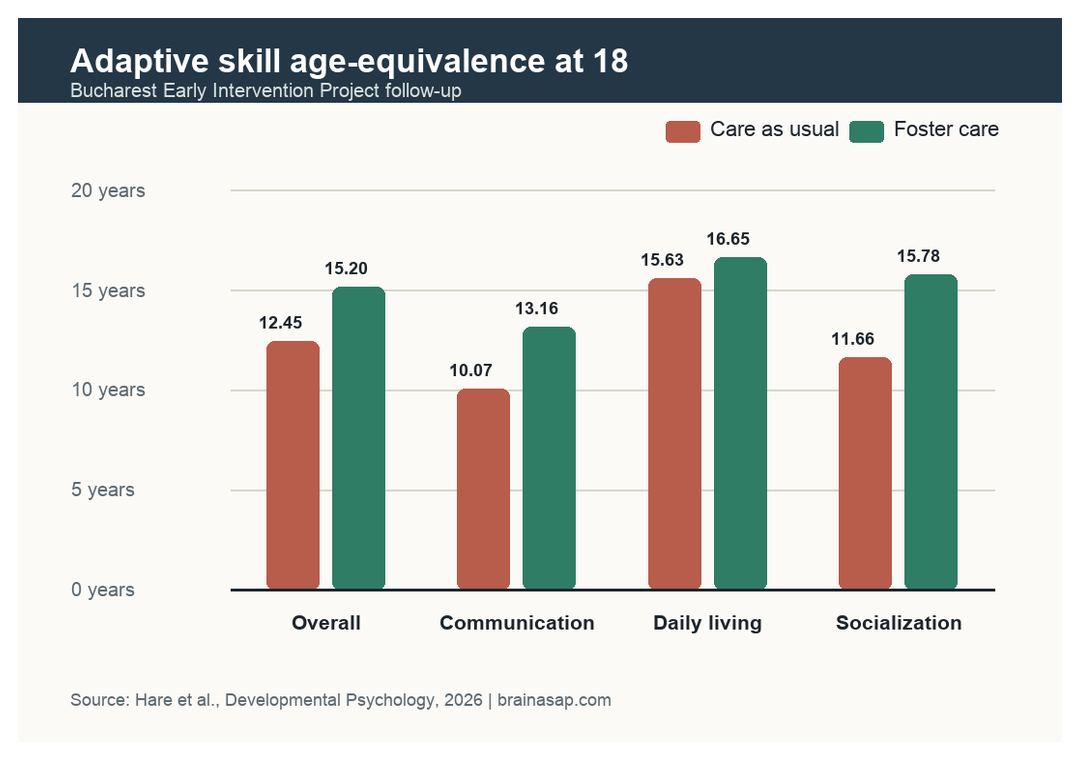
- Overall adaptive functioning: 15.20 years in the foster-care group versus 12.45 years in care as usual.
- Communication: 13.16 years in the foster-care group versus 10.07 years in care as usual.
- Socialization: 15.78 years in the foster-care group versus 11.66 years in care as usual.
- Daily living: 16.65 years in the foster-care group versus 15.63 years in care as usual.
That does not mean foster care erased the early-deprivation gap. It means the randomized foster-care group showed stronger practical development than the care-as-usual group many years after placement.
The study also compared all ever-institutionalized participants with the never-institutionalized comparison group. That comparison showed a broader remaining gap.
The never-institutionalized group averaged 106.63 on the overall standard-score composite, compared with 82.68 for the ever-institutionalized group. Age-equivalence scores showed a similar difference: 18.91 years versus 13.84 years overall.
This part of the analysis is not the randomized contrast. It is still useful because it shows that early institutional deprivation was associated with lasting functional differences even when some children later received family-based care.
Caregiving Quality Helped Explain The Difference
The researchers also tested whether caregiving quality helped explain adaptive-functioning outcomes. Staff rated caregiving quality during adolescence on a five-point scale from dangerous to acceptable.
The mediation analysis suggested that caregiving quality partly explained the link between randomized group assignment and adaptive functioning at age 18. In that model, caregiving quality explained about 74% of the total association between foster-care assignment and adaptive functioning.
That finding points away from a simple “placement label” interpretation. The practical signal was not just whether a child left an institution.
It was whether the child experienced stable, nurturing, developmentally appropriate care over time.
The most cautious reading is that high-quality foster care improved several adaptive skills after severe early deprivation, while leaving important limits. The care-as-usual group had especially low communication and socialization scores, and 41% of that group functioned below age 12 on the overall adaptive-functioning measure.
At the same time, the foster-care group did not fully match never-institutionalized peers. Daily living remained a concern, and the study measured one highly specific historical intervention rather than every foster-care system.
For policy, the result argues for early movement out of institutional care and into well-supported family settings. For clinical and educational planning, it also argues for continued assessment of communication, socialization, and daily-living skills as children exposed to early deprivation approach adulthood.
Source
Citation: DOI: 10.1037/dev0002029. Hare et al. Adaptive Functioning at Age 18 Years Following Severe Early Deprivation: Results of a Randomized Controlled Trial. Developmental Psychology. 2026;62(7):1393-1402.
Study Design: Longitudinal follow-up of a randomized controlled trial comparing high-quality foster care with care as usual after severe early institutional deprivation.
Sample Size: 134 young adults assessed at a mean age of 18.9 years, including 46 care-as-usual participants, 47 foster-care participants, and 41 never-institutionalized comparison participants.
Key Statistic: The foster-care group had higher overall adaptive-functioning age-equivalence scores than care as usual, 15.20 versus 12.45 years, with clear communication and socialization advantages.
Caveat: Daily living standard scores did not significantly differ between the randomized groups, and the trial’s foster-care program was a specific supported intervention rather than a generic foster-care label.