TL;DR: A 2026 analysis in Brain, Behavior, & Immunity – Health of 827 middle-aged adults found that profiles combining intestinal-permeability biomarkers with age, cardiometabolic risk, or lifestyle factors were associated with smaller brain volumes and higher plasma neurofilament light in sex-specific patterns, with only the women’s profiles also associated with higher 4-year odds of neurological diagnoses.
Key Findings
- Sex split mattered: The same gut-barrier markers did not behave the same way in women and men once age, cardiometabolic risk, alcohol, sleep, diet, social connection, and other lifestyle variables were included.
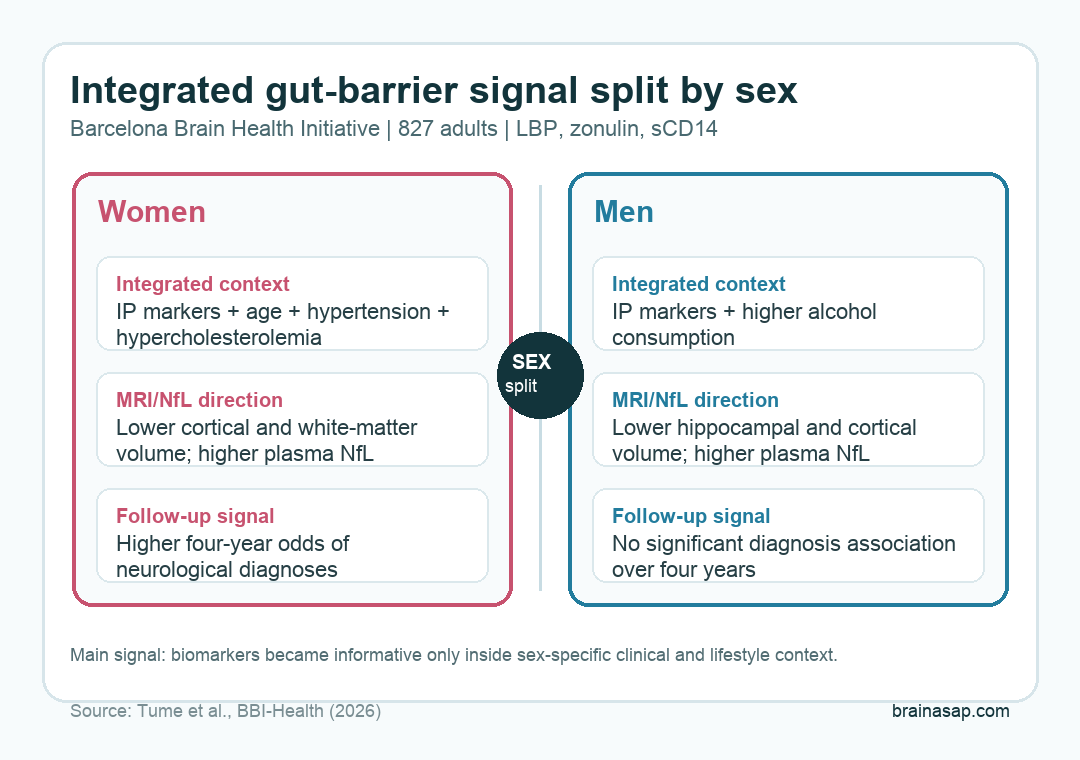
- Women carried the forward pattern: A female dimension combining intestinal-permeability markers with age, hypertension, and hypercholesterolemia was linked to lower cortical and white-matter volume, higher plasma NfL, and higher 4-year odds of neurological diagnoses.
- Men’s pattern tied to alcohol: In men, the clearest integrated dimension paired higher intestinal-permeability markers with higher alcohol consumption and related to smaller hippocampal and cortical volumes plus higher NfL.
- Single markers stayed weak: Individual markers such as LBP, zonulin, and sCD14 showed only small adjusted associations, which is why the integrated lifestyle-and-biomarker dimensions carried the main result.
- Clinical use stayed premature: The paper frames the findings as exploratory and hypothesis-generating, not as proof that blood gut-barrier markers can already screen brain-health risk.
Source: Brain, Behavior, & Immunity – Health (2026) | Tume et al.
The Gut-Brain Signal Only Became Clear After Sex Was Kept Separate
Proposed gut-brain mechanisms include microbial products entering the bloodstream and promoting inflammation, but this observational analysis could not test that causal sequence.
This analysis made the claim more conditional. The cohort was not defined by diagnosed gastrointestinal disease or advanced dementia.
The study instead focused on apparently healthy middle-aged adults. It asked whether blood markers of intestinal permeability lined up with cognition, mood symptoms, MRI brain volumes, plasma neurofilament light, and later diagnoses.
The cohort came from the Barcelona Brain Health Initiative, a prevention-oriented study of adults in midlife. The analysis included 827 people, with a median age around 52, who had neuropsychological testing, brain MRI, plasma NfL, and blood measurements of three intestinal-permeability markers.
Those markers were lipopolysaccharide-binding protein, zonulin, and soluble CD14.
They do not measure the same biological process. LBP and sCD14 relate to bacterial lipopolysaccharide handling and immune activation. Zonulin is commonly used as a proxy for barrier regulation.
Sex stratification changed the interpretation. Women and men were analyzed separately because gut-brain biology is shaped by hormones, metabolism, immune tone, body composition, and lifestyle patterns.
The split produced two different risk patterns. Neither was clean enough for a one-marker blood test.
Women’s Brain Signal Mixed Gut Markers With Age and Cardiometabolic Risk
In women, the clearest readout did not come from one biomarker on its own. It came from an integrated dimension that combined higher intestinal-permeability markers with older age, higher BMI, hypertension, and hypercholesterolemia.
That dimension was associated with lower cortical volume, lower white-matter volume, and higher plasma NfL, all in the direction of poorer brain health.
Plasma NfL is a nonspecific blood marker of neuroaxonal injury. It does not identify a disease by itself, but higher levels can suggest more strain on neuronal integrity.
The follow-up finding sharpened the female pattern. Across 4 years, integrated dimensions that included intestinal-permeability markers were associated with higher odds of new neurological disease diagnoses in women.
The abstract reports an odds ratio of 2.3 for neurological diagnoses and 1.3 for the broader disease endpoint.
Those associations do not prove that intestinal permeability caused the outcomes. Age and cardiometabolic risk were part of the same dimension, and the paper treats the work as exploratory.
The more defensible next step is to study gut-barrier biology, menopause transition, vascular risk, and brain aging together in midlife women.
Men Showed a Different Pattern Around Alcohol and Hippocampal Volume
The male result pointed somewhere else. In men, the integrated dimension most tied to brain structure combined higher intestinal-permeability biomarkers with higher alcohol consumption and Mediterranean diet score.
That dimension was associated with smaller left and right hippocampal volumes, smaller cortical volume, and higher plasma NfL.
The alcohol link is biologically plausible because heavy or sustained alcohol exposure can impair intestinal barrier integrity and increase microbial translocation.
In this study, the male pattern did not translate into a statistically significant 4-year diagnosis association. It did, however, touch the hippocampus, a memory region watched closely in brain-aging research.
This is not a claim that every man with higher gut-permeability markers has a shrinking hippocampus.
The standardized associations were modest, and the paper is not a clinical cutoff study. In men, gut-barrier markers look more interpretable when lifestyle exposures that stress the intestinal barrier are included.
- Alcohol context: higher consumption was part of the male integrated dimension.
- Brain structure: hippocampal and cortical volumes moved in the lower direction.
- Clinical follow-up: diagnosis associations did not reach significance in men.
Reducing the paper to “leaky gut hurts the brain” would miss the point. The male pattern was leaky-gut biology in a lifestyle context, with alcohol carrying enough weight to change the integrated dimension.
Why Individual Biomarkers Looked Too Small for a Simple Blood Test
The paper does not oversell LBP, zonulin, or sCD14.
Individual-marker associations were mostly small after adjustment. Many standardized beta coefficients sat around |0.10|, a weak relationship in a heavily adjusted observational model.
Gut-brain biomarker language can get too confident too quickly.
LBP and sCD14 have dual biological roles: they can participate in inflammatory signaling, but they can also help clear lipopolysaccharide. Zonulin assays can also be difficult to interpret.
- LBP: related to bacterial lipopolysaccharide handling, but not a one-direction inflammatory switch.
- sCD14: tied to immune recognition of microbial products, with sex-specific interpretation in this paper.
- Zonulin: often used as a barrier-regulation proxy, but not a complete intestinal-permeability test.
The statistical strategy reflected that uncertainty. Principal-component analysis combined the three gut markers, while multiple-factor analysis integrated biomarkers with age, BMI, lifestyle, socioeconomic status, cardiometabolic status, sleep, social network, purpose-in-life measures, and diet.
The picture was less flashy than a single blood-test headline, but more defensible. Brain health did not map cleanly onto one molecule. It mapped onto sex-specific risk context.
The gut barrier may still belong in brain-health prevention work, but interpretation needs sex, age, cardiometabolic risk, alcohol exposure, and lifestyle in view. A test that ignores those layers could be measurable and still misleading.
Midlife May Be the Right Window, but the Evidence Is Still Early
Timing is the prevention angle.
For women especially, midlife may be a window when intestinal-permeability biology, menopause transition, and cardiometabolic risk converge.
Brain-health interventions usually work best before clinical disease is obvious, so this window deserves more direct testing.
The limits are real. The cohort was relatively healthy and highly educated. The study was observational, diagnosis counts over 4 years were not large, and biomarker associations were subtle.
The permeability measurement also stayed indirect. The analysis used circulating markers that are biologically informative but imperfect, not a direct gold-standard permeability challenge.
Still, the paper pushes gut-brain research toward a better question.
Instead of asking whether “leaky gut” matters in the abstract, the next studies should ask for whom, in what biological context, and alongside which lifestyle risks.
In this dataset, the answer differed by sex.
Gut-barrier biomarkers looked most meaningful when treated as part of a sex-specific midlife risk profile. The finding is less sensational, but more actionable for future prevention studies.
Citation: DOI: 10.1016/j.bbih.2026.101276 | Tume R, Cattaneo G, Carmona-Pontaque F, Solana-Sánchez J, Iglesias-Vejar L, Cubedo-Cullere M, et al. Sex differences in the associations between lifestyle, intestinal permeability and brain health in middle-aged adults. Brain, Behavior, & Immunity – Health. 2026;55:101276.
Study design: Observational cohort analysis using sex-stratified regression, principal-component analysis, and multiple-factor analysis.
Sample size: 827 Barcelona Brain Health Initiative participants with neuropsychological testing, plasma NfL, MRI data, and intestinal-permeability biomarkers.
Key statistic: In women, dimensions including intestinal-permeability markers were associated with neurological diagnoses over 4 years, with OR 2.3 and 95% CI 1.5-3.6.
Caveat: The study was exploratory and observational, and circulating LBP, zonulin, and sCD14 are indirect permeability markers rather than direct clinical screening tests.
Authors’ affiliations: University of Barcelona, Barcelona, Spain; CIBERFES, Instituto de Salud Carlos III, Madrid, Spain; Institut Guttmann, Badalona, Spain; Hospital Clínic de Barcelona and IDIBAPS, Barcelona, Spain; Harvard Medical School and Hebrew SeniorLife, Boston, Massachusetts, USA.