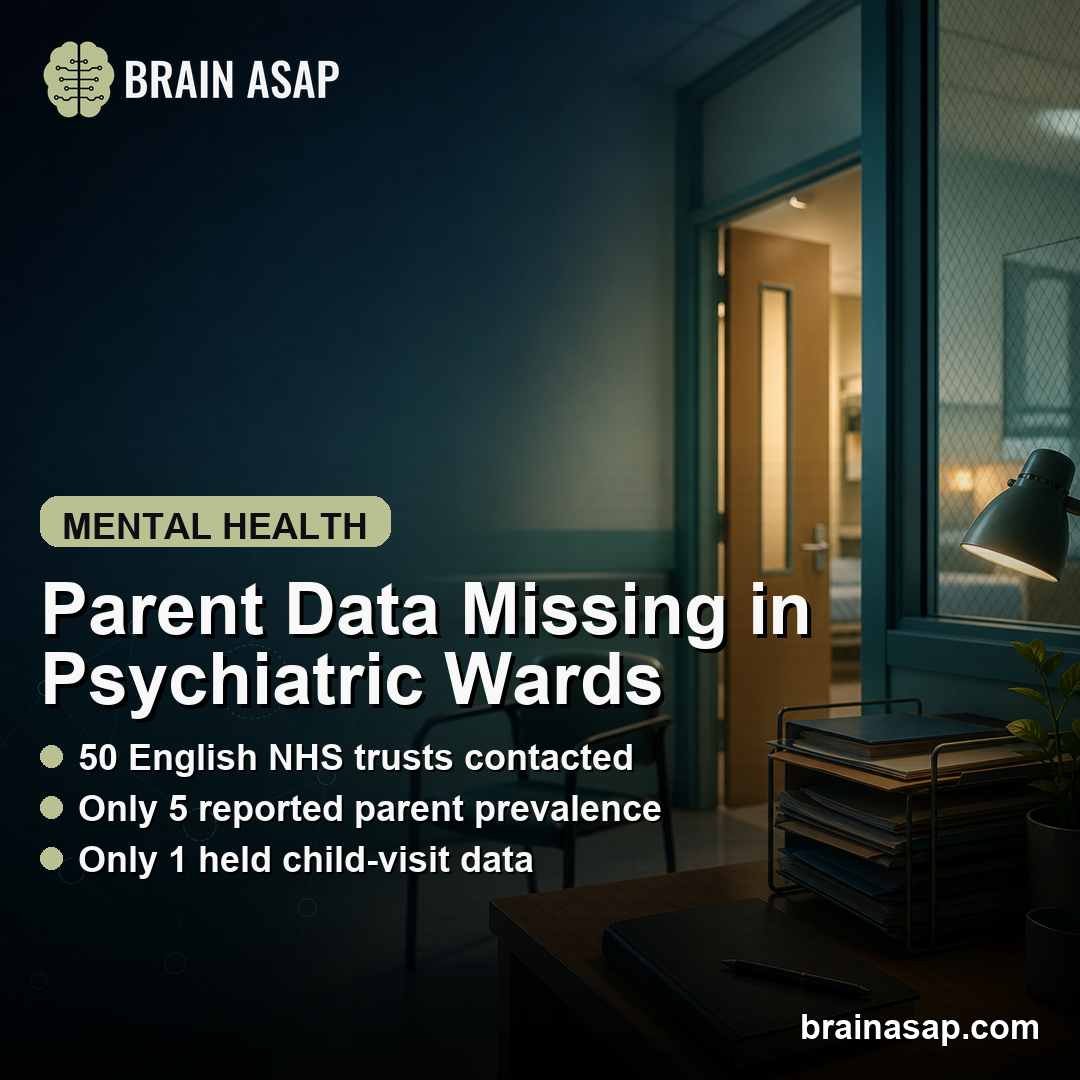
TL;DR: A 2026 study in BJPsych Bulletin used Freedom of Information requests and found that most English NHS trusts providing in-patient psychiatric care were unable to report basic data on which patients were parents of children under 18.
Key Findings
- 50 trusts contacted: Researchers sent Freedom of Information requests to all English NHS trusts providing in-patient psychiatric care.
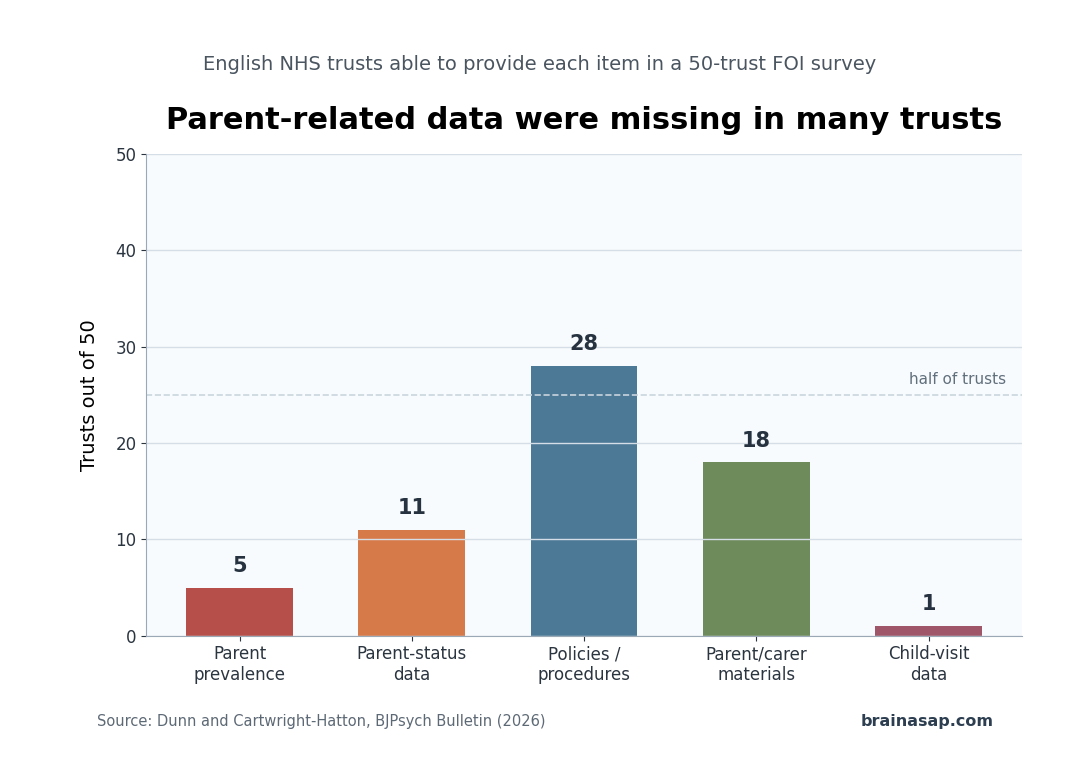
- Only 5 trusts reported parent prevalence: Those trusts identified parents in 4.3% to 21.0% of in-patient cases, with a mean of 13.9%.
- Only 11 trusts described parent-status data: No trust reported collecting every parental-status item listed by the researchers.
- 28 trusts provided policies: Fewer than 60% sent any policy, procedure, or information pack related to in-patients with parental responsibilities or their children.
- Child-visit data were nearly absent: Only 1 trust held data on child visits, and those data covered only some secure wards.
Source: BJPsych Bulletin (2026) | Dunn and Cartwright-Hatton
Psychiatric hospital admission can separate parents from their children at a time when family contact is already fragile. The clinical issue is not only whether visits are allowed, but whether services know which patients are parents and can support that family role.
Dunn and Cartwright-Hatton used Freedom of Information (FOI) requests to test whether English mental health trusts were able to answer basic operational items about in-patients who are parents.
Most Trusts Could Not Count In-Patient Parents
The survey targeted all 50 English NHS trusts that provide in-patient psychiatric care. Researchers asked for 2018-2019 data to avoid the direct disruption of the COVID-19 period.
Three trusts did not respond at all. The remaining 47 trusts provided at least partial information, but parent-specific data were much thinner than the overall response rate.
- Admissions data: 38 trusts returned basic information on psychiatric in-patient admissions.
- Parent prevalence: Only 5 trusts provided meaningful data on how many in-patients were parents.
- Reported range: In those 5 trusts, parenthood was identified in 4.3% to 21.0% of cases.
- Mean estimate: The mean parenthood prevalence among reporting trusts was 13.9%.
The missing information is clinically important because parental hospitalisation can disrupt the parent-child relationship and place children under stress. A service cannot reliably offer parent-specific support if it cannot identify parents in its own wards.
Parent-Status Questions Were Inconsistent
Researchers also asked what data trusts routinely collected when an in-patient was admitted or during care. Only 11 trusts were able to answer that item.
Even among those 11, no single trust reported collecting all the parent-related items listed in the FOI request. Some trusts also made parent-status fields conditional, triggering them only when safeguarding risk had already been identified.
The reported fields covered practical details that would matter for family support and safeguarding. Examples included children’s names and ages, legal responsibility, current care arrangements, other agencies involved, whether any children lived with the patient, and whether support for parenting was needed.
Several trusts said the requested information was held in individual case notes rather than a central system. Others reported unusable data, inaccessible data, missing data, or no reason for non-response.
The operational problem is concrete. Information buried in individual case notes cannot easily show ward leaders how many parents are admitted, whether child contact is happening, or where family-support gaps are concentrated.
- Identification: Services need to know whether an in-patient has dependent children.
- Care planning: Teams need enough detail to understand where children are staying and who is responsible for them.
- Support beyond risk: Parenting concerns can exist even when there is no immediate safeguarding trigger.
Policies and Materials Were Also Patchy
The Mental Health Act Code of Practice includes expectations around family roles and child visits, including written policies and child-appropriate explanations of visiting. The survey found uneven local documentation.
Across all 50 trusts, 28 trusts returned policies or procedures relating to in-patients who are parents. Fewer than 60% provided any such policy or information pack in response to the request.
- Welcome packs: 11 trusts sent in-patient welcome packs, and 8 of those included some reference to parents’ needs.
- Carer materials: 13 trusts sent information sheets for carers of in-patients.
- Parent-specific carer content: Only 8 sent carer materials that referred to in-patient parents or their children.
- Child-facing materials: Only 3 trusts provided resources for children of in-patients.
Where policies mentioned child visits, the content often focused on documentation and risk assessment. The researchers describe limited evidence of practical support for children or carers navigating a parent’s psychiatric admission.
Child-Visit Data Were Almost Missing
The sharpest data gap involved actual child visits. Only 1 trust provided information on child visits, and even that answer covered only some secure wards.
No trust reported how many parents had received child visits. Without a denominator linking visits to parent admissions, researchers were unable to calculate a meaningful visit rate.
- Operational gap: Trusts can allow child visits without tracking whether visits actually happen.
- Service-planning gap: National leaders cannot plan family-focused support well if trust-level parenthood data are inaccessible.
- Safeguarding gap: The absence of usable records makes it harder to verify that services are consistently meeting family and child-protection responsibilities.
The finding is a narrow but serious systems warning for psychiatric service oversight. The FOI survey does not prove that every trust failed individual families, but it shows that parent-related psychiatric in-patient care is poorly counted, inconsistently documented, and difficult to monitor across NHS England.
Citation: DOI: 10.1192/bjb.2026.10235. Study authors et al. Dunn A, Cartwright-Hatton S. Support for parents in in-patient psychiatric care in English NHS trusts: Freedom of Information survey. BJPsych Bulletin . 2026.
Study Design: Cross-sectional Freedom of Information survey of English NHS trusts providing in-patient psychiatric care.
Sample Size: 50 trusts contacted, with 47 providing at least partial information.
Key Statistic: Only 5 trusts reported the prevalence of parenthood among psychiatric in-patients; only 1 held child-visit data.
Caveat: Failure to provide data does not prove failure in every ward, but inaccessible data cannot reliably guide family-focused service delivery.