TL;DR: A 2026 study in Neuropsychopharmacology used CRISPR gene editing in human microglia-like cells and found that several schizophrenia-linked genes changed phagocytosis, cell shape, and immune-transcription programs.
Key Findings
- Schizophrenia-linked microglia genes were testable: The screen focused on 30 genes predicted from postmortem transcriptomic data and microglial biology to affect phagocytosis pathways.
- CYFIP1, MSR1, TREM2, SYK, ITGB2, ITGAM, and IRF8 stood out: These targets changed microglial phagocytosis or cell-shape features tied to activation state.
- ITGB2 and ITGAM pushed cells toward an ameboid profile: Targeting these complement receptor 3 subunits increased solidity and reduced eccentricity, a morphology linked with higher phagocytic activity.
- TREM2, IRF8, HLA-DMB, and SYK reshaped transcription most broadly: RNA profiling showed gene-specific downstream programs involving phagocytosis, lysosomes, activation, cytokine signaling, and cytoskeletal remodeling.
- Phagocytosis and shape tracked together: Higher solidity correlated with higher phagocytosis, while higher eccentricity correlated with lower phagocytosis across the targeted genes.
Source: Neuropsychopharmacology (2026) | Horng et al.
Schizophrenia Risk Genes Were Tested in Microglia-Like Cells
Schizophrenia genetics has produced many risk loci, but a list of associated genes does not automatically explain what changes inside brain cells.
This study moved one step closer to function by testing whether schizophrenia-linked genes alter microglia-like cells, the brain immune cells involved in synapse pruning, surveillance, inflammation, and debris clearance.
Researchers used peripheral blood mononuclear cell-derived induced microglia-like cells, or piMGLCs. These lab-generated human cells model microglial behavior closely enough for scalable screening.
The team then delivered CRISPR ribonucleoprotein complexes to perturb selected genes and measured what happened to cell function.
The target list was not random. Genes were prioritized from postmortem schizophrenia transcriptomic datasets, predicted microglial expression, and ontology links to phagocytosis.
That design gave the screen a focused question: which schizophrenia-associated genes actually change microglial behavior?
CRISPR Screening Flagged Phagocytosis Genes With Different Effects
The central assay measured phagocytosis, meaning the ability of microglia-like cells to engulf material. In brain development and disease, microglia can clear synaptic material, damaged components, and inflammatory debris.
Several targets changed phagocytic activity enough to move into follow-up testing. The most important pattern was not one simple direction.
Different genes pushed microglia-like cells toward stronger or weaker uptake, suggesting that schizophrenia-linked immune biology may involve several routes into the same cellular behavior.
- Reduced phagocytosis: Targeting CYFIP1, MSR1, and TREM2 was linked with lower phagocytic activity in the screen.
- Higher phagocytosis: Targeting ITGB2 and ITGAM, the two subunits of complement receptor 3, shifted cells toward a more phagocytic profile.
- Validation signal: Secondary screens with redesigned guide RNAs reproduced many of the primary effects, with a high primary-secondary correlation when one outlier was excluded.
Microglial synaptic pruning has long been discussed in schizophrenia. The new result does not prove that these genes cause patient symptoms.
It shows that some schizophrenia-linked genes can directly alter a microglia-relevant function in a human cell model.
Cell Shape Helped Separate Microglial Activation States
The researchers also measured cell morphology using high-content confocal imaging. Two measures carried much of the interpretation: solidity, which rises when cells look more rounded or ameboid, and eccentricity, which rises when cells are more elongated or ramified.
These shape features are useful because microglia change form as their functional state changes. In this study, morphology and phagocytosis moved together in a measurable way: higher solidity correlated with higher phagocytosis, while higher eccentricity correlated with lower phagocytosis.
The strongest morphology shifts came from genes already tied to immune or cytoskeletal pathways. ITGB2 and ITGAM moved cells toward a more ameboid shape.
VAV1 and SYK moved cells toward a more ramified profile. That split shows that gene perturbations were not simply making cells sick or globally activated; they produced distinguishable functional states.
RNA Profiling Split the Genes Into Distinct Microglial Programs
After the imaging assays, researchers used DRUG-seq, a multiplexed RNA-sequencing method, to measure transcriptional effects across the targeted genes.
This step added context because phagocytosis and shape do not explain the full state of a microglia-like cell.
The RNA data showed that different targets changed different downstream programs. Some genes acted like broader regulatory nodes, while others produced narrower effects.
- Broad transcriptional effects: TREM2, IRF8, HLA-DMB, and SYK produced some of the largest numbers of differentially expressed genes.
- Phagocytosis pathways: TREM2, IRF8, and SYK affected genes involved in uptake and clearance, including receptor and effector programs.
- Lysosomal pathways: ITGB2, TLR2, NCKAP1L, and TREM2 affected lysosomal organization, including genes tied to acidification and trafficking.
- Cell-shape programs: TREM2 had broad effects on signaling and cytoskeletal genes, while ITGB2, ITGAM, and TLR2 more strongly affected chemokine expression.
A gene can produce a large transcriptional shift without producing the largest visible phenotype. A gene can also change phagocytosis without rewriting the entire transcriptome.
The study argues for measuring multiple layers of microglial state rather than relying on one readout.
What the Microglia Screen Does and Does Not Prove
The result supports a specific model: subsets of schizophrenia-associated genes can tune microglial phagocytosis, activation, lysosome biology, and cytoskeletal behavior through partly distinct mechanisms. That is a more concrete claim than saying schizophrenia has an immune component.
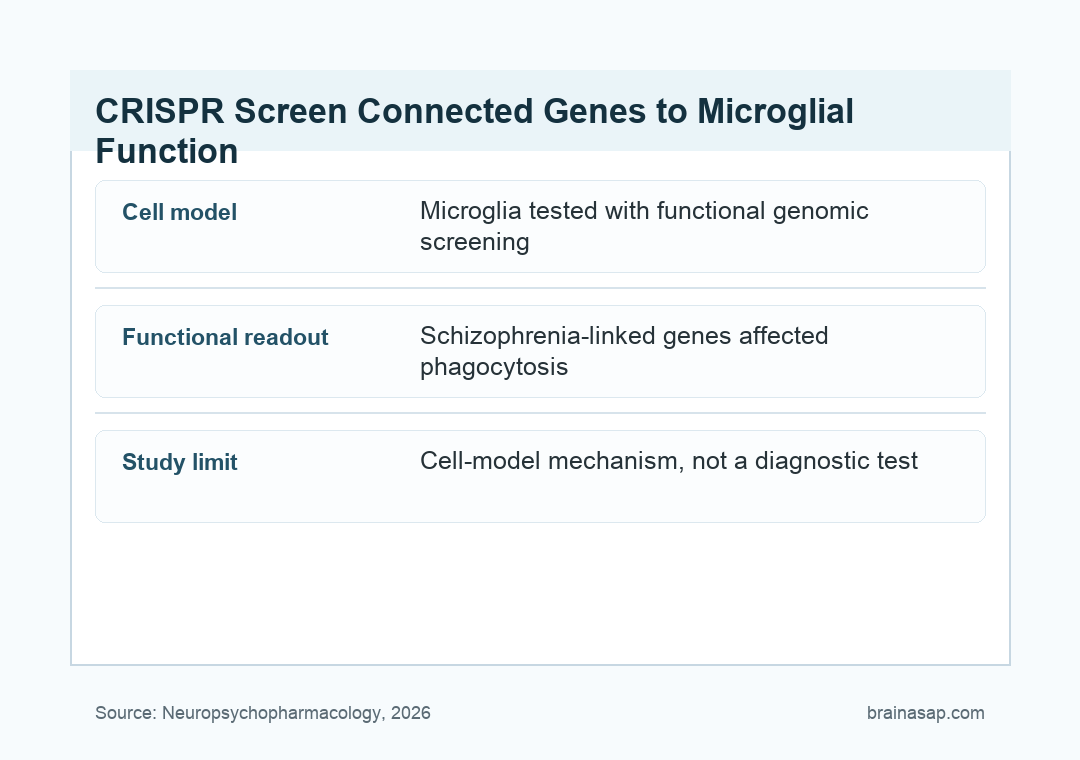
The study also has clear limits. The work used a cell model, not brain tissue from living patients.
CRISPR perturbation in piMGLCs cannot capture every developmental timing issue, brain-region environment, medication exposure, or patient-specific genetic background that shapes schizophrenia biology.
- Best-supported claim: Several schizophrenia-linked genes have measurable effects on microglia-like cell function.
- Main boundary: The screen identifies cellular mechanisms to follow up, not diagnostic markers or treatment targets ready for clinical use.
- Useful next step: Clonal induced pluripotent stem cell-derived microglia and 3D culture systems could test whether the same gene effects persist in higher-fidelity disease models.
The main use is prioritizing follow-up work. Genes such as TREM2, SYK, IRF8, ITGB2, ITGAM, CYFIP1, and MSR1 now have functional evidence that connects schizophrenia genetics with microglial behavior.
That evidence gives future studies a clearer path than starting from a genome-wide association list alone.
Citation: DOI: 10.1038/s41386-026-02406-1. Horng et al. Functional genomic profiling of schizophrenia-associated genes reveals key microglial regulators. Neuropsychopharmacology. 2026.
Study Design: Arrayed CRISPR functional screen in human peripheral blood-derived induced microglia-like cells, followed by image-based phenotyping and multiplexed RNA sequencing.
Sample/Model: 30 schizophrenia-associated genes tested in piMGLCs, with secondary validation for selected targets and three biological replicate libraries for transcriptomic profiling.
Key Statistic: Morphology and phagocytosis were linked across genotypes, with solidity explaining 0.564 of phagocytic-index variation and eccentricity explaining 0.479.
Caveat: The findings come from a scalable human cell model, so patient-level relevance still needs validation in more complex brain and disease models.