The Hidden Postpartum Crisis Nobody Screens For: Paternal Depression Peaks at 10-12 Months
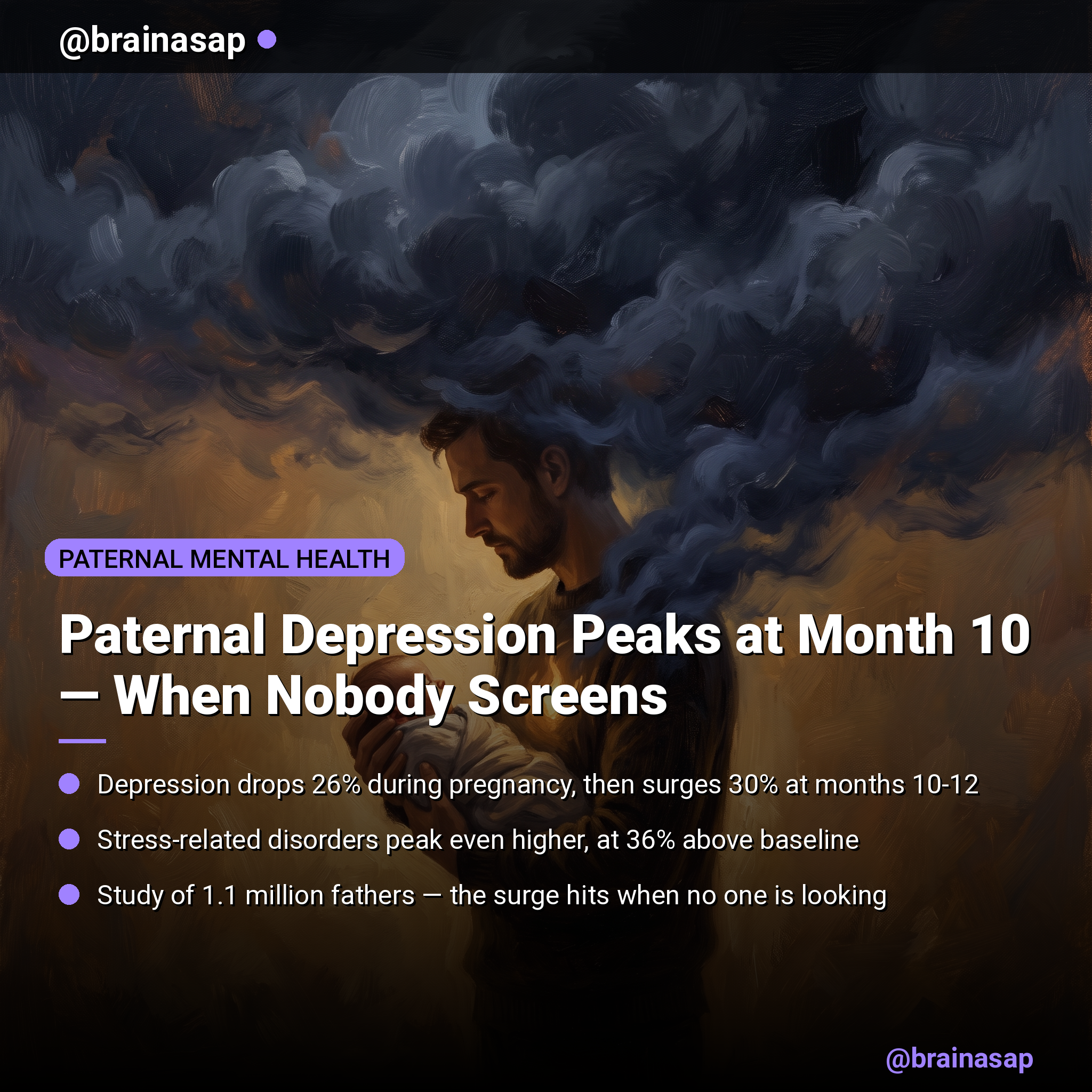
TL;DR: Fathers experience a protective period early postpartum (depression drops by 26%), but depression and stress surge at months 10-11, creating a 30-36% elevated risk when no one is screening for it.
Perinatal psychiatry has a crisis of attention. Mothers are screened relentlessly. Fathers are largely invisible. Yet a groundbreaking Swedish national study reveals something more troubling: a fundamental misalignment between when fathers actually get sick and when anyone bothers to look.
Depression and stress-related disorders don’t spike immediately after birth. They surge months later, reaching a 30 to 36 percent elevation above baseline around month 10 or 11 postpartum—a peak that occurs long after standard screening has ended and fathers have stopped appearing at healthcare visits. The protective period everyone assumes exists is real. Nobody realized the crisis waits on the other side.
Key Findings
- 26% protective decline during pregnancy: psychiatric diagnoses declined 26 percent during pregnancy (from 7.00 to 5.50 per 1,000 person-years) reaching a nadir at week 41 of pregnancy, then remained suppressed through the first two months postpartum.
- 30% late-postpartum depression surge: suppressed in early postpartum, depression incidence rose progressively and peaked at postpartum weeks 45-49 with an incidence rate ratio (IRR) of 1.30, representing a 30 percent elevation above pre-pregnancy baseline.
- 36% stress-related disorder peak: the same late-postpartum pattern but more severe, reaching IRR 1.36 at weeks 45-49—a 36 percent elevation—suggesting fathers are responding to genuine objective overwhelm, not just mood instability.
- Substance use temporary decline: alcohol and drug use disorders declined during pregnancy but returned to pre-pregnancy levels afterward, indicating pregnancy-related behavioral change that doesn’t persist.
- No variation in stable conditions: ADHD, bipolar disorder, tobacco use disorder, and psychosis showed no variation across the perinatal period, confirming that the depression and stress surges are specific to life-transition stressors, not measurement artifacts.
- Massive rigorous dataset: 1.1 million fathers, 1.9 million births across Sweden from 2003-2021, with standardized weekly incidence calculations and adjustment for age, region, education, income, and psychiatric history—likely the most rigorous population study of paternal perinatal mental health ever conducted.
Source: JAMA Network Open (2026) | Xiang, Lu et al.
A Dataset So Large It Reveals What Smaller Studies Miss
Swedish national registers linked births, hospitalizations, and diagnoses across the entire population, eliminating selection bias. This study captured 1,096,198 fathers and 1,915,722 births from 2003-2021—nearly two decades.
The strength: it captures clinical diagnoses, not surveys or self-reports. Researchers calculated weekly incidence rates for psychiatric diagnoses across five key periods: one year before conception, pregnancy week by week, and one year after birth.
With numbers this large, noise disappears. What they found was precise: psychiatry’s screening protocols are timing mismatches.
The Protective Paradox: Why Fathers Get Better Before They Get Worse
Psychiatric diagnoses actually declined when fatherhood began. In the preconception year, incidence was 7.00 per 1,000 person-years. In late pregnancy, it had fallen to 4.01—a 26 percent reduction that held through the first eight weeks postpartum. Fathers were genuinely getting diagnosed less frequently.
Two Mechanisms at Work
First: behavioral change. The anticipation of fatherhood motivates genuine modifications—men reduce substance use, improve sleep, make health-conscious choices. Alcohol and drug use disorders showed the largest declines; fathers were actually changing behavior, not just avoiding healthcare.
Second: healthcare-seeking suppression. Some reduction reflects men avoiding mental health care during their partner’s pregnancy, focused entirely on her needs.
A False Baseline
The protective period is real but creates a dangerous false security. A father appearing mentally well at a six-week postpartum visit should not be reassured. The real at-risk window opens later.
The Wave Arrives at Month 10: When Cumulative Stress Breaks the Threshold
Depression followed a distinctive arc: declined during pregnancy, stayed suppressed weeks 1-8 postpartum, then climbed steadily. By postpartum weeks 45-49 (months 10-12), the incidence rate ratio reached 1.30—a 30 percent surge. This wasn’t acute crisis from childbirth; it was delayed onset, emerging when accumulated stress reached critical mass.
What accumulates by month 10? Chronic sleep deprivation. Newborn sleep improves at 3-4 months but doesn’t consolidate into full infant sleep allowing parental recovery until 6-12 months. By month 10, most fathers have endured a year of fragmented nights.
Relationship strain intensifies. The fantasy—bonding, pride, purpose—collides with reality: relentless feeding, diaper changes, financial pressure, and lost sleep and independence.
Stress-Related Disorders: A More Direct Signal of Overwhelm
Stress-related disorders reached IRR 1.36—a 36 percent elevation, steeper than depression’s surge. Fathers aren’t struggling with underlying mood instability; they’re struggling with their actual circumstances.
Standard perinatal screening focuses on anxiety and depression—conditions that emerge without acute stressors. But father data show a different pattern: stress-related disorders dominate. This isn’t mood regulation failure; it’s a response to genuine, cumulative, objective stress. The circumstances are overwhelming.
An Internal Control Group Reveals This Is Real, Not Measurement Bias
What if diagnoses increase because fathers seek more healthcare, not because symptoms worsen? The study includes an elegant control: ADHD, bipolar disorder, tobacco use disorder, and psychosis. These conditions remain stable across the lifespan. If the entire perinatal period drove healthcare-seeking, all diagnoses should increase.
They don’t. ADHD, bipolar, tobacco use, and psychosis remained flat. The surge in depression and stress-related diagnoses reflects genuine increased vulnerability, not healthcare-seeking bias.
The brain’s vulnerability to life-event-triggered conditions increases in the late postpartum period specifically, while neurodevelopmental and substance-use conditions remain stable. The signal is real.
[Insert image: line graph showing paternal psychiatric disorder incidence across pregnancy and postpartum — protective decline followed by late-postpartum surge at months 10-12]
A Screening Crisis: The Gap Between When Fathers Get Sick and When We Look
Perinatal psychiatry has a screening calendar for mothers: early pregnancy, late pregnancy, two weeks postpartum, six weeks postpartum. For fathers? Standard practice offers no systematic screening.
And this data shows screening at six weeks would be useless—the protective period hasn’t lifted. Real risk emerges months later.
By month 10, fathers have stopped attending most routine appointments. The result: a population at peak psychiatric vulnerability going completely unscreened, silent because no one is listening.
When Paternal Depression Is a Family Disease
Screening for paternal mental health isn’t just about the father. Paternal depression predicts worse outcomes:
- For partners: increased maternal postpartum depression, relationship dysfunction
- For infants: delayed attachment, reduced responsive parenting
The father’s illness becomes the family’s illness.
The findings point to a simple intervention: shift screening to months 9-12 using the infant’s regular well-child visits as the touchpoint. Recognize that late-postpartum depression in fathers is common, treatable, and directly linked to objective life stressors—not a sign of personal failure.
For the 1.1 million fathers in this study, the protective period eventually ended. Some stayed well. Others encountered depression or stress-related symptoms in the months when nobody was looking for them.
That gap between vulnerability and visibility is the hidden crisis perinatal psychiatry has failed to acknowledge—until now.
Citation: Xiang N, Zhou J, Lin Y, Yang Y, Martini M, Tang B, Chen Y, Papadopoulos FC, Fransson E, Skalkidou A, Huang J, Lu D. Psychiatric disorders among fathers in Sweden before, during, and after partner pregnancy. JAMA Netw Open. 2026;9(3):e262725. DOI: 10.1001/jamanetworkopen.2026.2725
Authors: Department of Medical Epidemiology and Biostatistics, Karolinska Institutet, Stockholm, Sweden; Department of Neuroscience, Central South University, Changsha, China; multiple international collaborators.