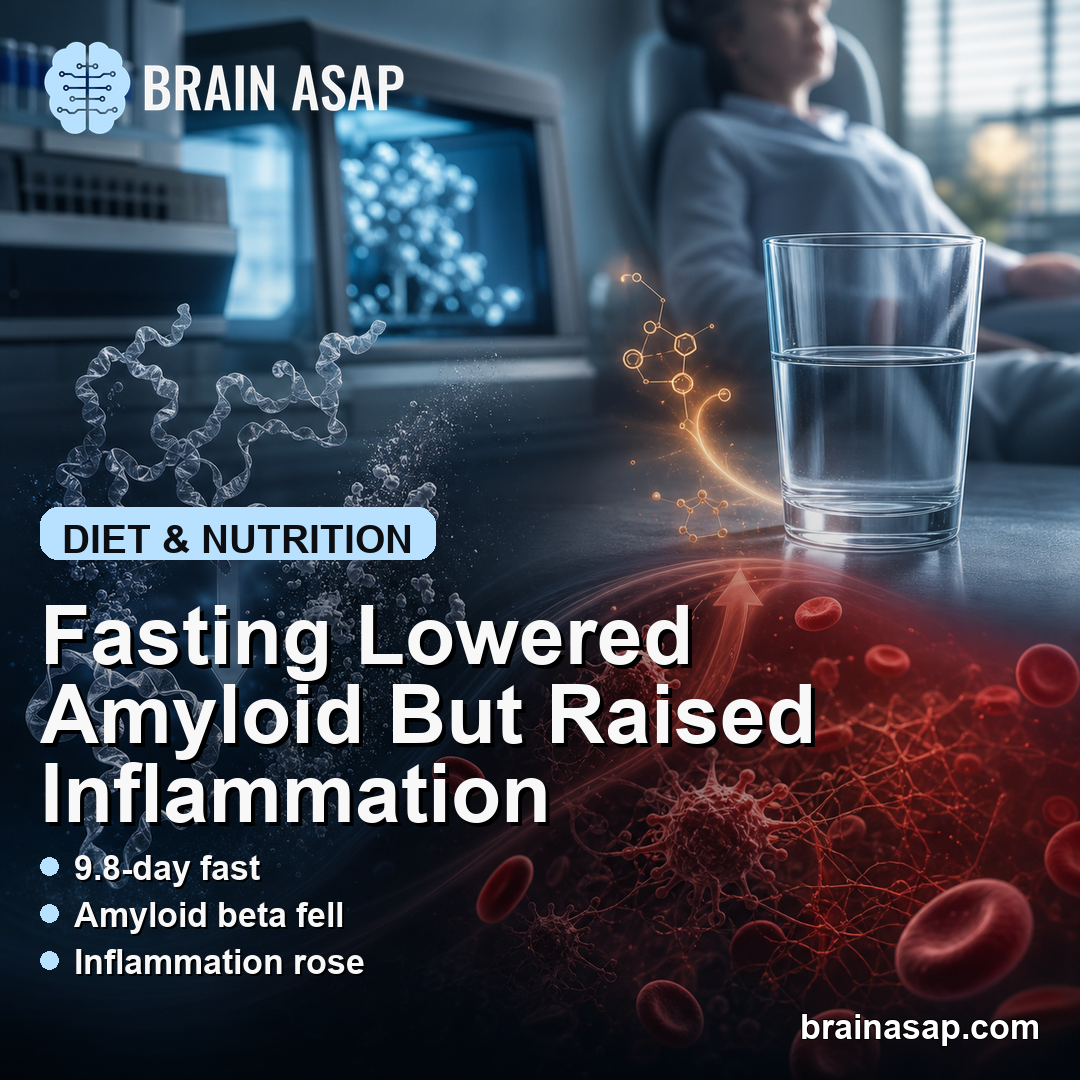
TL;DR: A 2025 human proteomics study in Molecular Metabolism found that about 10 days of medically supervised water-only fasting caused weight loss and lower circulating amyloid beta proteins, but also increased inflammatory and platelet-activation markers.
Key Findings
- 20 volunteers: The main cohort included 20 middle-aged adults with mean age 52.2 years and mean BMI 28.8 kg/m2.
- 9.8-day fast: Participants completed a medically supervised water-only fast averaging 9.8 days, followed by 5.3 days of guided refeeding.
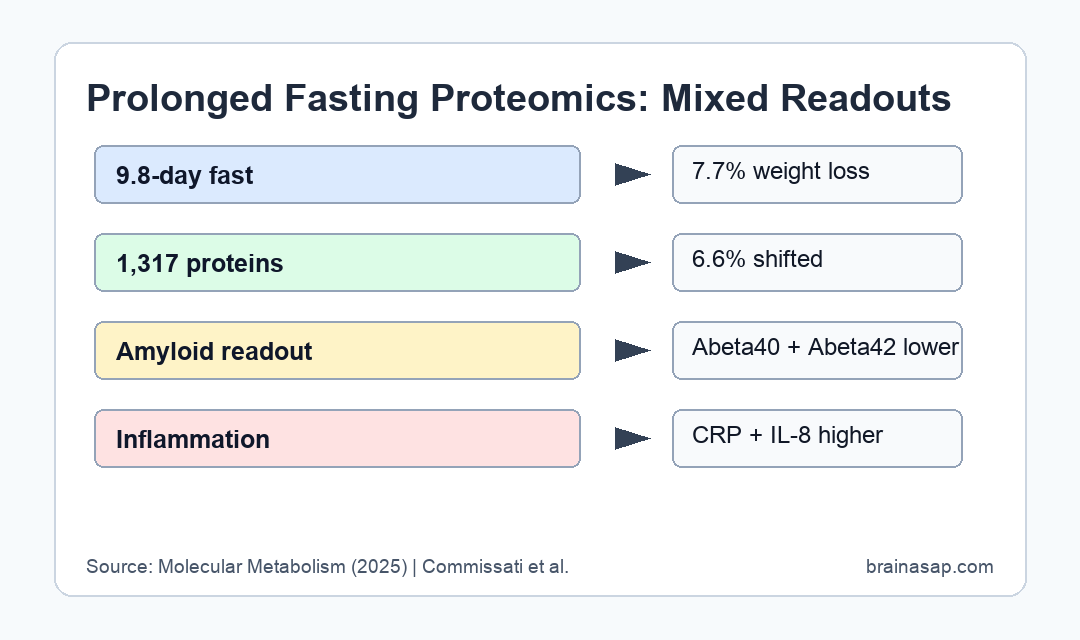
- 7.7% weight loss: Fasting caused a mean 7.7% weight loss and increased beta-hydroxybutyrate, confirming a fasting metabolic state.
- 1,317 proteins: SOMAScan plasma proteomics found significant shifts in 6.6% of measured proteins during fasting.
- Inflammation signal: Fasting increased CRP, hepcidin, midkine, IL-8, TGF-beta signaling, platelet degranulation, and complement/coagulation pathways.
Source: Molecular Metabolism (2025) | Commissati et al.
Prolonged fasting is often discussed as an anti-inflammatory or longevity intervention. This study complicates that story by measuring 1,317 circulating proteins before, during, and after a medically supervised fast.
The most BrainASAP-relevant result is the mixed profile: lower circulating amyloid beta proteins appeared alongside a clear acute inflammatory response.
Water-Only Fasting Lasted About 10 Days Under Medical Supervision
The main study recruited 20 middle-aged volunteers at a fasting clinic. Participants averaged 52.2 years of age, and mean BMI was 28.8 kg/m2.
The protocol involved an average 9.8-day water-only fast, followed by an average 5.3 days of guided refeeding with a plant-based diet. Blood and urine were collected in the morning to reduce time-of-day variation.
- Weight change: Participants lost an average of 7.7% of baseline body weight during fasting.
- Ketone marker: Serum beta-hydroxybutyrate increased from 0.6 to 5.0 mmol/L, confirming the fasting metabolic state.
- Proteomics panel: SOMAScan measured 1,317 plasma proteins, with targeted mass spectrometry and ELISA checks for selected biomarkers.
Several adverse events were reported, including headache, weakness, fatigue, insomnia, dry mouth, and orthostatic hypotension. 6 participants transitioned to broth or juice fasting when needed.
Fasting Shifted 6.6% of Plasma Proteins, Mostly Transiently
Untargeted plasma proteomics showed that fasting changed 6.6% of the measured plasma proteome. After refeeding, less than 1% of proteins remained significantly altered, suggesting that many changes were transient.
The protein changes were not all pointing in one simple direction. Some pathways fit expected fasting biology, while others raised safety questions.
- Metabolic adaptation: Fasting altered IGF and PPAR-alpha signaling, consistent with growth and lipid-metabolism shifts.
- Cell signaling: PTEN, STAT3, and MAPK pathways changed during limited nutrient availability.
- Inflammatory response: TGF-beta signaling and acute-phase markers increased, contrary to a simple anti-inflammatory story.
Researchers also compared results with 2 external fasting datasets. That added context helps, but the main trial was still small and selected for people willing to undergo supervised prolonged fasting.
Amyloid Beta 40 and 42 Fell During Fasting
One notable finding was a reduction in circulating amyloid beta proteins Abeta40 and Abeta42. These proteins are best known as components of amyloid plaques in Alzheimer’s disease, although blood levels do not directly equal brain plaque burden.
Researchers reported reduced amyloid fiber formation and lower circulating Abeta40 and Abeta42, while the Abeta40/Abeta42 ratio did not change. Targeted methods validated the result and external fasting cohorts provided additional checks.
- What changed: Circulating Abeta40 and Abeta42 decreased during prolonged fasting.
- What did not change: The amyloid beta ratio was not affected in the same way.
- Interpretive limit: The study did not measure brain amyloid with positron-emission tomography, cognition, or dementia risk.
- Brain-aging relevance: The result gives a measurable molecular link between fasting and amyloid-related blood biology.
This molecular change is worth studying, not a reason to treat prolonged fasting as an Alzheimer’s prevention strategy. The clinical relevance of short-term blood amyloid changes remains uncertain.
Inflammation and Platelet Activation Increased Instead of Falling
The strongest caution is that prolonged fasting increased inflammatory markers. Plasma C-reactive protein, hepcidin, midkine, and IL-8 rose during fasting.
A retrospective cohort of 1,422 individuals undergoing modified fasting also showed CRP increasing from 2.8 to 4.3 mg/L. The acute-phase response was accompanied by platelet degranulation and complement/coagulation pathway activation.
- Possible benefit: Weight loss, ketosis, and amyloid-related protein changes may interest metabolic and brain-aging researchers.
- Possible drawback: Inflammation, platelet activation, and coagulation markers raise cardiometabolic concerns.
- Practical boundary: The study supports medical supervision and individualized risk assessment, not unsupervised long fasts.
The balanced interpretation is straightforward. Prolonged fasting produced measurable molecular changes, but the profile was not uniformly anti-inflammatory or clearly brain-protective.
Small Supervised Cohort Limits Direct Wellness Claims
The study is informative because it measured many proteins with repeated sampling, but the main intervention cohort was small. A group of 20 fasting-clinic volunteers cannot represent the safety profile for older adults, frail patients, people with diabetes, or people taking cardiovascular medications.
The fasting protocol was also medically supervised. Medical oversight is central because researchers reported symptoms and clinically relevant adverse events, including orthostatic hypotension, palpitations, arrhythmia, hypokalemia, abdominal pain, and diarrhea in some participants.
- Brain-aging boundary: Lower blood Abeta40 and Abeta42 are notable molecular readouts but not proof of lower brain amyloid.
- Cardiometabolic concern: CRP, platelet degranulation, and coagulation markers argue for caution in people with clotting or vascular risk.
- Best interpretation: Prolonged fasting is a biologically powerful stressor with mixed molecular effects, not a simple anti-aging shortcut.
Future studies would need larger, more diverse cohorts, longer follow-up, clinical endpoints, and direct brain measures before the amyloid-related change can be interpreted as neuroprotective.
Citation: DOI: 10.1016/j.molmet.2025.102152. Commissati et al. Prolonged fasting promotes systemic inflammation and platelet activation in humans: A medically supervised, water-only fasting and refeeding study. Molecular Metabolism. 2025;96:102152.
Study Design: Human fasting and refeeding proteomics study with external dataset comparisons.
Sample Size: Main cohort of 20 volunteers, plus retrospective modified-fasting validation for CRP in 1,422 individuals.
Key Statistic: Fasting shifted 6.6% of 1,317 measured proteins and increased CRP from 2.8 to 4.3 mg/L in the retrospective cohort.
Caveat: The study did not measure brain amyloid, cognition, dementia outcomes, or long-term clinical risk after fasting.