Mediterranean Diet Linked Mitochondrial Microproteins
TL;DR: Mediterranean diet adherence tracked with higher mitochondrial microproteins Humanin and SHMOOSE in older adults, pointing to a possible mitochondrial route for healthy-aging benefits.
Key Findings
- Higher adherence tracked with SHMOOSE: Patients with stronger Mediterranean diet adherence showed higher circulating SHMOOSE levels.
- Humanin moved with diet and Nox2: Humanin was linked to Mediterranean diet adherence and appeared in a Humanin-Nox2 oxidative-stress relationship.
- 49 older AF patients were analyzed: The cross-sectional sample had a mean age of 78.4 years and came from a non-valvular atrial fibrillation cohort.
- Oxidative stress was measured directly: The study used sNox2-dp and 8-iso-PGF2alpha as oxidative-stress readouts.
- Mitochondria became the diet mechanism: The result frames diet quality as a possible modulator of mitochondrial signaling rather than only lipid or glucose risk.
Source: Frontiers in Nutrition (2025) | Vicinanza et al.
The Mediterranean diet is usually discussed through olive oil, fiber, fish, and cardiometabolic risk. This paper points to a smaller signal: microproteins encoded by mitochondrial DNA. In older adults with atrial fibrillation, better diet adherence aligned with circulating Humanin and SHMOOSE, two molecules tied to aging, stress biology, and neuroprotection.
Diet Quality Met the Mitochondrial Genome
The intriguing move here is biological scale. The Mediterranean diet is a whole dietary pattern, but the proposed mediator is tiny: a microprotein made from mitochondrial DNA.
Humanin and SHMOOSE are not standard nutrition markers. They sit closer to mitochondrial stress adaptation, aging biology, and cellular resilience, all of which are relevant to brain aging and neurodegeneration.
The paper’s value is that it does not stop at a familiar diet score. It asks whether a healthy dietary pattern leaves a measurable trace in mitochondrial signaling, a layer of biology that could connect nutrition to cellular repair and oxidative stress.
- Diet layer: Mediterranean diet adherence captured the broader eating pattern rather than one nutrient.
- Mitochondrial layer: Humanin and SHMOOSE served as circulating signals linked to mitochondrial biology.
- Stress layer: sNox2-dp and 8-iso-PGF2alpha helped place the microproteins in an oxidative-stress context.
Humanin and SHMOOSE Were Not Just Decorative Biomarkers
The study measured circulating Humanin and SHMOOSE with in-house sandwich ELISAs, then compared them with Mediterranean diet adherence and oxidative stress markers. High adherence was found in 20 participants, while 29 had low-to-medium adherence.
The main signal was that better adherence aligned with higher mitochondrial microprotein levels. That does not prove the diet caused the change, but it gives the Mediterranean diet a more specific molecular handle.
Humanin has been studied as a stress-responsive peptide with links to cell survival and age-related disease biology. SHMOOSE is newer, but it has also been discussed in the context of mitochondrial function and aging-related vulnerability.
The biomarker choice goes beyond a generic inflammation panel. The authors were looking for signals close to the machinery that helps cells manage energetic stress.
The cohort matters too. These were older adults with non-valvular atrial fibrillation, a cardiovascular condition tied to age, vascular risk, and systemic stress. That is not the same as a general healthy-aging sample, but it is a biologically relevant place to look for mitochondrial signals.
Nox2 Connected Olive Oil, Mitochondria, and Oxidative Stress
Nox2 is part of a reactive-oxygen-generating system, and sNox2-dp was used as a marker of its activation. The Humanin-Nox2 link suggests a possible route by which diet-associated mitochondrial signaling relates to oxidative stress.
For aging brains, oxidative stress and mitochondrial dysfunction are not side notes. They are recurring features in cognitive decline, vascular disease, and neurodegenerative vulnerability.
The Mediterranean diet has often been connected to lower cardiometabolic and cognitive risk. This study adds a possible mechanistic bridge: diet quality may relate to molecules that help mitochondria communicate cellular stress.
Humanin and SHMOOSE are not the whole explanation. They can become measurable readouts in trials that try to move from food-pattern advice to testable biology.
The Small Sample Keeps the Claim Narrow
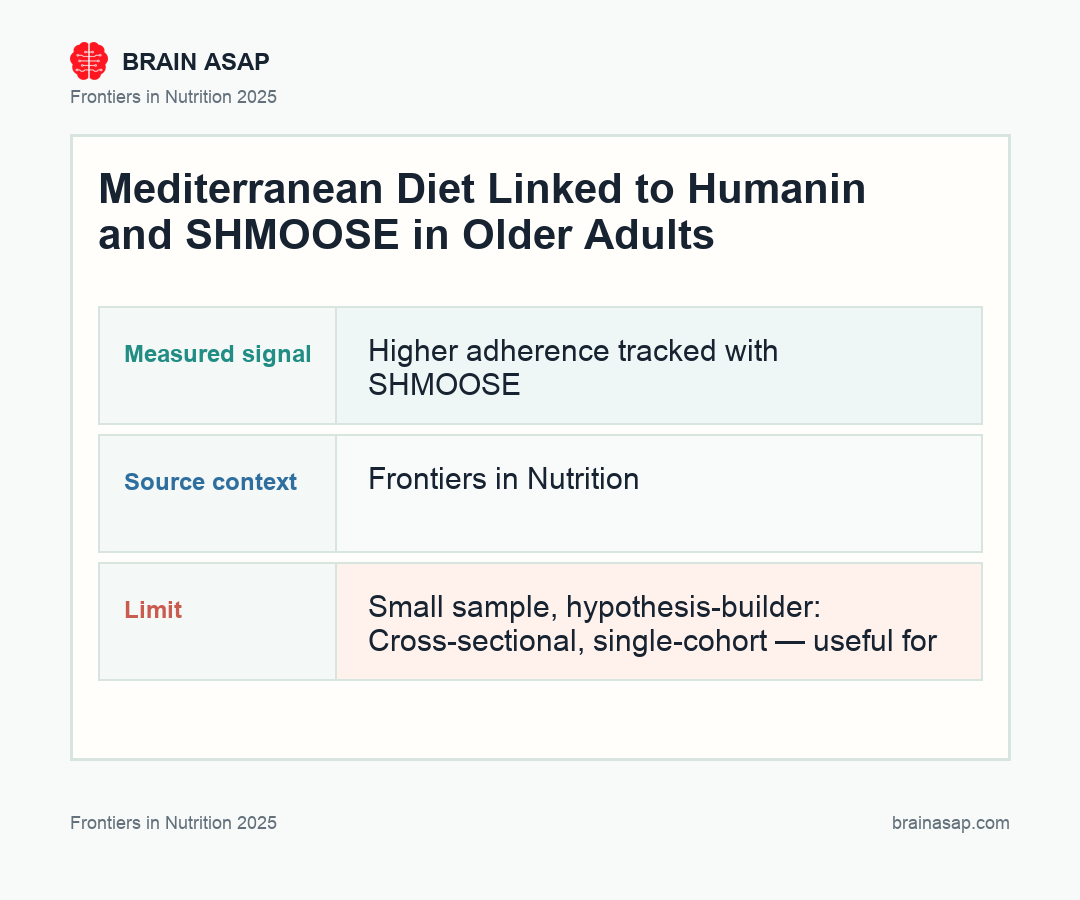
This was a cross-sectional analysis of 49 older adults with atrial fibrillation, so it is better suited to hypothesis-building than causal certainty.
The stronger takeaway is that mitochondrial microproteins can help explain why dietary patterns matter. A stronger study would follow Humanin and SHMOOSE over time after diet change.
Cross-sectional studies are snapshots. They can show that diet adherence and biomarkers travel together, but they cannot show which one moved first or whether a third factor shaped both.
People with higher Mediterranean diet adherence may differ in medication use, physical activity, socioeconomic context, frailty, supplement intake, or clinical monitoring. Those factors can matter a lot in a small older cohort.
The next step would be a prospective diet intervention with repeated sampling. If Humanin and SHMOOSE rise after a structured Mediterranean diet program, the causal argument would become much stronger.
Atrial Fibrillation Made This a Stress-Biology Signal
The article is not saying a Mediterranean diet instantly raises brain-protective peptides in everyone. It is saying that diet adherence may leave a measurable mitochondrial signature.
That is a better explanation than generic superfood language. It makes nutrition biology specific enough to test.
The sharper frame is healthy aging under biological stress. Atrial fibrillation, vascular risk, oxidative stress, and mitochondrial function all touch the brain through blood flow, inflammation, and energy metabolism.
The Mediterranean diet may help because it is a pattern, not because one ingredient carries the whole story. Olive oil, fish, legumes, vegetables, nuts, and lower ultra-processed food intake can converge on vascular and metabolic resilience.
Microproteins give that broad pattern a sharper endpoint. Instead of asking only whether people report better diets, future studies can ask whether diet change shifts mitochondrial stress signaling in a direction that matches healthier aging.
That is especially relevant for brain aging because neurons are energy-demanding cells. They depend on mitochondrial stability, vascular support, and controlled oxidative signaling. A dietary pattern that nudges those systems in a favorable direction would not need to act like a drug to matter over years.
The atrial-fibrillation cohort also keeps the finding grounded in people who already carry vascular and inflammatory stress. The sample is less general, but the biology may be more visible. Subtle mitochondrial signals can be easier to detect when the system is under strain.
The next version of this work should connect diet change, microprotein change, oxidative-stress change, and clinical outcomes in the same participants. Until then, Humanin and SHMOOSE are best read as promising mechanistic breadcrumbs, not proof that one diet score directly protects the brain.
The finding is small, but it gives nutrition research a more concrete molecular target. Long-term dietary patterns may matter partly because they change the stress systems that keep heart, brain, and aging cells metabolically stable.
That is the useful editorial balance. The study should not be sold as another Mediterranean-diet miracle, but neither should its small size make the mechanism disposable. It points to a testable bridge between food pattern, mitochondrial communication, oxidative stress, and aging biology.
If future trials can move those microproteins with diet, the field gets a sharper endpoint than memory scores alone.
For now, the right claim is modest: diet quality can touch mitochondrial aging signals in measurable ways.
That modest claim is still worth testing because it connects nutrition advice to biology researchers can actually follow.
That is where nutrition science gets more honest and more useful.
That endpoint could be especially valuable in prevention studies, where clinical brain outcomes may take years to separate.
Paper: Mediterranean diet adherence is associated with mitochondrial microproteins Humanin and SHMOOSE; potential role of the Humanin-Nox2 interaction in cardioprotection. Frontiers in Nutrition. 2025. DOI: 10.3389/fnut.2025.1727012
Authors: Vicinanza et al.
Study Design: Cross-sectional biomarker analysis.
Sample Size: 49 older adults with non-valvular atrial fibrillation.
Key Statistic: High Mediterranean diet adherence was associated with higher SHMOOSE and Humanin-related oxidative-stress signaling.