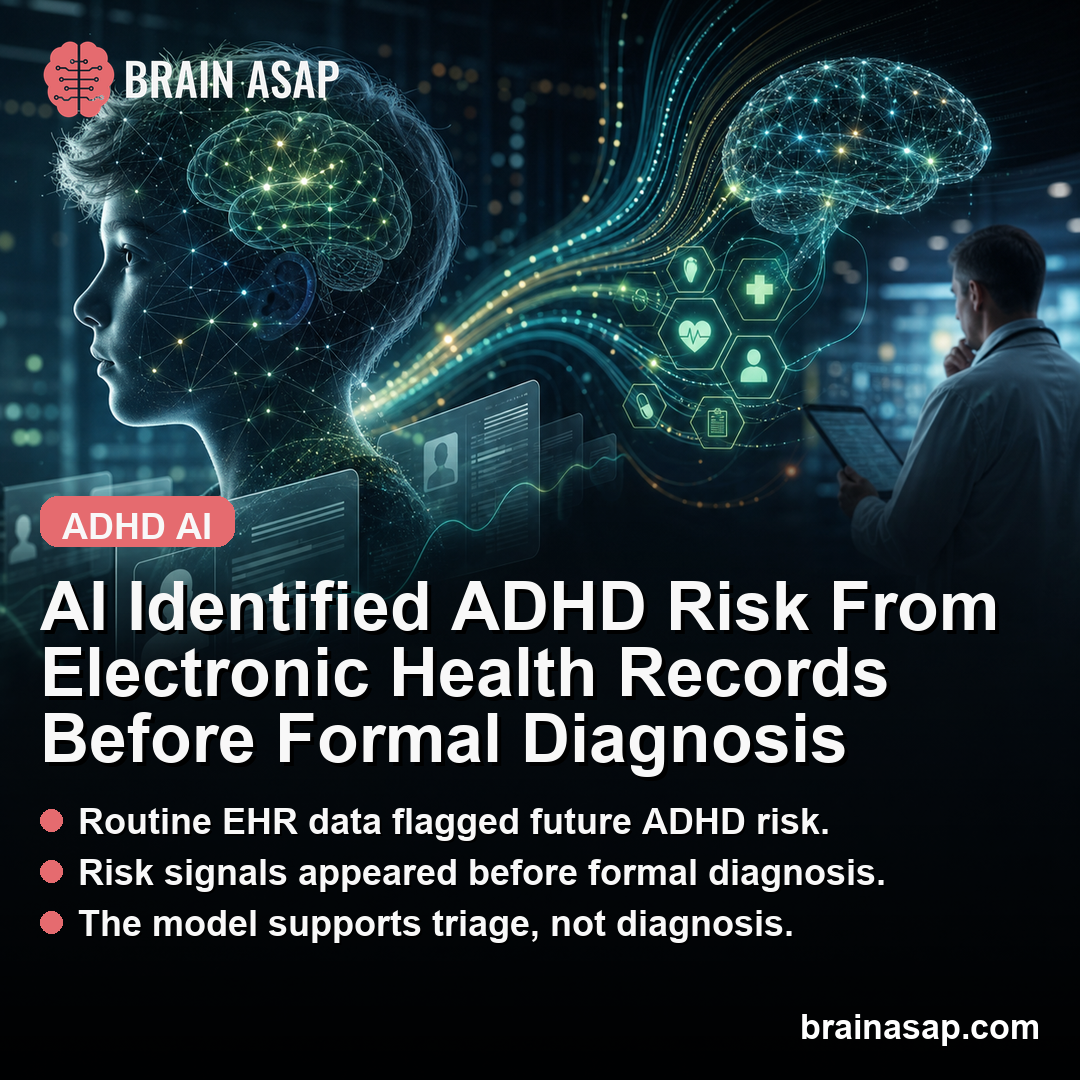
TL;DR: A 2026 study in Nature Mental Health describes an AI system that scans routine electronic health records (EHRs) and combines early-life visits, prescriptions, and comorbidities into a risk flag for ADHD evaluation before formal diagnosis.
Key Findings
- AI flagged ADHD risk from routine EHR data alone: The model identified patterns predictive of future ADHD diagnosis using ordinary clinical records — visits, prescriptions, comorbidities, lab patterns — without specialized cognitive testing or behavioral rating scales.
- Risk signals appeared before formal diagnosis: The model’s flags preceded the eventual ADHD diagnosis in many cases, identifying at-risk individuals early in the clinical pathway.
- The “hidden patterns” are combinations, not single features: No individual EHR variable was strongly diagnostic; the predictive power came from how features combined — exactly the kind of multi-variable pattern AI is suited to detect.
- Aim is triage, not diagnosis: The system is positioned as a flag for further clinical evaluation, not a replacement for the structured ADHD diagnostic process.
- Can shrink time-to-diagnosis: If validated and deployed, the approach can compress the years often spent between symptom onset and formal diagnosis — particularly relevant for adults with undiagnosed ADHD.
- Privacy and equity concerns travel with this: EHR-based AI risk-flagging raises real questions about consent, deployment context, and whether patterns generalize across populations.
Source: Nature Mental Health (2026)
The standard ADHD diagnostic pathway has a timing problem. Children are often diagnosed only after teachers or parents flag academic or behavioral struggles.
Adults frequently receive diagnoses after years of unidentified difficulty with focus, follow-through, and emotional regulation. Earlier identification can enable earlier intervention, but pediatricians and primary care doctors do not have the time or specialized training to systematically screen every patient.
Routine EHR data, however, is already there. It’s just not being used.
Why ADHD Is Diagnosed Late More Often Than Early
The structural delays in ADHD identification are well-documented:
- Symptom-driven diagnostic pathway: Most diagnoses follow visible academic, occupational, or relationship struggles — meaning the diagnosis usually comes after the impairment has already accumulated.
- Inattentive subtype is especially under-detected: Children whose ADHD presents as inattention rather than hyperactivity often fly under the radar of behavior-based screening.
- Adult ADHD is frequently missed entirely: Many adults reach 40 or 50 before recognition, often after one of their children gets diagnosed and they recognize the same patterns in themselves.
- Specialized assessment is bottlenecked: Comprehensive ADHD evaluation requires trained clinicians, structured interviews, and rating scales that aren’t available to every primary care setting.
The delay has clinical consequences because earlier identification enables earlier intervention — academic accommodations, behavioral strategies, and (when appropriate) medication that can reduce the cumulative impairment of unidentified ADHD.
Routine EHR Variables Combined Into an ADHD Risk Signal
The AI approach the Nature Mental Health team developed doesn’t look for one diagnostic feature. It looks for combinations of routine clinical variables that, taken together, predict eventual ADHD diagnosis better than any single variable alone:
- Visit frequency patterns — how often, for what kinds of complaints, with what timing.
- Prescription histories — including non-ADHD medications that correlate with the ADHD-risk profile.
- Comorbid condition patterns — anxiety, depression, sleep problems, learning difficulties, certain medical conditions that cluster with ADHD.
- Healthcare utilization patterns — emergency visits, missed appointments, prescription refill timing.
None of these features individually flags ADHD. But the AI assembles them into a probabilistic pattern that, in retrospect, distinguished people who were eventually diagnosed from people who were not.
The hidden pattern was present in ordinary clinical data but not visible to clinicians scanning charts one feature at a time.
How EHR AI Can Reshape ADHD Identification at Scale
If the system validates in independent cohorts, several deployment scenarios become plausible:
- Primary care alerting: Routine EHR review can flag patients whose patterns match the high-risk profile for primary-care discussion and possible specialist referral.
- Pediatric early identification: Children with the risk signature can be evaluated before academic problems consolidate.
- Adult screening at major life transitions: Patterns can be reviewed at events that often surface adult ADHD — career changes, parenting, returning to education.
- Health-system-level intervention planning: Aggregate risk profiling can help allocate ADHD specialist resources to where they’re most needed.
The use case isn’t replacing diagnosis. It’s finding the people who would benefit from getting evaluated and aren’t currently being evaluated.
The Concerns That Have to Travel With AI Mental Health Screening
EHR-based AI risk-flagging raises legitimate concerns even when the technology works:
- Consent and patient awareness: Should patients be told their EHR is being scanned for psychiatric risk? Who sees the flag?
- False positives matter clinically. A false ADHD risk flag can lead to unnecessary evaluation, anxiety, or labeling — particularly for children.
- Generalization across populations is unproven. A model trained on one health system’s records does not automatically work in different demographic, geographic, or socioeconomic contexts. Bias in training data becomes bias in flags.
- Insurance and employment implications: If risk flags become discoverable beyond the clinical setting, the patient impact extends to coverage decisions and workplace consequences.
- Diagnostic threshold ambiguity: ADHD already has a contested diagnostic threshold. AI risk flags don’t resolve that — they amplify the question of where to draw the line.
The Honest Boundary: This Is Triage Tech, Not Diagnosis Tech
The study’s careful claim is that EHR-based AI can identify likely candidates for further ADHD evaluation, not diagnose ADHD itself. That distinction changes both deployment and interpretation:
- Clinical conversation: A model flag is a starting point, not a diagnostic answer.
- Structured assessment: ADHD interviews, rating scales, and functional-impairment evaluation remain the diagnostic standard.
- Decision boundary: The AI’s job is to direct attention, not to make decisions.
- Prospective validation: The next research step is testing whether early flags improve outcomes beyond retrospective accuracy.
AI Screening Still Needs Prospective Outcome Testing
EHR-based AI screening is increasingly applied across psychiatry — for depression, suicide risk, psychosis, and now ADHD. The common pattern is that mental health conditions leave subtle clinical traces years before formal diagnosis, and machine learning is unusually well-suited to assembling those traces into predictive patterns.
The translational test is the same across applications: can these systems improve outcomes by getting people evaluated earlier, without producing harms (false flags, equity gaps, autonomy violations) that exceed the benefit?
The Nature Mental Health study extends that test to ADHD, where the case for earlier identification is unusually clear because of the long-tail impairment that builds up during years of unrecognized symptoms.
If the model deploys cleanly, the clinical pipeline for ADHD can compress meaningfully. If it deploys badly, false flags, bias, and opaque review processes can amplify the same problems that affect other AI mental health tools.
The Nature Mental Health study is the proof-of-concept; deployment work determines whether the system helps patients or adds another noisy clinical alert.
Citation: DOI: 10.1038/s44220-026-00628-2. AI Turn “Hidden Patterns” Into ADHD Insights. Nature Mental Health. 2026
Study Design: Machine learning analysis of electronic health records to identify multi-variable patterns predicting eventual ADHD diagnosis; retrospective validation against clinical diagnoses with risk flags positioned as triage signals for further clinical evaluation.
Sample Size: See full publication for cohort details.
Key Statistic: AI model identified patterns in routine EHR data (visits, prescriptions, comorbidities, utilization) that predicted future ADHD diagnosis before formal clinical recognition; predictive signal came from feature combinations rather than single variables.
Caveat: Model is for triage and flagging, not diagnosis; cross-population generalization, false-positive cost, consent, and deployment-context concerns require careful clinical implementation; whether prospective deployment improves outcomes vs current practice is the next research step.