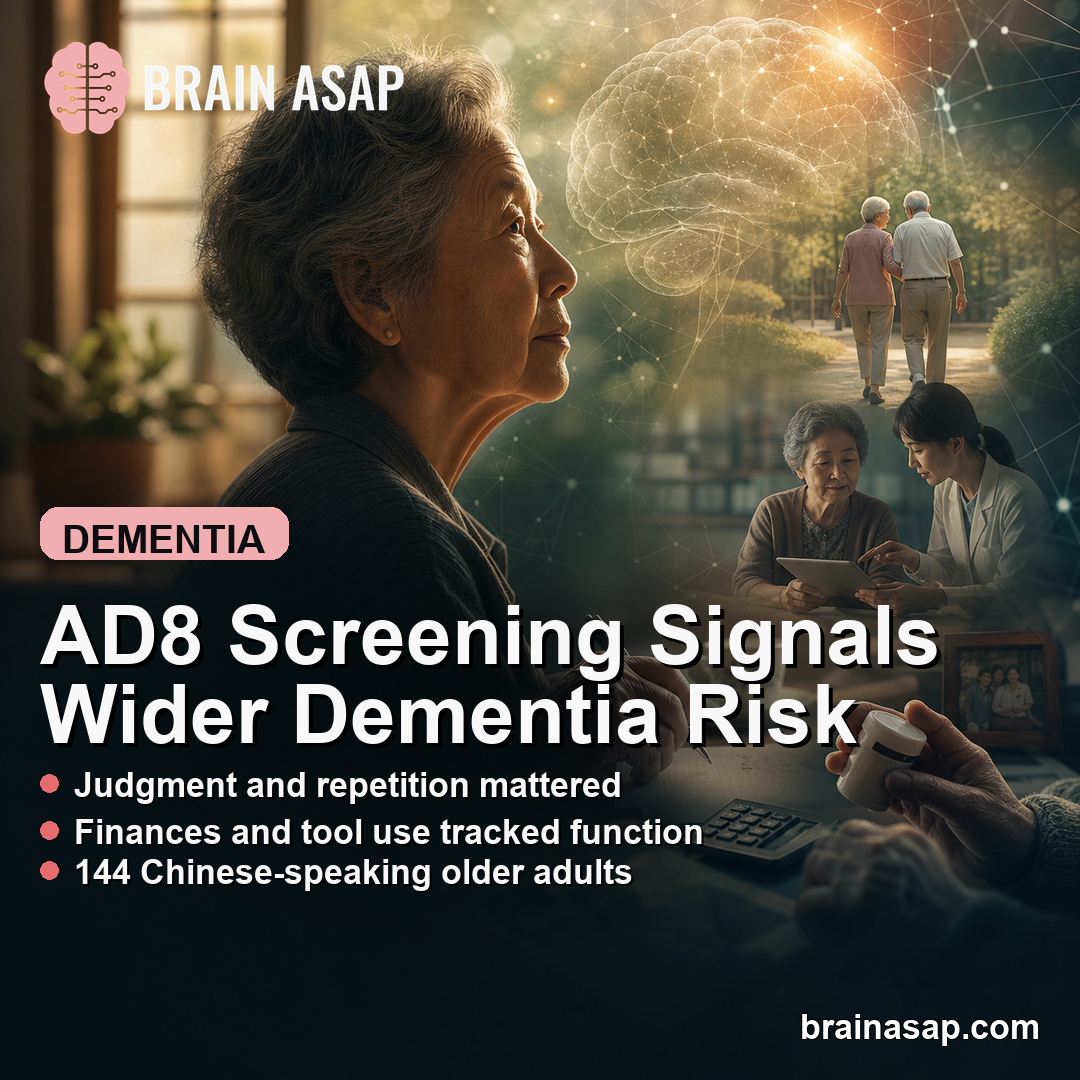
TL;DR: A 2026 medRxiv preprint found that specific AD8 dementia-screening items, especially judgment, repetition, finances, tool use, and daily memory problems, tracked functional and psychosocial vulnerability in 144 Chinese-speaking older adults.
Key Findings
- Small community sample: The cross-sectional study included 144 Chinese-speaking adults with a mean age of 73.1 years.
- Three AD8 domains: Exploratory factor analysis grouped the eight items into memory impairment, executive/interest decline, and functional recall difficulties, explaining 61.7% of variance.
- Functional items mattered: Financial-management and tool-use difficulties were linked with mobility challenges and poorer wellbeing.
- Emotional vulnerability overlapped: Repetition, judgment problems, and daily memory issues were associated with hopelessness, helplessness, emptiness, or worthlessness.
- Main caveat: The preprint was cross-sectional and self-reported, so it cannot show that AD8 changes caused later dementia or distress.
Source: You et al. 2026 medRxiv preprint.
AD8 Screening Was Tested in 144 Chinese-Speaking Older Adults
The AD8 Dementia Screening Interview is an eight-item screen for perceived changes in judgment, memory, repetition, interest, appointments, finances, and daily functioning.
In this study, researchers used the AD8 as a self-report community screening tool rather than as a formal dementia diagnosis.
The sample included 144 community-dwelling Chinese-speaking older adults recruited through community organizations in Australia. Participants had a mean age of 73.1 years, and 81.3% were women.
Health burden was common. The paper reported that 68.1% had at least one chronic disease, while 13.2% reported a diagnosed mental health disorder.
The researchers also collected items from the 15-item Geriatric Depression Scale (GDS-15), a late-life depression-symptom questionnaire, to examine psychosocial vulnerability.
The questionnaire was bilingual and designed for people who used Mandarin or Cantonese in community settings. Cognitive screening can miss or distort early symptoms when language, cultural expectations, or stigma make standard clinic tools harder to use.
- Screening measure: AD8 items captured perceived changes in judgment, memory, repetition, interest, tool use, finances, appointments, and daily thinking.
- Psychosocial measure: GDS-15 items were used as vulnerability indicators, not as a clinical diagnosis of depression.
- Functional measures: The study tracked tiredness, stair climbing, walking distance, chronic disease, diagnosed illness, and recent weight loss.
AD8 Items Split Into Memory, Executive, and Functional Recall Domains
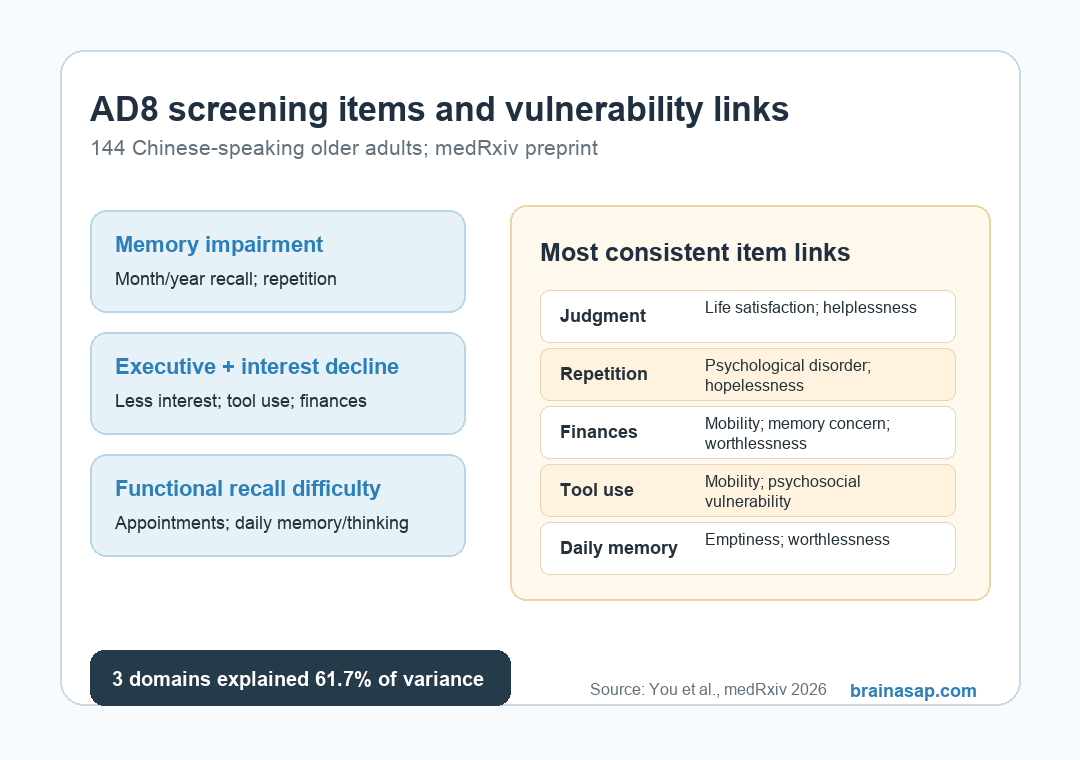
Exploratory factor analysis found a three-domain AD8 structure. The domains were memory impairment, executive and interest decline, and functional recall difficulties. Together, those domains explained 61.7% of variance.
The strongest memory-domain loading came from forgetting the correct month or year. Reduced interest in hobbies and activities loaded strongly on the executive/interest domain, while appointment memory and daily memory problems loaded on the functional recall domain.
The AD8 is often discussed as a short dementia screen. Here, the item pattern suggested that different AD8 items may point toward different kinds of real-world vulnerability.
The paper also reported satisfactory internal consistency for the eight-item scale, with Cronbach’s alpha of .685. That does not make the tool diagnostic by itself, but it supports treating the items as related indicators rather than isolated yes/no responses.
Judgment, Repetition, Finances, and Tool Use Carried the Main Findings
The clearest associations came from a smaller set of AD8 items. Judgment problems, repetition, financial-management difficulty, tool-use difficulty, and daily memory problems appeared most consistently across health, functional, and psychosocial outcomes.
Financial-management difficulty was linked with age and mobility challenges. Tool-use difficulty was also linked with mobility limitations, which makes practical sense: learning or using appliances can combine memory, attention, motor confidence, and daily independence.
Repetition was notable because it predicted diagnosed psychological disorders and hopelessness in the regression models. The paper did not show whether repetitive questioning caused distress, reflected distress, or came from a shared underlying vulnerability.
That uncertainty is clinically important. A person who repeats statements or struggles with finances may need cognitive follow-up, but they may also need support for mood, daily functioning, medication management, mobility, or family communication.
- Judgment problems: Associated with lower life satisfaction, lower positive affect, and greater helplessness.
- Repetition: Associated with multimorbidity, diagnosed psychological disorders, and hopelessness.
- Financial difficulty: Associated with mobility limitations, memory concerns, and feelings of worthlessness.
- Tool-use difficulty: Associated with mobility limitations and psychosocial vulnerability.
Psychosocial Outcomes Were More Sensitive Than Some Health Outcomes
The AD8 items did not predict every outcome. The paper reported weaker or non-significant associations for boredom, social withdrawal, energy, and some general health measures.
Psychosocial indicators were more sensitive. Judgment difficulty tracked lower life satisfaction and greater helplessness.
Daily memory problems were linked with emptiness and worthlessness. Financial and tool-use problems also pointed toward poorer perceived wellbeing.
The study frames these findings as a reason to interpret brief cognitive screens in a broader context.
A reported change in finances or tool use may be clinically relevant even when a person does not yet have a formal dementia diagnosis.
- Not a dementia diagnosis: AD8 item endorsement should trigger closer assessment, not an automatic label.
- Not only memory: Executive and functional items may catch vulnerability that a memory-only screen misses.
- Cultural context: The sample was mostly Chinese-speaking, and dementia stigma or language barriers may shape what people report.
The Preprint Supports Broader Community Screening, With Limits
In community settings, the AD8 may help clinicians and community health workers notice early vulnerability across cognition, daily function, and emotional wellbeing.
The limitation is central to the finding. This was a cross-sectional preprint with self-reported cognitive change and a relatively small, mostly female community sample.
The study cannot prove that AD8 item changes predict future dementia, and some regression models may be unstable because certain outcomes were uncommon.
Still, the paper gives a concrete reason to look beyond a total screen score. In this sample, specific AD8 items carried different practical meanings, especially for finances, tool use, repetition, judgment, and daily memory.
Citation: DOI: 10.64898/2026.04.08.26350424. You et al. Pre-Dementia Indicators and Multidomain Vulnerabilities: Insights from AD8 Screening in Older Chinese Speaking Adults. medRxiv. 2026.
Study Design: Cross-sectional community study using AD8 screening items, selected GDS-15 psychosocial items, exploratory factor analysis, and logistic regression.
Sample Size: 144 community-dwelling Chinese-speaking older adults, mean age 73.1 years.
Key Statistic: Three AD8 domains explained 61.7% of variance; judgment, repetition, finances, tool use, and daily memory were the most consistent vulnerability indicators.
Caveat: The paper is a preprint, uses self-report, and cannot establish causal or longitudinal dementia prediction.