TL;DR: A 2026 placebo-controlled study in Human Psychopharmacology: Clinical and Experimental found that ebselen did not meaningfully reduce motor impulsivity, reflection impulsivity, delay discounting, or emotion-recognition outcomes in 130 healthy adults.
Key Findings
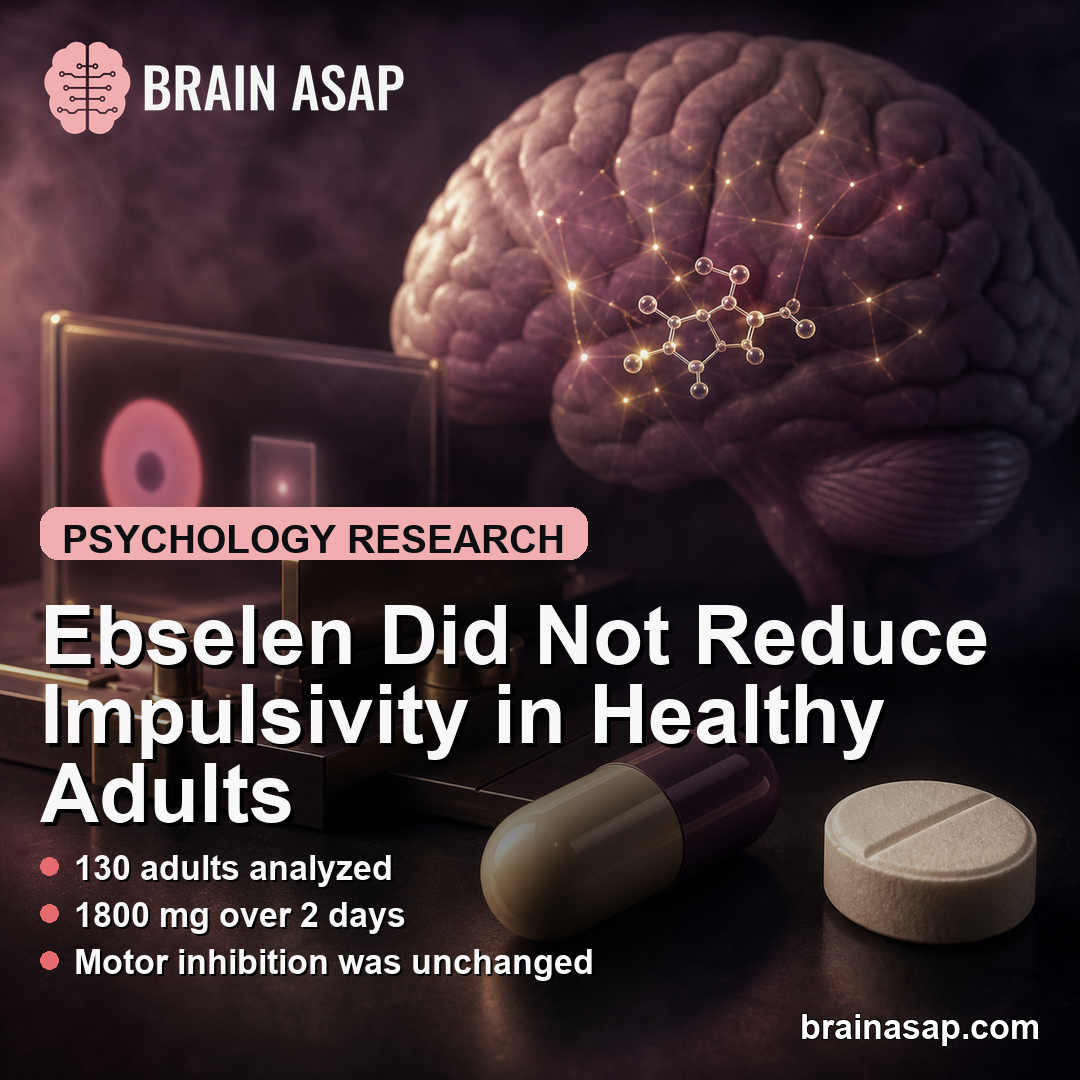
- 130 adults analyzed: The double-blind study compared 66 adults assigned to ebselen with 64 assigned to placebo.
- 1800 mg over 2 days: Participants received a dose previously shown to reduce medial prefrontal myo-inositol, a biochemical target linked to inositol monophosphatase inhibition.
- Motor inhibition was unchanged: Stop-signal response time did not differ meaningfully between ebselen and placebo groups (beta = -9.69 +/- 10.81).
- Delay discounting had no main effect: Titrating Alternatives and Monetary Choice Questionnaire outcomes did not show a clear ebselen advantage over placebo.
- Trait impulsivity did not rescue the result: Higher Barratt Impulsivity Scale scores did not reveal stronger anti-impulsive effects of ebselen.
Source: Human Psychopharmacology: Clinical and Experimental (2026) | John et al.
Ebselen Was Tested as a Lithium-Like Impulsivity Target
Ebselen is a bioavailable antioxidant that also inhibits inositol monophosphatase, often shortened to IMPase. That enzyme is relevant because lithium affects IMPase and can reduce impulsive behavior in some manic or high-risk clinical states.
The biological idea is tied to myo-inositol, a signaling molecule involved in phosphatidylinositol pathways. If reducing myo-inositol can change impulse-control circuitry, ebselen could offer a more targeted way to test that pathway than lithium itself.
The researchers focused on healthy adults rather than a clinical impulsivity sample. That choice makes the result cleaner for a mechanism test, but it also limits how far the finding can be stretched into addiction, mania, gambling disorder, or self-harm treatment.
130 Healthy Adults Completed a Double-Blind Protocol
The study enrolled 132 participants, then analyzed 130 after assignment to ebselen or placebo. The final groups were closely matched by age, sex, education, mood measures, and Barratt Impulsivity Scale scores.
Participants received treatment over 2 days before completing laboratory measures. The total ebselen dose was 1800 mg, a dose already linked in prior work to reduced medial prefrontal myo-inositol and changes in reward learning or emotional processing.
The design tested several forms of impulsivity rather than relying on 1 task:
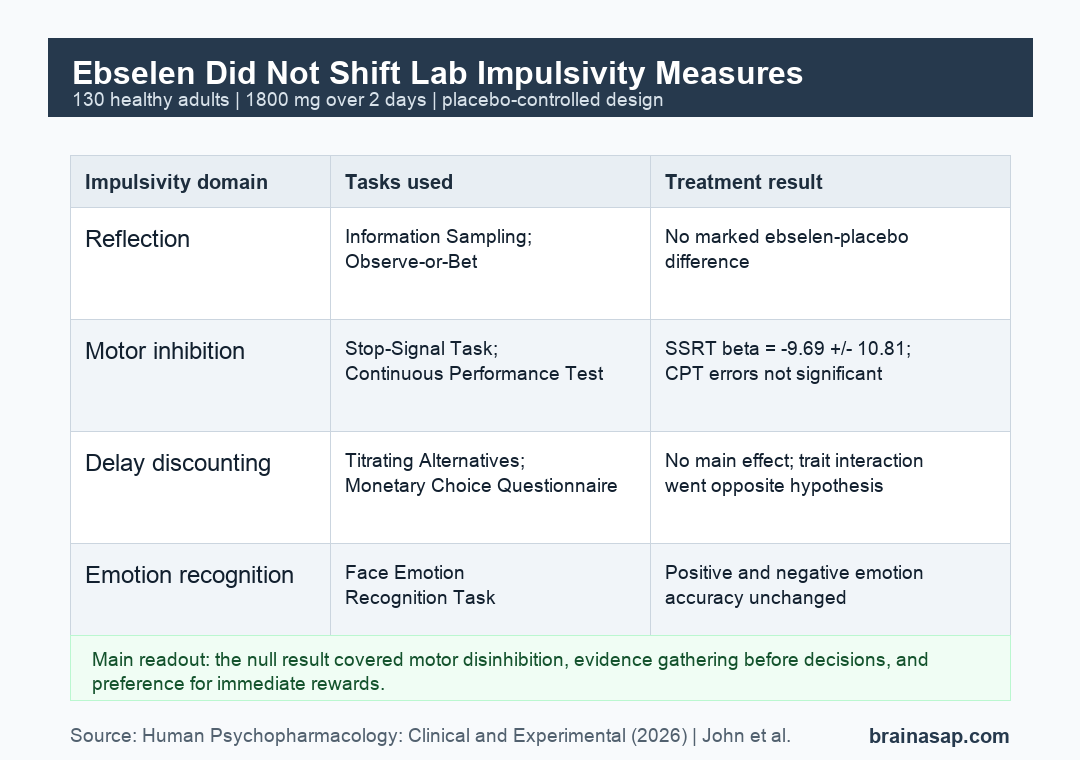
- Motor impulsivity: Stop-Signal Task and Continuous Performance Test measured response inhibition and commission errors.
- Reflection impulsivity: Information Sampling and Observe-or-Bet tasks measured how much evidence people gathered before deciding.
- Delay discounting: Titrating Alternatives and Monetary Choice Questionnaire tasks measured preference for smaller immediate rewards over larger delayed rewards.
- Emotion recognition: the Face Emotion Recognition Task checked whether ebselen shifted recognition of positive or negative facial expressions.
The researchers also tested whether people with higher trait impulsivity would show larger ebselen effects. That was important because a drug might have little visible effect in low-impulsivity volunteers but still matter in higher-risk groups.
Reflection Impulsivity and Motor Inhibition Stayed Similar
The reflection-impulsivity results did not support an ebselen effect. On the Information Sampling Task, ebselen participants opened slightly fewer boxes than placebo participants before choosing a majority color, but the estimate was small and imprecise.
On the Observe-or-Bet task, the groups had similar observation behavior and similar points earned. The placebo and ebselen groups averaged 41.90 and 42.70 points, respectively, a difference too small to carry a practical interpretation.
Motor inhibition also stayed close to placebo. Stop-signal data were available for 92 participants, and stop-signal response time showed no meaningful group difference.
The Continuous Performance Test result fit the same pattern:
- Commission errors: the ebselen group had a marginally higher error ratio, but the difference was not significant.
- Target reaction time: responses were fractionally faster under ebselen, 441 ms versus 446 ms, without a clear treatment signal.
- Overall interpretation: the drug did not produce a coherent improvement in stopping, sustained attention, or response control.
Delay Discounting Did Not Show the Expected Trait Pattern
Delay discounting asks how strongly someone prefers a smaller immediate reward over a larger delayed reward. Steeper discounting is often treated as a behavioral marker of impulsive choice.
The main ebselen-placebo comparison did not show gentler discounting under ebselen. Titrating Alternatives log k values, area under the curve values, and Monetary Choice Questionnaire discounting all lacked a clear main treatment effect.
The trait-impulsivity analysis was more complicated but still unfavorable for the original hypothesis. Ebselen was not more helpful in high-impulsivity participants.
Across discounting measures, the interaction went in the opposite direction from the predicted clinical signal:
- Lower non-planning impulsivity: ebselen was linked to marginally gentler delay discounting than placebo.
- Higher non-planning impulsivity: ebselen was linked to steeper discounting, meaning stronger preference for immediate rewards.
- Best reading: the researchers treated this as likely sampling error rather than evidence that ebselen worsens impulsive choice.
For interpretation, the secondary hypothesis was not just unsupported. The observed pattern did not point toward hidden benefit in people with higher trait impulsivity.
Emotion Recognition and Side Effects Also Stayed Close to Placebo
The Face Emotion Recognition Task did not replicate a positive emotion-recognition shift reported in some earlier ebselen studies. Accuracy for positive expressions was nearly identical: 75.60% versus 75.40%.
Negative-expression accuracy was also similar, at 48.20% versus 49.60%. Response times for positive and negative faces did not show a clear treatment effect either.
Side effects were broadly comparable between groups. Headache, stomach upset, nausea, fatigue, frequent urination, thirst, and dizziness did not separate ebselen from placebo in a clinically obvious way.
The practical conclusion is limited to the tested population and dose. In this healthy-adult sample, IMPase inhibition through ebselen did not look like a reliable way to reduce laboratory impulsivity.
The Null Result Narrows the Ebselen Impulsivity Hypothesis
The study had several strengths: double-blind assignment, a placebo control, preregistration, matched groups, open data, and a broader task battery than many small pharmacology experiments.
It also had important limits:
- Healthy volunteers: the sample did not consist of patients with addiction, bipolar mania, gambling disorder, or clinically severe impulsivity.
- Single dose level: earlier human work used 3600 mg over 2 days for some impulsivity findings, twice the dose tested here.
- Task sensitivity: laboratory tasks may miss real-world impulsive behavior, especially when baseline clinical risk is low.
- Multiple impulsivity systems: motor stopping, evidence gathering, and reward delay depend on overlapping but separable brain and neurotransmitter systems.
For now, the result argues against assuming that lowering myo-inositol through ebselen will automatically improve impulse control. Clinical samples, dose-response work, and real-world outcomes would be needed before treating ebselen as an anti-impulsivity strategy.
Citation: DOI: 10.1002/hup.70040. John et al. No Evidence of Moderated Impulsivity Following Administration of the IMPase Inhibitor Ebselen in Healthy Adults. Human Psychopharmacology: Clinical and Experimental. 2026;41:e70040.
Study Design: Between-subjects, double-blind, placebo-controlled psychopharmacology study in healthy adults.
Sample Size: 130 healthy adults, including 66 assigned to ebselen and 64 assigned to placebo.
Key Statistic: Stop-signal response time did not differ meaningfully between groups (beta = -9.69 +/- 10.81), and delay-discounting outcomes showed no main ebselen benefit.
Caveat: The sample was healthy and nonclinical, so the null result does not settle whether different doses or clinical impulsivity groups would respond differently.