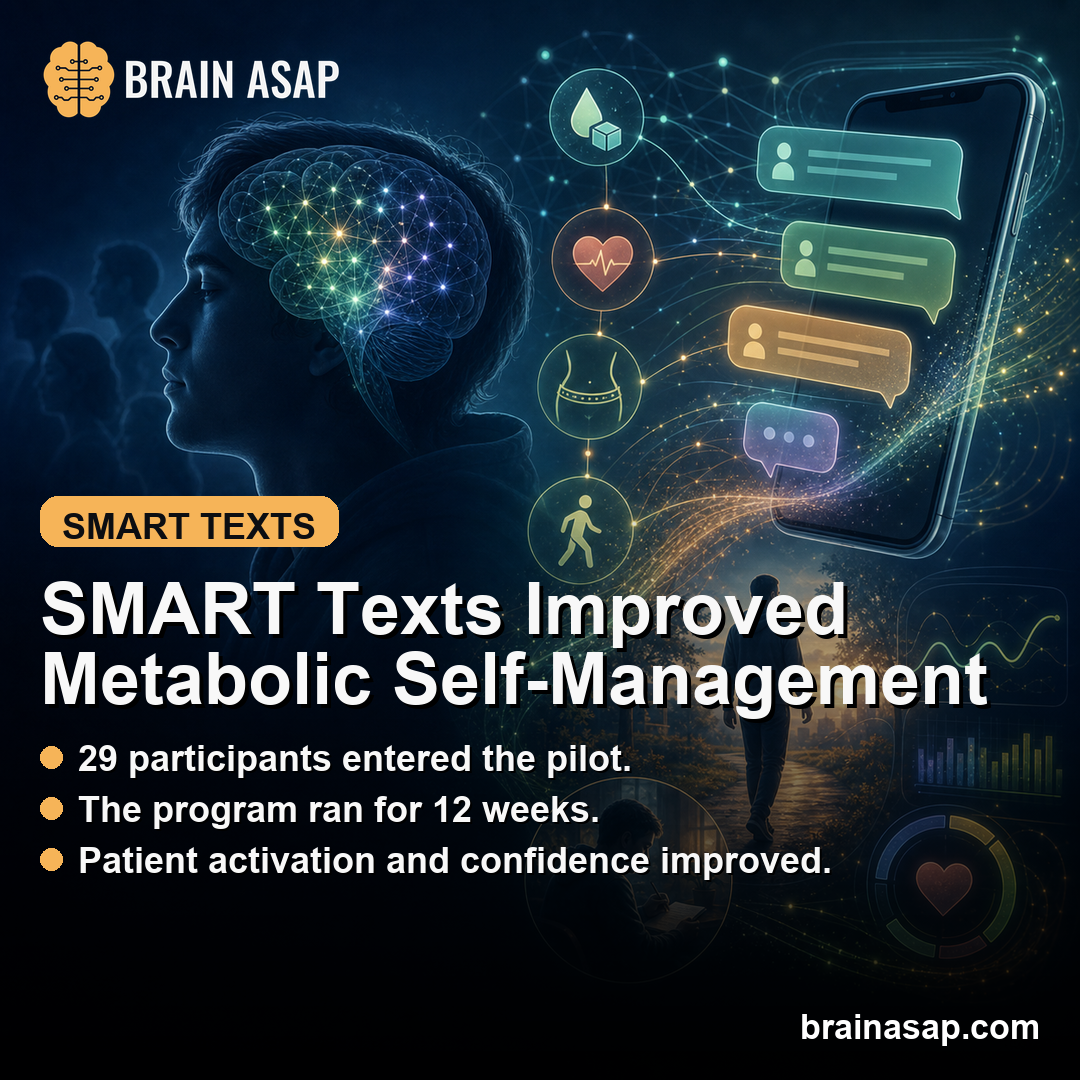
TL;DR: A 2026 uncontrolled pilot study in BJPsych Open found that SMART, a personalized text-message program for metabolic health in people with schizophrenia spectrum disorders, improved patient activation, diabetes self-management confidence, health literacy, and recovery scores over 12 weeks, while objective cardiometabolic markers did not significantly change.
Key Findings
- SMART reached a schizophrenia-risk group: Researchers recruited adults with schizophrenia spectrum disorders who either had type 2 diabetes, pre-diabetes, or metabolic syndrome.
- Personalized text prompts ran for 12 weeks: SMART delivered up to 6 core text messages per week on nutrition, weight management, physical activity, and stress coping, with optional smoking/vaping and blood-glucose modules.
- Patient activation improved: Patient Activation Measure (PAM-13), a scale of health self-management knowledge, skills, and confidence, increased from 38.98 to 41.85 points.
- Diabetes confidence increased: Skills, Confidence and Preparedness Index confidence scores increased from 4.61 to 5.28 among participants with type 2 diabetes.
- High feasibility: Recruitment, retention, and text-message adherence were 67.4%, 92.9%, and 93.0%, respectively.
Source: BJPsych Open (2026) | Arnautovska et al.
SMART stands for Schizophrenia and diabetes Mobile-Assisted Remote Trainer.
The intervention was built for a clinical problem that sits across psychiatry and physical health: people with schizophrenia spectrum disorders have high rates of type 2 diabetes and metabolic syndrome, while standard lifestyle programs often fail to match their cognitive, motivational, and care-access needs.
SMART Targeted Type 2 Diabetes Risk in Schizophrenia Spectrum Disorders
Schizophrenia spectrum disorders, or SSD, include schizophrenia, schizoaffective disorder, and related psychotic disorders. The metabolic risk is not a side issue.
The paper notes that people with SSD die 15 to 20 years earlier than the general population, mostly from cardiovascular disease driven by obesity and type 2 diabetes.
The intervention focused on daily self-management rather than clinic-only education. SMART used automated text messages to provide personalized psychoeducation, reminders, and behavior prompts that could fit around ordinary care.
The design logic had several patient-specific pieces:
- Low-tech delivery: Text messages were chosen because they require less digital friction than apps, portals, or wearable-device systems.
- Short message structure: Messages were kept brief and limited to 1 action, a deliberate adaptation for attention and planning difficulties in SSD.
- Behavior theory: Message wording drew on Self-Determination Theory and Social Cognitive Theory to support motivation, agency, and competence.
- Behavior-change techniques: SMART included goal setting, planning, social support, and other techniques selected from the behavior-change taxonomy.
The evidence supports an early feasibility and self-management signal, not a test of whether text messages improve glucose control or weight in this population.
29 Participants Used SMART for 12 Weeks
Researchers recruited participants from 3 Metro South Addiction and Mental Health Services sites in metropolitan Brisbane, Australia. The sites included an outpatient endocrinology clinic and 2 community-based mental health rehabilitation facilities.
The eligibility criteria selected for a specific cardiometabolic-risk group:
- Psychosis diagnosis: Participants needed a clinical diagnosis of SSD recorded in medical records.
- Metabolic risk: Participants had type 2 diabetes, pre-diabetes, or metabolic syndrome documented through records, clinician diagnosis, or blood testing.
- Capacity and access: Participants had to be adults able to consent, read English, and use a mobile phone.
- Stability requirement: People experiencing an acute relapse of psychiatric symptoms were excluded.
The final cohort included 29 participants.
Median age was 44 years, 41.4% were female, 58.6% had type 2 diabetes, 58.6% met metabolic-syndrome criteria, and median BMI was 37 kg/m², in the obesity range.
Baseline cognition is important because the intervention was designed around cognitive load.
The Montreal Cognitive Assessment (MoCA), a cognitive screening test, classified 48.3% in the normal range, 31.0% with mild cognitive impairment, and 20.7% with moderate cognitive impairment.
SMART Sent Personalized Text Prompts Across Core Health Modules
SMART delivered automated text messages to participants’ phones for 12 weeks. The four core modules were nutrition, weight management, physical activity, and stress coping.
Participants could also choose optional modules for smoking or vaping cessation and blood-glucose monitoring.
Messages used the participant’s preferred name, arrived at a preferred time of day, and reflected how the participant ranked the core health modules.
The message schedule was structured but adjustable:
- 6 core messages weekly: The 2 highest-priority core modules received 2 messages per week, while the third and fourth modules received 1 message per week.
- Optional module messages: Participants who chose smoking/vaping cessation or blood-glucose monitoring could receive additional weekly messages, up to a maximum of 8 total messages per week.
- Interactive replies: Participants can answer Yes, No, or Unsure, triggering automated follow-up replies tailored to the response.
- Non-response safety check: If a participant did not respond for 3 consecutive days, researchers received an automated alert and called to check the reason.
Weight management and physical activity were the most common top-priority modules. Blood-glucose monitoring was selected by 12 participants, and 5 of 13 current smokers chose the smoking/vaping module.
Patient Activation and Diabetes Confidence Improved After SMART
The main outcome was patient activation, a measure of whether someone has the knowledge, skills, and confidence to manage their health.
PAM-13 total score increased from 38.98 to 41.85 , with p = 0.005. The calibrated PAM-13 score increased from 56.67 to 63.45, with p = 0.014.
The self-management outcomes that improved clustered around confidence, health literacy, and recovery:
- Diabetes confidence: SCPI confidence increased from 4.61 to 5.28, with p < 0.001, among participants with type 2 diabetes.
- Diabetes self-management total: SCPI total increased from 4.60 to 5.16, with p = 0.017.
- Health literacy: Health Literacy Questionnaire domain 3, active health management, increased from 2.81 to 3.04, with p = 0.032.
- Mental health recovery: Recovery Assessment Scale domain 1, “doing things I value,” increased from 17.97 to 19.14, with p = 0.022.
- Effect sizes: Health literacy and recovery changes had medium-to-large effect sizes, with Cohen’s d values of 0.49 and 0.45.
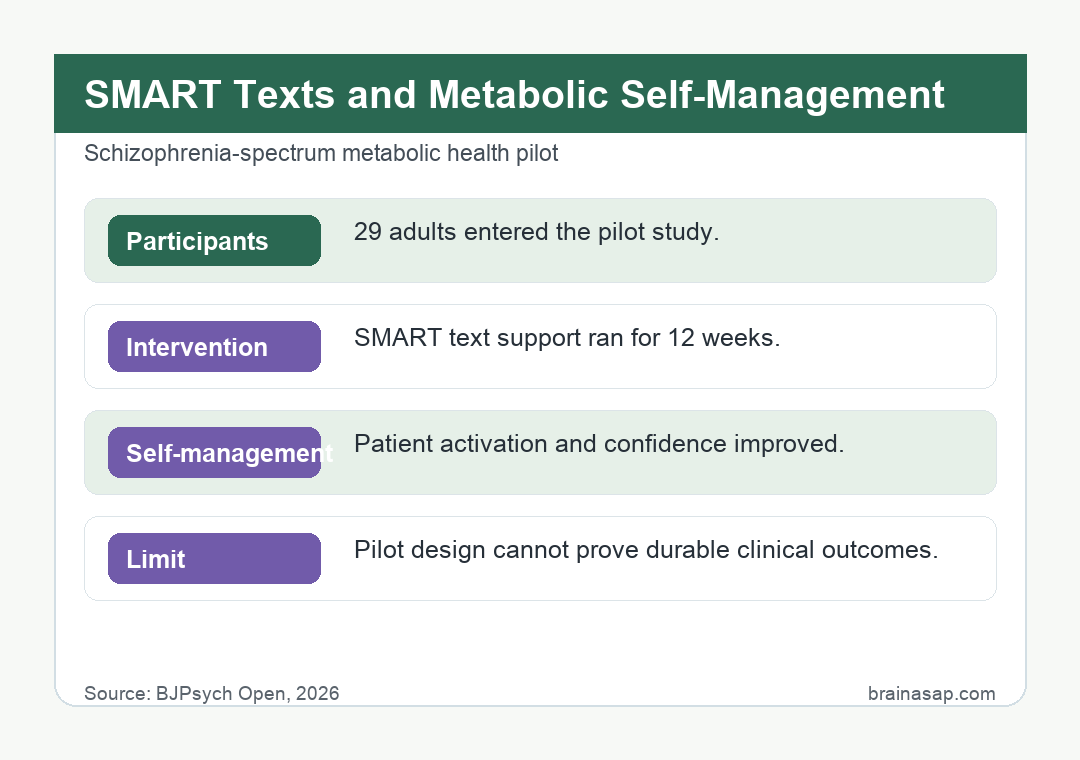
The psychiatric-symptom scores did not significantly change. Depression, anxiety, stress, clinical global impression, and sleep quality measures stayed statistically unchanged over the 12-week period.
The physical-health measures also did not show significant improvement. Weight, BMI, waist circumference, blood pressure, HbA1c, fasting glucose, triglycerides, HDL, LDL, and total cholesterol were not significantly different at the endpoint.
Feasibility Was Strong, But Cardiometabolic Outcomes Stayed Unchanged
The clearest operational result was feasibility. Recruitment was 67.4%, retention was 92.9%, and attrition was 6.9%, with 2 participants withdrawing during the study.
Text-message adherence was high enough to make the intervention worth testing in a controlled trial:
- 93% response rate: Mean response rate to SMART text messages was 93% across the 12 weeks.
- Stable engagement: Weekly engagement stayed at or above 90% except for week 4, when it dropped to 82% around the Christmas period or phone-credit issues.
- Module-level response: Response rates ranged from 90% for physical activity to 98% for blood-glucose monitoring.
- Usability rating: Median System Usability Scale score was 75, corresponding to grade B usability.
Feasibility does not equal clinical effectiveness.
A 12-week text-message program may improve confidence and engagement before it changes weight, glucose, lipids, or blood pressure, especially in a small sample with high baseline cardiometabolic burden.
The study also included an important adverse-event note.
1 participant withdrew in week 11 because of reportedly increased paranoia and anxiety related to anticipation of the endpoint assessment, recorded as an adverse event.
SMART Needs a Controlled Trial Before Clinical Claims
The biggest limitation is the uncontrolled pre-post design.
Without a control group, the study cannot separate SMART from usual care, staff contact, repeated assessment, motivation among volunteers, time effects, or regression toward the mean.
Several other limits constrain the interpretation:
- Small sample: The study was designed around a sample of about 30 participants to inform a future powered trial, not to provide definitive efficacy evidence.
- Short duration: 12 weeks may be enough to detect engagement and confidence changes, but slower cardiometabolic outcomes may need longer follow-up.
- Outpatient sample: Participants were outpatients or in rehabilitation settings, so the findings may not generalize to people with more acute illness or less support.
- English and phone access: Eligibility required English comprehension and mobile-phone use, which may exclude some high-need groups.
- Intervention-specific tailoring: SMART was co-designed and personalized, so a generic reminder-text program should not be assumed to produce the same engagement.
The strongest interpretation is that SMART improved self-management readiness in a small group of people with SSD and high metabolic risk.
The next test is whether those gains survive randomization and whether they eventually translate into measurable improvements in diabetes risk, weight, activity, diet, or glycaemic control.
A controlled trial should compare SMART with usual care or an active digital control, include longer follow-up, and predefine which cardiometabolic outcomes are expected to move.
It should also track who benefits most: people with type 2 diabetes, pre-diabetes, metabolic syndrome, cognitive impairment, low baseline activation, or specific module preferences.
Citation: DOI: 10.1192/bjo.2026.11032. Arnautovska et al. SMART: preliminary efficacy, feasibility and acceptability of a theory-informed digital intervention for metabolic health in people with schizophrenia and related disorders. BJPsych Open. 2026;12:e122.
Study Design: Uncontrolled 12-week pilot study of personalized text messages for metabolic-health self-management.
Sample/Model: 29 adults with schizophrenia spectrum disorders and type 2 diabetes, pre-diabetes, or metabolic syndrome.
Key Statistic: Patient activation and diabetes-confidence scores improved, while objective cardiometabolic markers did not significantly change.
Caveat: The pilot had no control group, so feasibility and self-management changes need controlled-trial confirmation.