TL;DR: A 2026 pilot trial in PLOS One found that a 7-day chicory-and-green-tea herbal supplement did not improve sleep, quality of life, or objective sleep architecture more than placebo in adults with insomnia.
Key Findings
- Small crossover pilot: The crossover pilot enrolled 10 adults aged 50 years or older with insomnia; 9 were women and the average age was 59 years.
- 7-day periods: Participants consumed either a chicory-and-green-tea supplement drink or a visually similar placebo drink for 7 days, then crossed over after a 2-week washout.
- No quality-of-life gain: Quality-of-life scores did not show a meaningful supplement-placebo difference, and most participants already scored near a very good quality-of-life range at baseline.
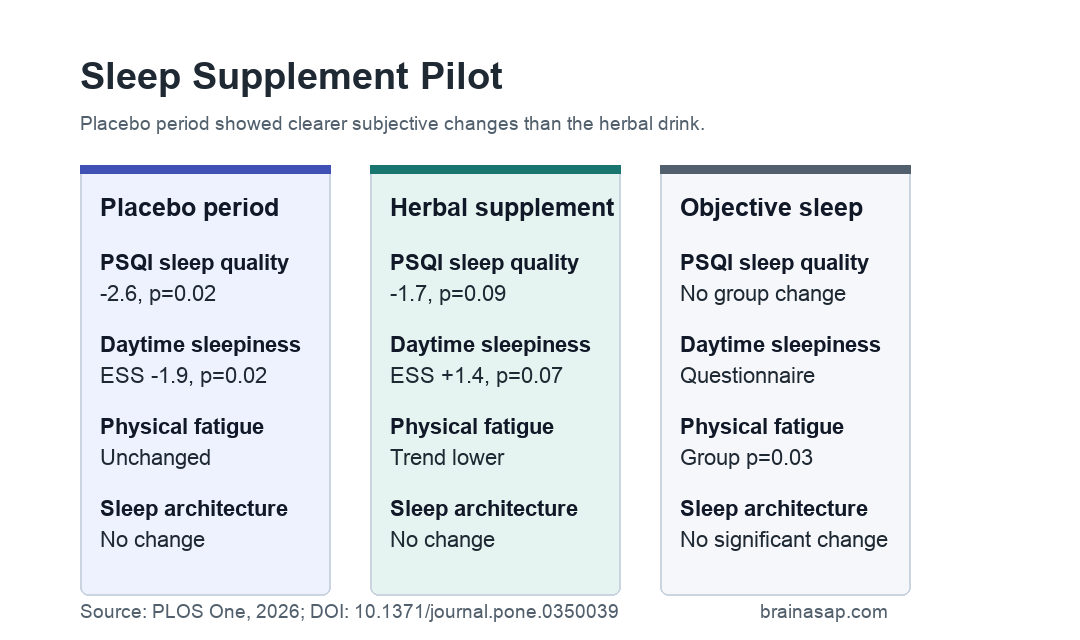
- Placebo sleep-quality change: Pittsburgh Sleep Quality Index scores decreased after placebo, -2.6, p = 0.02, but only trended lower after the supplement, -1.7, p = 0.09.
- Objective sleep null: Polysomnography and 7-day accelerometry did not show significant between-group changes in sleep efficiency, sleep latency, REM latency, or wake after sleep onset.
Source: PLOS One (2026) | Singh et al.
Insomnia supplements are often marketed faster than they are tested. This pilot trial asked a narrow question: whether a drink containing extracts from chicory and decaffeinated green tea improved sleep-related quality of life in older adults with insomnia.
The trial result was mostly negative. The trial was small, but its crossover design and placebo control show that subjective sleep improvement can appear even when the active supplement does not outperform a matched drink.
Chicory and Green Tea Were Tested in a Crossover Insomnia Pilot
The study enrolled adults aged 50 years or older who had chronic sleep difficulty and objective evidence of sleep disruption. Eligibility required an Insomnia Severity Index (ISI) score of at least 10 and at least 30 minutes of sleep latency or wake after sleep onset by screening accelerometry.
The final sample included 10 participants. Their baseline ISI score averaged 21, consistent with moderately severe clinical insomnia, and screening wake after sleep onset averaged 75 minutes.
- Study design: Double-blind, randomized, placebo-controlled crossover pilot trial.
- Intervention: A 1.79-ounce study drink containing chicory and green-tea-derived ingredients.
- Comparison: A similar-tasting, visually indistinguishable placebo drink.
- Timing: Each drink was taken for 7 days, with a 2-week washout before crossover.
The supplement was intended to be taken 1 to 2 hours before bedtime. Researchers selected the 7-day duration because the product was expected to have an acute same-day sleep effect if it worked.
Quality of Life Did Not Improve More With the Supplement
The primary goal was quality of life, measured with a 20-item scale where higher scores reflect better perceived life quality. At baseline, most participants already had high scores: 7 had scores above 100, 2 were above 95 to 100, and only 1 scored below 90.
With scores already high, there was limited room for improvement. The study did not find a meaningful treatment difference in quality of life after the supplement versus placebo.
- Quality-of-life scale: Scores range from 20 to 140, with 100 or higher generally reflecting very good quality of life.
- Baseline ceiling: Most participants already started near or above that very-good range.
- Treatment finding: Neither the supplement nor placebo produced a significant quality-of-life change from treatment baseline.
This does not prove the supplement can never affect quality of life. It shows that this small pilot, in this sample, did not support the product’s intended quality-of-life claim.
Subjective Sleep Improved After Placebo More Than the Herbal Drink
The most reader-facing result came from subjective sleep and daytime symptoms. The Pittsburgh Sleep Quality Index (PSQI), where lower scores indicate better sleep quality, improved after placebo but only trended lower after the supplement.
The supplement-placebo difference in PSQI change was not significant: 0.1, 95% CI -0.5 to 0.8, p = 0.69. Within-period changes still tell an important story because the placebo period showed the clearer subjective improvement.
- PSQI after placebo: Sleep-quality scores decreased by 2.6 points from treatment baseline, p = 0.02.
- PSQI after supplement: Scores decreased by 1.7 points, p = 0.09, which was a trend rather than a significant within-period change.
- Daytime sleepiness: Epworth Sleepiness Scale scores decreased after placebo, -1.9, p = 0.02, but trended upward after supplement, +1.4, p = 0.07.
- General fatigue: General fatigue decreased after placebo, -1.3, p = 0.03, and only trended lower after supplement, -1.1, p = 0.07.
Physical fatigue was the exception. The treatment comparison for change in physical fatigue was significant, p = 0.03, and the supplement period showed a trend toward lower physical fatigue.
That isolated result did not translate into broader sleep or quality-of-life improvement.
Polysomnography and Accelerometry Did Not Support a Sleep Effect
The study did not rely only on questionnaires. Participants wore a wrist accelerometer for 7 days, kept a sleep diary, and completed overnight polysomnography, the sleep-lab recording method that measures sleep stages and related physiology.
At baseline, the sample had objective sleep disruption. Polysomnography showed poor sleep efficiency averaging 75%, wake after sleep onset averaging 82 minutes, REM latency averaging 129 minutes, and NREM3 deep sleep averaging 10%.
- Sleep efficiency: No significant between-group change was seen, delta -0.37, p = 0.77.
- Sleep latency: No significant between-group change was seen, delta -0.10 minutes, p = 0.98.
- Wake after sleep onset: No significant between-group change was seen, delta 0.25 minutes, p = 0.97.
- 7-day accelerometry: Nighttime sleep duration trended higher in the placebo period, 448 versus 437 minutes, p = 0.07.
These objective measures make the null result stronger. If the supplement had meaningfully improved sleep architecture or habitual sleep timing over 7 days, the study was set up to detect at least preliminary movement in those measures.
The Main Lesson Is About Placebo Control in Sleep Supplement Studies
The researchers emphasized that placebo effects are common in insomnia studies. In this pilot, sleep quality, daytime sleepiness, and general fatigue improved significantly during the placebo period, while the active supplement period did not show the same pattern.
Several limitations keep the conclusion bounded. The study enrolled only 10 people, mostly women, and the high baseline quality-of-life scores limited room for improvement. The trial also tested only a short 7-day intervention.
The study still gives a practical answer for this chicory-and-green-tea supplement drink. The available pilot evidence did not show better sleep, better quality of life, or better objective sleep architecture than placebo.
Larger trials would need to show a clear active-treatment advantage before the product’s sleep claims are convincing.
Citation: DOI: 10.1371/journal.pone.0350039. Singh et al. Effect of an herbal supplement on quality of life in participants with insomnia: A randomized placebo controlled cross-over pilot trial. PLOS One. 2026;21(5):e0350039.
Study Design: Double-blind, randomized, placebo-controlled crossover pilot trial.
Sample Size: 10 adults aged 50 years or older with insomnia; supplement analyses included 9 participants and placebo analyses included 10.
Key Statistic: No objective sleep parameter showed a significant supplement-placebo change; PSQI improved after placebo (-2.6, p = 0.02) but not significantly after supplement (-1.7, p = 0.09).
Caveat: The trial was small, short, and mostly female, with high baseline quality-of-life scores that limited room for improvement.