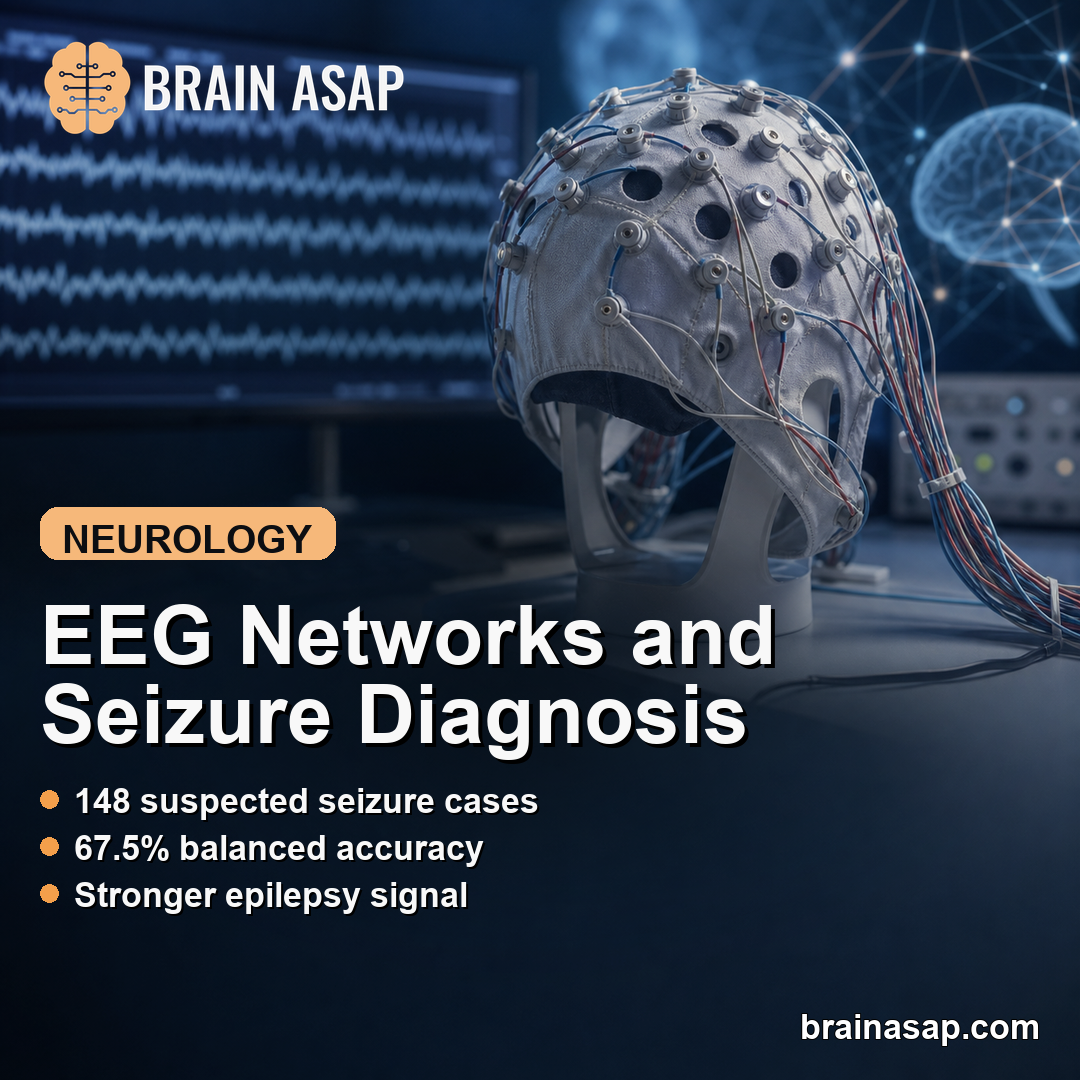
Resting-State EEG Network Markers Distinguished Epilepsy From Functional Seizures

Resting-State EEG Network Markers Distinguished Epilepsy From Functional Seizures

TL;DR: A 2026 medRxiv preprint found that multivariate resting-state electroencephalography (EEG) network markers separated non-lesional epilepsy from functional/dissociative seizures above chance, but the best model was stronger at identifying epilepsy than at identifying functional/dissociative seizures. Key Findings 148 suspected seizure cases: Researchers analyzed medication-free, visually normal, eyes-closed EEG recordings from 75 people later diagnosed with …

Read more

Protein Shake Brain Model Warns AI Can Produce Unowned Thoughts

Protein Shake Brain Model Warns AI Can Produce Unowned Thoughts

TL;DR: A 2026 conceptual paper in Integrative Psychological and Behavioral Science argued that heavy reliance on AI-generated language can create “Protein Shake Brain,” a state where thoughts are fluent and available but not fully owned by the person using them. Key Findings Protein Shake Brain is a proposed cultural-psychological label for AI-assisted thinking that feels …

Read more

Smartphone Migraine Study Captured Daily Brain Fog and Symptom Burden

Smartphone Migraine Study Captured Daily Brain Fog and Symptom Burden

TL;DR: A 2026 medRxiv preprint enrolled 177 adults with migraine in a 30-day smartphone study and found that daily cognition and symptom check-ins were feasible, with 3,688 completed assessments and higher baseline burden in chronic migraine. Key Findings Migraine cohort: The MIND study followed 177 adults with migraine using once-daily smartphone surveys and brief mobile …

Read more

Hebbian Learning Trapped Activity in Network Spreading Model

Hebbian Learning Trapped Activity in Network Spreading Model

TL;DR: A network model in Communications Physics (2026) found that Hebbian learning, the familiar “fire together, wire together” rule, trapped activity in old routes, while anti-Hebbian weakening helped activity reach new areas. Key Findings Positive reinforcement trapped activity: when successful activation made the same link more likely to be used again, activity tended to circle …

Read more

Centaur AI Model Passed Psychology Tests Without Following New Instructions

Centaur AI Model Passed Psychology Tests Without Following New Instructions

TL;DR: A 2026 study in National Science Open argued that Centaur, an AI model promoted as a simulator of human cognition, could reproduce psychology-test answers while failing a simple instruction-understanding check. Key Findings Centaur was tested as a cognition simulator: the earlier model reportedly performed well across 160 psychology tasks, including decision-making and executive-control experiments. …

Read more

Brain Tumor MRI Classifier Hit 99.29% Accuracy in One Dataset

Brain Tumor MRI Classifier Hit 99.29% Accuracy in One Dataset

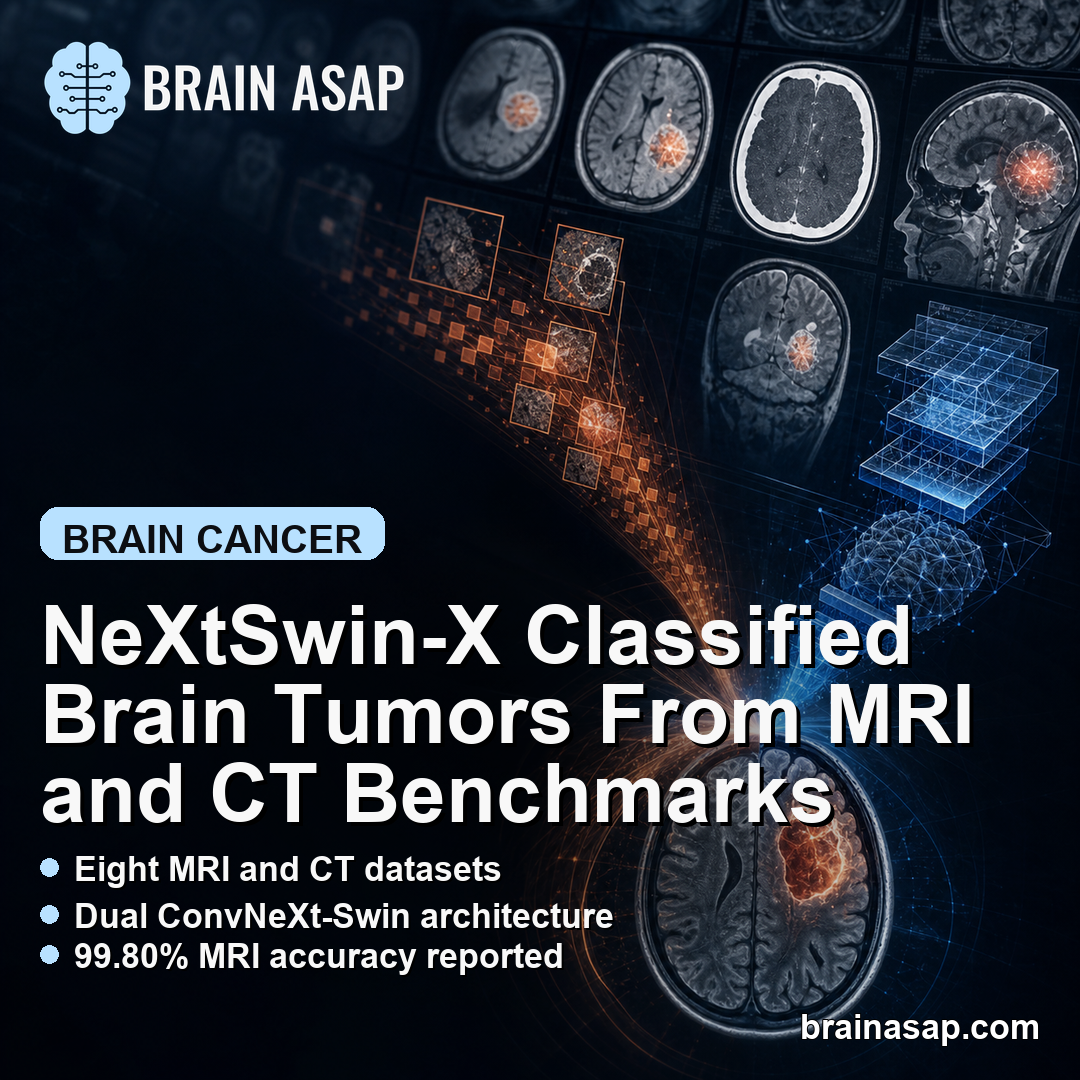
TL;DR: A 2026 Scientific Reports study reported that machine learning models classified brain tumor MRI images across four categories with high internal accuracy, led by a convolutional neural network at 99.29% on a single public dataset. Key Findings 7,023 MRI images: Researchers trained and tested models on 7,023 brain MRI images from a publicly available …

Read more

AI-Assisted Bayesian Inference Found Gamma-Secretase Alzheimer Pathways

AI-Assisted Bayesian Inference Found Gamma-Secretase Alzheimer Pathways

TL;DR: A 2026 medRxiv preprint applied ChatGPT-4o-assisted Bayesian-frequentist hybrid inference to Alzheimer’s single-nucleus RNA-seq data and identified gamma-secretase and HP1 transcription pathways that a no-evidence frequentist setting did not recover. Key Findings 427 ROSMAP samples: The application used postmortem prefrontal cortex single-nucleus RNA-seq data from 427 Religious Orders Study and Memory and Aging Project samples. …

Read more

Mental-Health AI Agents Still Lack Real Clinical Validation

Mental-Health AI Agents Still Lack Real Clinical Validation

TL;DR: A 2026 medRxiv review found that mental-health AI agents are moving quickly toward large-language-model chatbots, but most systems still rely on text self-report, narrow depression/anxiety/suicide use cases, and offline tests rather than prospective clinician or patient trials. Key Findings More than 300 recent papers were reviewed: Researchers audited mental-health AI agent systems from 2023 …

Read more

VR-CBTp for Paranoia May Fit Higher Avolition and Delusion Severity

VR-CBTp for Paranoia May Fit Higher Avolition and Delusion Severity

TL;DR: A 2026 study in Psychological Medicine found that people with schizophrenia spectrum disorders and higher avolition or moderate-to-high delusion severity appeared to improve more after virtual reality cognitive behavioral therapy for psychosis (VR-CBTp), while lower delusion severity favored standard CBTp. Key Findings FaceYourFears dataset: The exploratory moderator study used trial data from 254 participants, …

Read more

AI Model Predicted Student Mental Health Risk With 95% Accuracy

AI Model Predicted Student Mental Health Risk With 95% Accuracy

TL;DR: A 2026 machine-learning study in PLOS One used student mental-health survey features to test an interpretable FT-Transformer plus LSTM model, which reached 95% accuracy for low, medium, and high risk prediction in a public dataset. Key Findings 95% accuracy: the full interpretable FT-Transformer plus LSTM model outperformed AdaBoost, SVM, logistic regression, Random Forest, LSTM, …

Read more