Machine Learning Predicted Mindfulness App Engagement in Generalized Anxiety Disorder

Machine Learning Predicted Mindfulness App Engagement in Generalized Anxiety Disorder

TL;DR: A 2026 study in Journal of Affective Disorders used interpretable machine learning to predict who completed more prompts during a 14-day mindfulness app trial for generalized anxiety disorder. Key Findings Trial size: A two-arm randomized trial included 110 people with generalized anxiety disorder, assigned to a mindfulness ecological momentary intervention or a self-monitoring app. …

Read more

Fluorescent Aptamers Linked Brain Cell Identity to Connectomics

Fluorescent Aptamers Linked Brain Cell Identity to Connectomics

TL;DR: A 2026 Nature Communications paper introduced CAptVE, a fluorescent aptamer method that labels molecular features in mouse brain tissue while preserving ultrastructure for electron-microscopy connectomics. Key Findings Detergent-free labeling: CAptVE used slow off-rate modified aptamers to label brain cells without detergent permeabilization that can disrupt ultrastructure. Three fixation steps: The optimized pipeline balanced fluorescence …

Read more

Positive Emoji Use Tracked College Student Mental Health in Smartphone Study

Positive Emoji Use Tracked College Student Mental Health in Smartphone Study

TL;DR: A 2026 Research Square preprint followed 120 college students with a smartphone app and found that a higher share of positive emoji check-ins was the most consistent digital marker tied to lower depression, lower anxiety, and higher flourishing. Key Findings 120-student smartphone study: The app combined brief emoji check-ins, symptom questionnaires, voice samples, GPS-derived …

Read more

AI Chatbot Support Lowered Anxiety Scores in High-Risk Pregnancy

AI Chatbot Support Lowered Anxiety Scores in High-Risk Pregnancy

TL;DR: A 2026 study in Scientific Reports found that 300 high-risk pregnant women in Egypt reported much lower pregnancy anxiety and stress scores after 4 weeks of daily AI chatbot emotional support, although the pre-post design cannot prove the chatbot caused the full change. Key Findings 300 high-risk pregnancies: Researchers recruited women aged 18-45 from …

Read more

CatBoost Predicted Stroke-Associated Pneumonia After Bridging Therapy

CatBoost Predicted Stroke-Associated Pneumonia After Bridging Therapy

TL;DR: A 2026 preprint in medRxiv reported that an interpretable CatBoost machine-learning model predicted stroke-associated pneumonia after acute ischemic stroke bridging therapy with a test-set AUC of 0.932, with 7-day stroke severity and early inflammatory markers among the strongest contributors. Key Findings 135 stroke patients: The retrospective analysis included 135 acute ischemic stroke patients who …

Read more

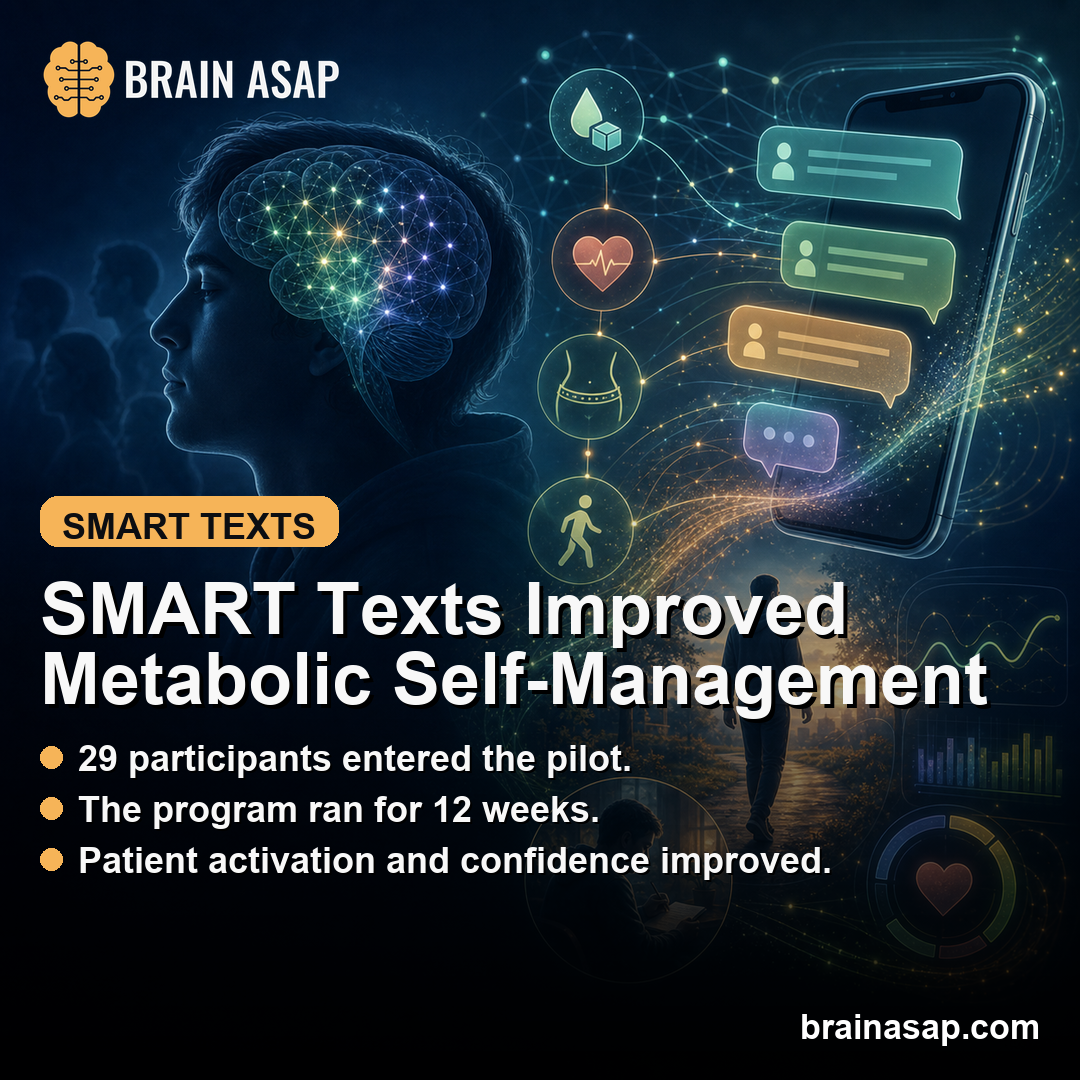
SMART Text Messages Improved Self-Management in Schizophrenia Metabolic Health Pilot

SMART Text Messages Improved Self-Management in Schizophrenia Metabolic Health Pilot

TL;DR: A 2026 uncontrolled pilot study in BJPsych Open found that SMART, a personalized text-message program for metabolic health in people with schizophrenia spectrum disorders, improved patient activation, diabetes self-management confidence, health literacy, and recovery scores over 12 weeks, while objective cardiometabolic markers did not significantly change. Key Findings SMART reached a schizophrenia-risk group: Researchers …

Read more

PAP Mask Leak Predicted Lower Sleep Apnea Treatment Adherence

PAP Mask Leak Predicted Lower Sleep Apnea Treatment Adherence

TL;DR: A 2026 HomePAP secondary analysis in Journal of Clinical Sleep Medicine found that higher PAP mask leak predicted lower obstructive sleep apnea treatment adherence, but a new Real Leak measure, unintentional leak after subtracting expected mask leak, did not outperform conventional Average Leak. Key Findings HomePAP sample size: PAP data were available for 139 …

Read more

Self-Localized Pencil Beam Improved 3D Multiphoton BBB Imaging

Self-Localized Pencil Beam Improved 3D Multiphoton BBB Imaging

TL;DR: A 2026 Nature Methods paper described a self-localized ultrafast pencil beam that made volumetric multiphoton imaging faster and more stable, including 1-minute 3D scans of transferrin uptake in a live human blood-brain barrier model. Key Findings Optics advance: A standard multimode fiber produced a stable, sidelobe-suppressed Bessel-like pencil beam near critical power. Microscopy fit: …

Read more

Supervisory AI Safety Agent Detected More Suicide-Risk Vignettes

Supervisory AI Safety Agent Detected More Suicide-Risk Vignettes

TL;DR: A 2026 preprint on medRxiv tested suicide-risk vignettes and found that an independent supervisory safety agent detected intervention-level risk far more often than native ChatGPT Health safeguards. Key Findings 224 paired evaluations: Researchers tested suicide-related clinical vignettes under two information conditions, creating 224 paired comparisons between native safeguards and an external supervisory system. 91.5% …

Read more

PIK3CG PRKCD and TRIM22 Linked to Poorer Glioblastoma Survival

PIK3CG PRKCD and TRIM22 Linked to Poorer Glioblastoma Survival

TL;DR: A 2026 analysis in Journal of Korean Medical Science identified PIK3CG, PRKCD, and TRIM22 as glioblastoma gene markers linked to worse survival and stronger immune-activity signals in IDH-wildtype tumors. Key Findings 12,041-gene screen: Researchers screened tumor expression data to find genes tied to both poor prognosis and immune activation in grade IV glioma. 775 …

Read more