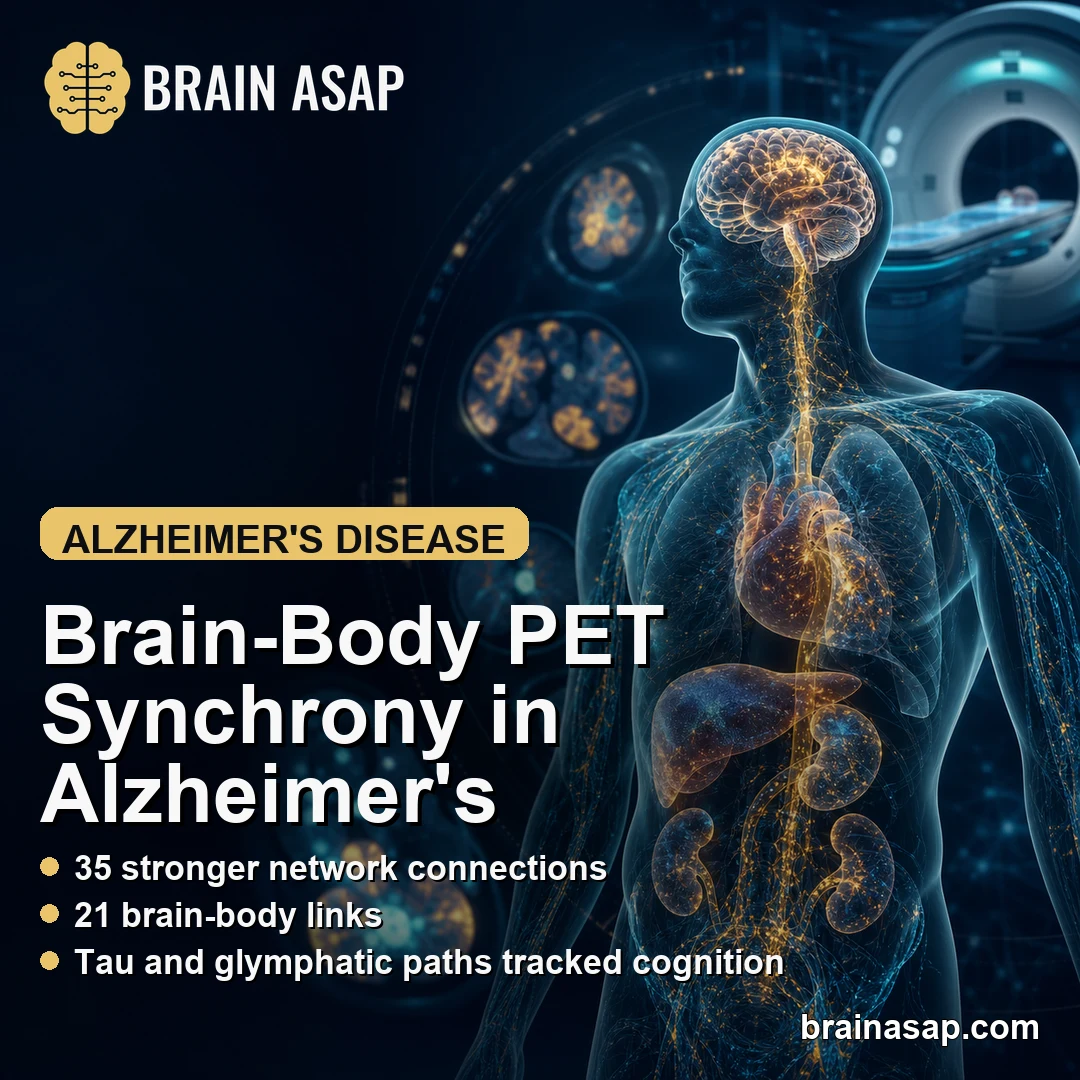
Brain-Organ Hypersynchrony Linked to Alzheimer’s Cognitive Decline

Brain-Organ Hypersynchrony Linked to Alzheimer's Cognitive Decline

TL;DR: A 2026 medRxiv preprint used total-body tau PET in Alzheimer’s disease and found stronger brain-organ network synchrony, a pattern that tracked cognitive impairment through cortical tau burden and MRI markers of glymphatic dysfunction. Key Findings Small imaging cohort: Researchers compared 28 Alzheimer’s disease patients with 23 matched negative controls using positron emission tomography (PET), …

Read more

Type I Interferon CD8 T Cells Clustered Around Amyloid Plaques

Type I Interferon CD8 T Cells Clustered Around Amyloid Plaques

TL;DR: A 2026 Nature Communications paper found that late-stage amyloid beta plaques in APP23 mice recruited CD8 T cells with a type I interferon program, linking Alzheimer-like amyloid pathology to a more adaptive immune response around plaques. Key Findings 21,156 immune cells profiled: The team used single-cell RNA and VDJ sequencing on CD45-positive brain immune …

Read more

Antrodia Silver Nanoparticles Reduced Parkinson’s Model Injury

Antrodia Silver Nanoparticles Reduced Parkinson's Model Injury

TL;DR: A 2026 study in Molecular Neurobiology found that Antrodia cinnamomea, a medicinal fungus extract, worked best when carried on citrate-stabilized silver nanoparticles in cell and rat models of Parkinson’s-like dopamine injury. Key Findings 6-OHDA created Parkinson’s-like injury: The toxin reduced SH-SY5Y cell viability and produced unilateral dopamine-system damage in rats. Combination treatment was strongest: …

Read more

VR Mindfulness Trial Will Test Dementia Caregiver Stress at Home

VR Mindfulness Trial Will Test Dementia Caregiver Stress at Home

TL;DR: A 2026 protocol in PLOS One describes a 90-person pilot randomized controlled trial that will test whether virtual reality mindfulness can reduce depression, anxiety, stress, and caregiver burden in family caregivers of people with dementia. Key Findings 90-caregiver pilot: The planned sample includes 90 caregivers of community-dwelling people with dementia in Hong Kong. Three …

Read more

Parkinson’s Metabolite Modeling Predicted Three Metabolic Subgroups

Parkinson's Metabolite Modeling Predicted Three Metabolic Subgroups

TL;DR: A 2026 npj Parkinson’s Disease study used brain transcriptome data and genome-scale metabolic modeling to predict Parkinson’s metabolite biomarkers, including dopamine-related changes, and separated 104 postmortem samples into three metabolic clusters. Key Findings Metabolic model: The study used TAMBOOR, a transcriptome-based metabolic modeling algorithm, to predict metabolite oversecretion and undersecretion. Brain tissue data: The …

Read more

PTP1B Inhibition Reduced Amyloid-Beta in Alzheimer’s Mice

PTP1B Inhibition Reduced Amyloid-Beta in Alzheimer's Mice

TL;DR: A 2026 mouse study in Proceedings of the National Academy of Sciences found that deleting or inhibiting PTP1B improved memory behavior, reduced amyloid-beta burden, and pushed microglia toward an amyloid-clearing state. Key Findings Memory behavior improved: APP/PS1 mice lacking PTP1B performed better in novel object recognition and Morris water maze tests; the PTP1B inhibitor …

Read more

Stress Internalization Predicted Memory Decline in 1,528 Older Chinese Americans Across Three Waves

Stress Internalization Predicted Memory Decline in 1,528 Older Chinese Americans Across Three Waves

TL;DR: A 2025 study in The Journal of Prevention of Alzheimer’s Disease found that stress internalization, not acculturation or activity engagement, predicted memory decline across three waves in 1,528 older Chinese Americans. Key Findings Stress internalization predicted longitudinal memory decline: A latent factor combining greater perceived stress, greater hopelessness, and lower conscientiousness was the single …

Read more

Generational Memory Gains May Help Explain Declining Dementia Incidence

Generational Memory Gains May Help Explain Declining Dementia Incidence

TL;DR: A 2026 preprint longitudinal cohort analysis in medRxiv found that later-born cohorts showed higher memory levels entering old age and slower rates of memory decline, while the projected 20-year cohort advantage at age 80 was large enough in the model to account for a reported 13% per-decade decline in dementia incidence. Key Findings Birth-cohort …

Read more

New-Onset Loneliness Accelerated Cognitive Decline in 635 Older Adults: ELSA Longitudinal Analysis

New-Onset Loneliness Accelerated Cognitive Decline in 635 Older Adults: ELSA Longitudinal Analysis

TL;DR: A 2026 longitudinal analysis in the Journal of Affective Disorders tracked 635 older adults with new-onset loneliness and found that cognitive decline matched controls before loneliness began, then accelerated after onset, especially when loneliness persisted. Key Findings Pre-loneliness cognitive trajectories were identical: Before the first reported episode of loneliness, cognitive scores in 635 future-lonely …

Read more

Parkinson’s Patients Had a Prominent Mood-Sleep Cluster

Parkinson's Patients Had a Prominent Mood-Sleep Cluster

TL;DR: A 2026 preprint on medRxiv using the Harvard Biomarkers Study found that 43% of Parkinson’s disease patients had depression, anxiety, sleep apnea, or restless legs syndrome, compared with 21% of controls. Key Findings 1,224-person cohort: Researchers analyzed 933 Parkinson’s disease cases and 291 controls in the Harvard Biomarkers Study. 43% mood-sleep burden: At least …

Read more