TL;DR: A 2026 study in Biological Psychiatry: Global Open Science found that trauma-exposed adolescents, especially those with higher posttraumatic stress symptoms, showed disrupted parent-cued fear extinction across skin-conductance, behavioral-learning, and…
Read article ↗
TL;DR: A study in Communications Biology found that environmental enrichment, richer housing with objects, running space, and novelty, reduced early-life-stress-linked visceral pain and depression-like behavior in rats while normalizing a CB1 receptor-sensitiv…
Read article ↗
TL;DR: A 2026 randomized pilot trial in European Journal of Psychotraumatology found no overall PTSD advantage when refugee-focused emotion-regulation skills training was added before narrative exposure therapy, but refugees living with high visa or family ins…
Read article ↗
TL;DR: A 2026 study in BMC Psychology found high rates of depression, anxiety, and recent self-harm thoughts among international students in Germany, with acculturative stress linked to worse mental health and mindfulness, optimism, self-efficacy, acceptance,…
Read article ↗
TL;DR: A 2026 study in European Journal of Psychotraumatology found that 3 days of Community Resiliency Model (CRM) training, a body-based trauma-regulation skills program, improved compassion, social cohesion, forgiveness, and resilience among 152 Rwandan gen…
Read article ↗
TL;DR: A 2026 cross-sectional study in Psychiatry Research surveyed 558 Palestinian refugees displaced to Egypt after the 2023 Gaza war and used Bayesian network analysis to map their psychological symptoms; suicidal ideation emerged as the central hub for bot…
Read article ↗
TL;DR: A 2025 study in The Journal of Prevention of Alzheimer’s Disease found that stress internalization, not acculturation or activity engagement, predicted memory decline across three waves in 1,528 older Chinese Americans. Key Findings Stress internalizati…
Read article ↗
TL;DR: A 2026 Frontiers in Behavioral Neuroscience study reported that inaudible infrasound shifted mood toward unease and raised stress-hormone markers under controlled conditions, offering a physiological explanation for some room-specific fear sensations wi…
Read article ↗
TL;DR: A 2026 rat study in Neuropsychopharmacology found that PACAP/PAC1 signaling in the lateral septum changed forced-swim coping, ACTH stress-hormone release, open-arm exploration, and grooming behavior. Key Findings Stress changed PACAP signals by brain re…
Read article ↗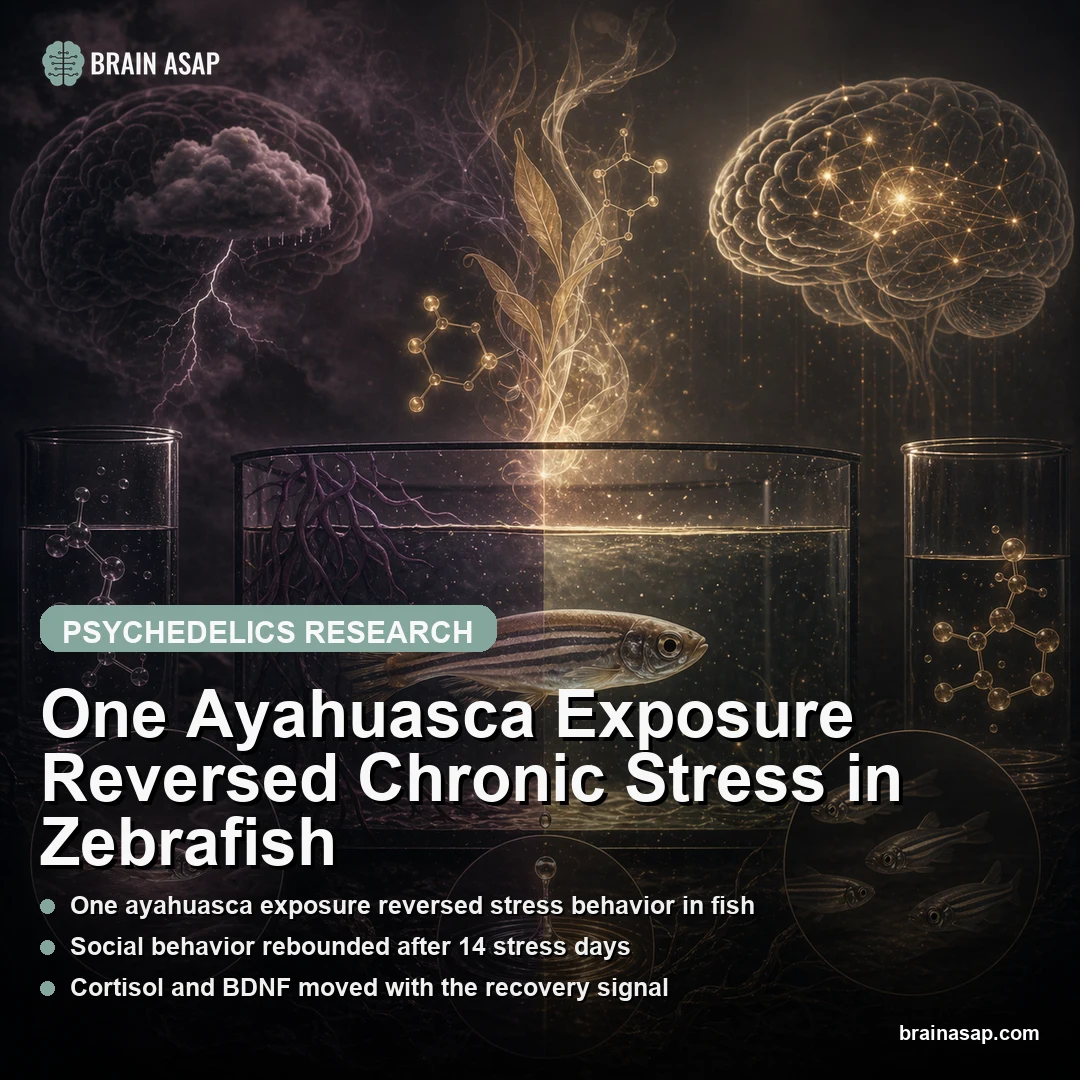
TL;DR: A 2026 study in Psychopharmacology found that after 14 days of unpredictable chronic stress, a single 1-hour ayahuasca exposure restored sociability, reduced anxiety-like behavior, normalized cortisol, and rescued whole-brain BDNF in adult zebrafish wit…
Read article ↗