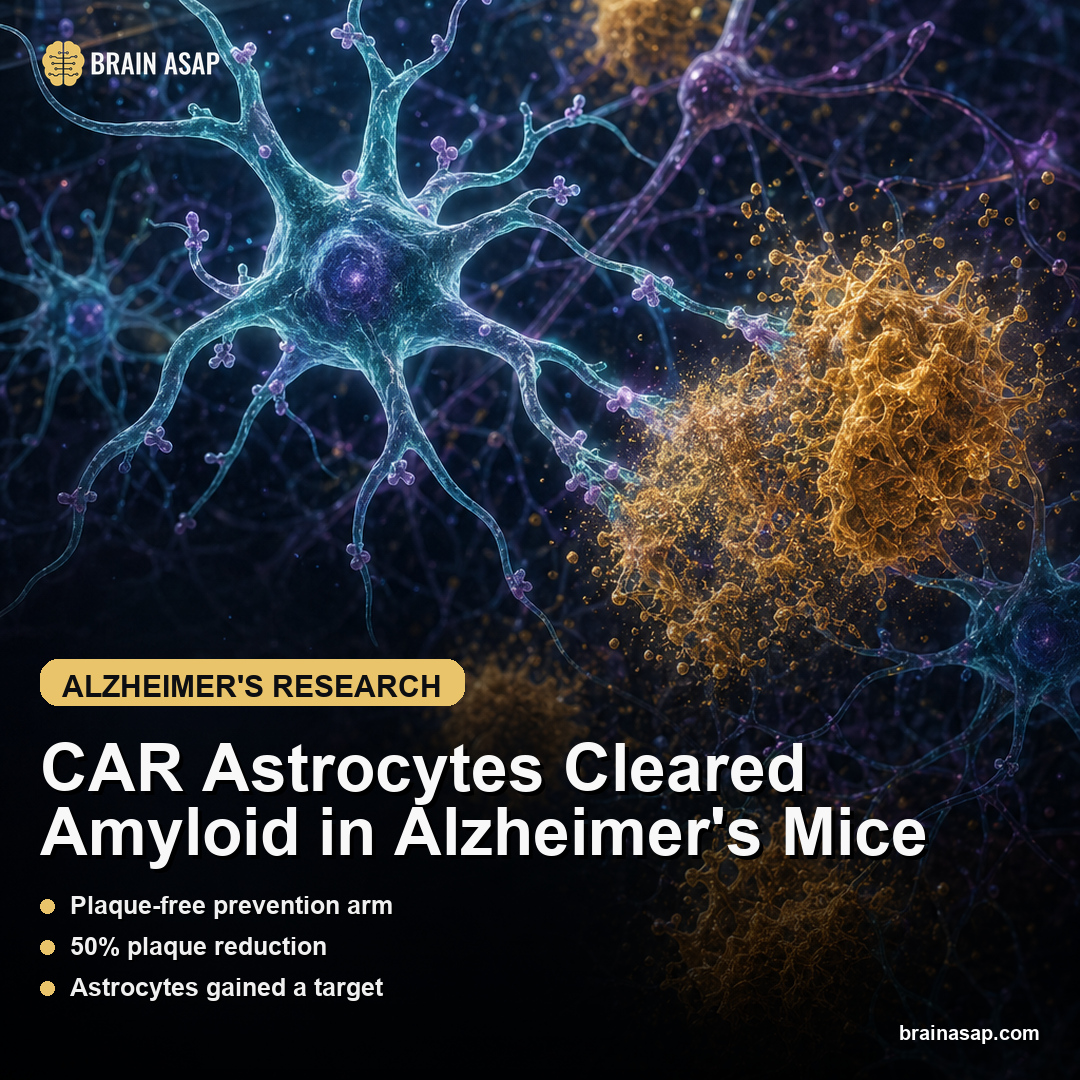
TL;DR: A CAR-style therapy aimed at astrocytes turned brain support cells into amyloid cleaners, preventing plaque development and cutting existing plaque burden by about half in mice.
Key Findings
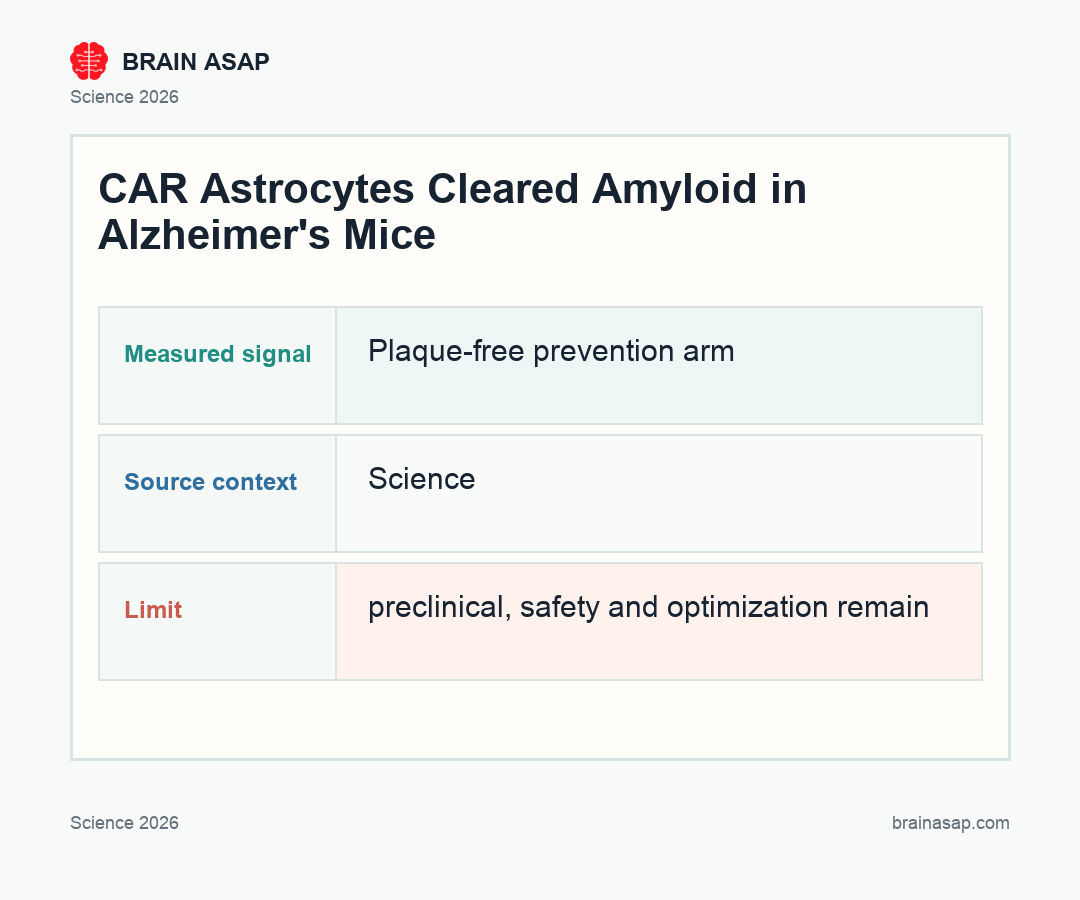
Plaque-free prevention arm: Young mice treated before plaques formed were reported plaque-free at nearly 6 months, when untreated Alzheimer-model mice are normally saturated.
50% plaque reduction: Older mice with established amyloid pathology had about a 50% reduction in plaque burden after one CAR-A treatment.
Astrocytes gained a target: A viral gene delivery system equipped astrocytes with a chimeric antigen receptor that recognized amyloid-beta.
Glia response shifted: Single-nucleus RNA sequencing found a distinct glial response involving coordinated astrocyte and microglial activity.
Mouse data, not clinic-ready: The source emphasizes optimization and side-effect work before human translation.
Source: Science (2026) | Chen et al.
CAR therapy usually brings to mind immune cells hunting cancer. CAR-astrocyte therapy asks a stranger question: what if the brain’s own support cells could be engineered to recognize amyloid-beta and help clear it?
Turning Astrocytes Into Amyloid Cleaners
Astrocytes are often described as support cells, but that phrase undersells them. They help maintain the brain’s environment, respond to injury, and interact with immune cells such as microglia.
The WashU team gave astrocytes a new targeting device. Like CAR-T therapy in cancer, the construct added a receptor that helped the engineered cells recognize a specific target, in this case amyloid-beta.
Astrocytes already live inside the tissue antibodies struggle to penetrate. Instead of repeatedly dosing a protein from outside the brain, the CAR-A approach tries to give resident glial cells a target and a cleanup job.
The delivery system is central to the claim. A viral construct has to reach enough astrocytes, express the receptor strongly enough to matter, and avoid pushing cells into a state that disrupts their normal support functions.
Target specificity is just as important. Amyloid-beta is present in pathological plaques, but engineered recognition has to avoid binding patterns that would interfere with normal proteins, vessels, or glial signaling.
A Single Injection Split Prevention From Cleanup
The study tested two practical scenarios in mice. One group received the CAR-A construct before amyloid plaques had developed; another received it after the brain was already saturated with plaques.
The prevention result was the cleanest: treated young mice were described as plaque-free at nearly 6 months. In the treatment arm, existing amyloid plaque burden fell by about 50% compared with control-virus mice.
- Prevention test: young Alzheimer-model mice received the construct before plaques formed.
- Cleanup test: older mice received the construct after amyloid pathology was already established.
- Control comparison: treated mice were compared with animals receiving a control viral construct.
- Readout: the central outcome was amyloid plaque burden, not human memory or daily function.
Microglia Still Shaped Amyloid Clearance After CAR Astrocytes
The therapy did not simply swap astrocytes in for microglia. Single-nucleus RNA sequencing suggested a coordinated glial response, with astrocytes and microglia changing together around amyloid pathology.
The reason is Alzheimer’s disease is not only a plaque-storage problem. The brain’s immune and support cells respond to plaques, sometimes helpfully and sometimes destructively, and a therapy that rewires one glial population can tug on the whole local ecosystem.
That ecosystem response is clinically relevant because amyloid clearance can carry inflammatory risk. Any future version of CAR-A would have to remove plaques without pushing astrocytes or microglia into a damaging chronic activation state.
Single-nucleus sequencing helps here because plaque burden alone cannot tell whether the surrounding glia are settling into a healthier state or becoming more reactive. The cell-state data gave the paper a way to look beyond the plaque count.
The Antibody Comparison Is About Burden, Not Proof
The source contrasts CAR-A with monoclonal antibodies, which require repeated high-dose infusions and have changed early Alzheimer’s care while leaving major limitations. CAR-A is conceptually different because it aims for a durable cellular cleanup system after a single delivery.
But the evidence is still in mice. Amyloid removal in a mouse brain is not cognitive benefit in a person, and the authors explicitly note the need to optimize the design and examine side effects.
The antibody comparison should stay focused on delivery logic rather than clinical superiority. Antibodies already have human outcome data and known safety issues; CAR-A has a striking mouse plaque result and many unanswered questions about control, reversibility, and long-term glial behavior.
Repeated antibody infusion and one-time cellular engineering also create different risk profiles. Antibodies can be stopped if problems appear; a persistent engineered glial program would need built-in safety controls or evidence that expression fades predictably.
That is why durability is double-edged. Long persistence could make a single treatment more powerful, but it also raises the threshold for proving controllability before human testing.
A New Glial Route Into Disease Modification
The most interesting part of the paper is not only that plaques fell. It is that astrocytes, usually treated as background biology in amyloid stories, became programmable therapeutic actors.
If the strategy can be made safe, targeted, and durable, it could expand the Alzheimer’s therapy toolbox beyond antibodies and into engineered brain-resident cells. That is a long road, but the mouse result gives the road a visible starting point.
A therapy built on astrocytes would also raise different safety questions from CAR-T cells. Astrocytes regulate synapses, extracellular ions, blood-brain barrier interactions, and metabolic support, so changing their behavior has to preserve normal housekeeping while adding amyloid recognition.
How to Read the CAR-Astrocyte Evidence
The evidence base here is best described as preclinical CAR-astrocyte engineering study with in vitro validation, Alzheimer mouse prevention and treatment experiments, and single-nucleus RNA sequencing. That design choice shapes the article’s claims as much as the headline result does.
The sample sets a narrow boundary: young mice treated before plaques formed and older mice treated after pathology was established. The result supports further preclinical work, not a claim that the treatment is ready for people.
The most useful numerical anchor is this: a single treatment left young treated mice plaque-free by nearly 6 months and cut existing amyloid plaque burden by about 50% in older mice. That number is a guidepost for mechanism and delivery, not a license to make a broader clinical promise.
The translation boundary is especially important because amyloid burden is only one part of Alzheimer’s disease. Tau pathology, synapse loss, vascular injury, immune state, and disease stage all influence whether amyloid clearance becomes functional benefit.
Where the Chen Result Fits Next
The larger value is the expansion of cellular immunotherapy logic into brain-resident support cells. Instead of asking antibodies to do all the cleanup from outside the tissue, CAR-A asks whether local glia can be given a precise target and a durable job.
The next step is safety. Engineered astrocytes would need tight control over targeting, persistence, inflammation, off-target binding, and normal astrocyte functions before a mouse plaque result can become a therapeutic platform.
A stronger follow-up would also measure cognition, synaptic integrity, gliosis, and tau-linked biology alongside plaque load. If CAR-A only clears amyloid without preserving function, it would remain a powerful mechanistic tool rather than a disease-modifying therapy.
The platform question extends beyond amyloid. If astrocytes can be safely programmed in the brain, similar logic could eventually be tested against other extracellular targets, but only after the amyloid model proves that engineered glia can be controlled over time.
Paper: Targeting amyloid-beta pathology by chimeric antigen receptor astrocyte (CAR-A) therapy. Science. 2026. DOI: 10.1126/science.ads3972
Authors: Chen et al.
Study Design: Preclinical CAR-astrocyte engineering study with in vitro validation, Alzheimer mouse prevention and treatment experiments, and single-nucleus RNA sequencing.
Sample Size: Young mice treated before plaques formed and older plaque-saturated mice treated after pathology was established.
Key Statistic: A single treatment left young treated mice plaque-free by nearly 6 months and cut existing amyloid plaque burden by about 50% in older mice.