Lifetime Cognitive Enrichment Delayed Alzheimer’s Dementia
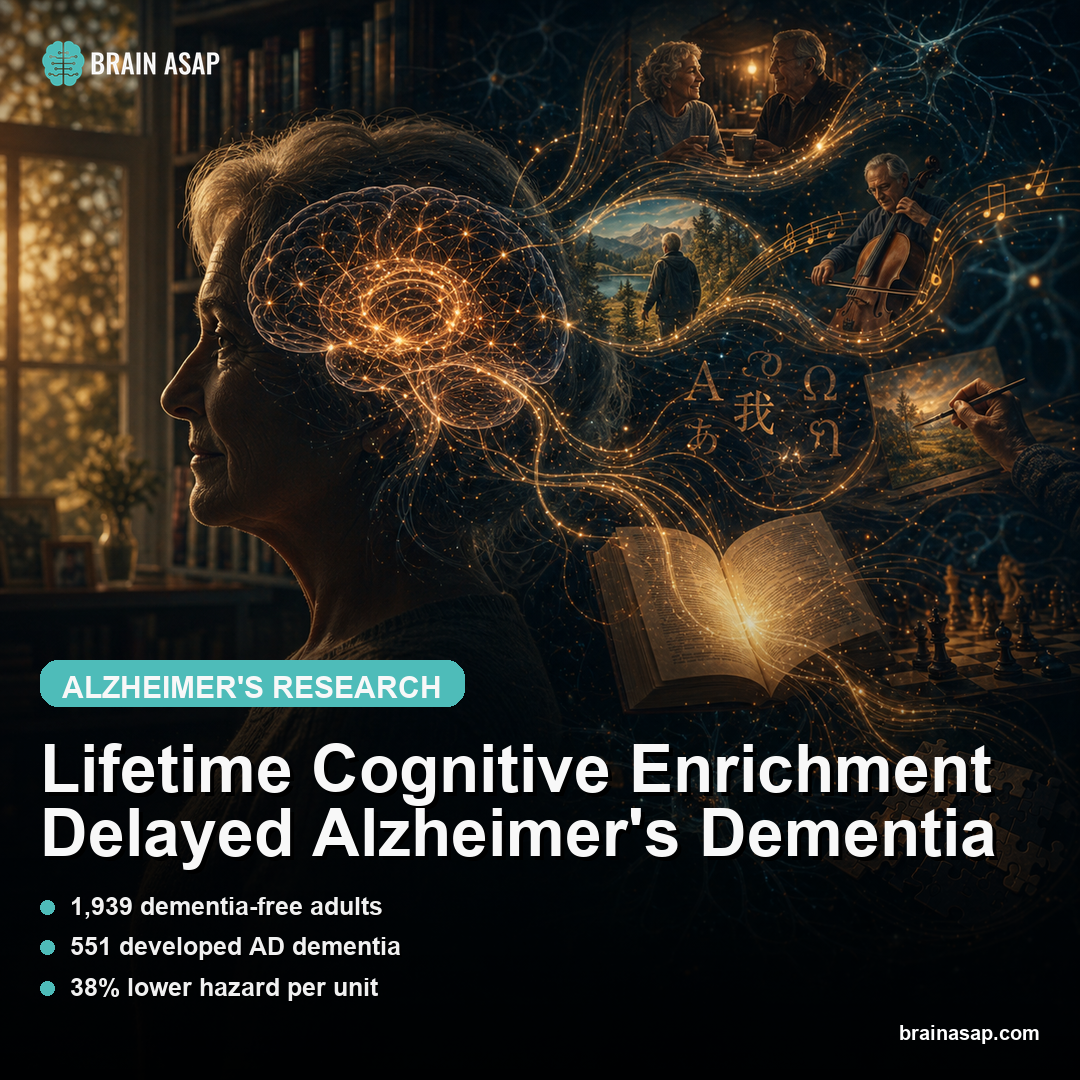
TL;DR: In 1,939 Rush Memory and Aging Project participants, higher lifetime cognitive enrichment was linked to 38% lower Alzheimer’s dementia hazard and about 5 years later dementia onset.
Key Findings
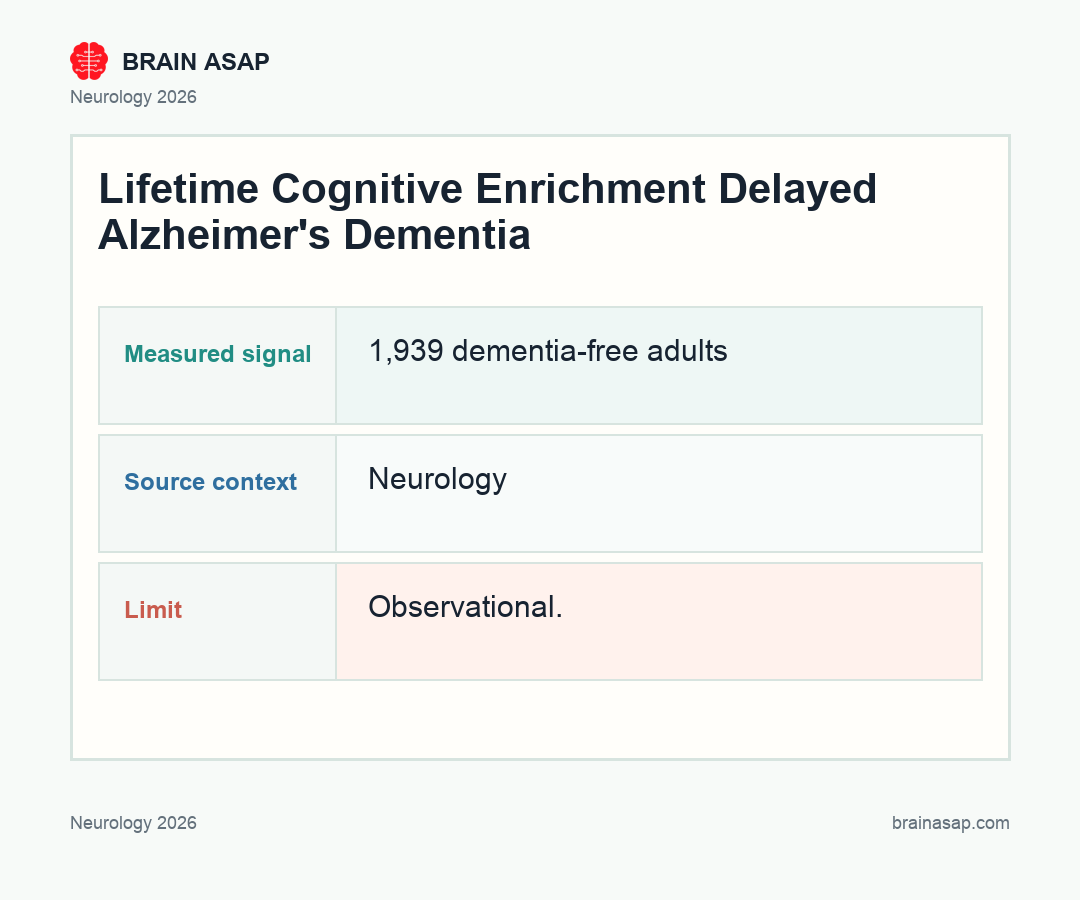
- 1,939 dementia-free adults: Participants were older adults from Northeastern Illinois in the Rush Memory and Aging Project, with a mean baseline age of 79.6 years.
- 551 developed AD dementia: Over an average 7.6 years of follow-up, 551 participants developed Alzheimer disease dementia.
- 38% lower hazard per unit: One unit higher lifetime enrichment was associated with lower AD dementia hazard (HR 0.62, 95% CI 0.52-0.73).
- Onset shifted years later: The highest enrichment group developed Alzheimer’s dementia about 5 years later and mild cognitive impairment about 7 years later.
- Resilience survived pathology adjustment: In an autopsied subset, enrichment related to slower cognitive decline after accounting for common ADRD pathologies.
Source: Neurology (2026) | Zammit et al.
Cognitive enrichment is often sold as a crossword-puzzle slogan. This study treated it as a life-course exposure: books and language before age 18, income and resources in midlife, and mentally active habits in old age.
The result was not immunity to Alzheimer’s pathology. It was resilience in the face of aging and disease.
Enrichment Was Measured Across a Whole Life
The exposure was not one hobby late in life. Early-life items included being read to, reading books, access to newspapers and atlases, and studying a foreign language. Midlife items included income and resources such as library cards, dictionaries, magazine subscriptions, and cultural visits.
Later-life enrichment included reading, writing, games, and income sources around age 80. The broad measurement is important because cognitive reserve is not built in one dramatic intervention. It accumulates through environments that keep the brain using language, memory, planning, and abstraction.
- Childhood exposure: books, newspapers, atlases, being read to, and foreign-language learning captured early cognitive environment.
- Midlife resources: income, library access, magazines, dictionaries, and cultural visits captured adult opportunity.
- Later-life activity: reading, writing, games, and resources around age 80 captured ongoing mental engagement.
- Life-course score: the combined measure treated enrichment as cumulative rather than a single late-life habit.
For interpretation, a late-life crossword habit may reflect decades of earlier opportunity. The study’s life-course approach is better suited to reserve biology than a snapshot of what someone did last month.
Alzheimer’s Dementia Arrived Later
The main statistic is clean: one unit higher lifetime enrichment was associated with 38% lower hazard of incident Alzheimer’s dementia. The study also found slower cognitive decline.
The timing translation is easier to feel. People with more enrichment developed Alzheimer’s dementia about 5 years later than those with the lowest enrichment, and mild cognitive impairment about 7 years later on average.
A delay of that size is not a cure, but it is a meaningful shift at the population level. Later onset can preserve independence, reduce caregiving burden, and compress the time someone spends with disabling cognitive symptoms.
Resilience Was Not Just Less Pathology
The autopsy subset is important because it asked a harder question. Was enrichment simply associated with fewer Alzheimer-related pathologies, or did it also relate to cognition after accounting for those pathologies?
The abstract says lifetime enrichment was associated with cognitive resilience, meaning slower decline after adjustment for common Alzheimer disease and related dementia pathologies. That is the reserve idea in a more testable form: two brains can carry similar pathology but differ in how much cognition is lost.
Reserve leaves pathology clinically important while changing how its effects appear. Brain networks, learned strategies, education, language, social resources, and daily cognitive practice may help some people function longer before pathology becomes clinically obvious.
That interpretation fits the clinic. Some older adults tolerate substantial brain pathology with less impairment than expected, while others decline earlier with a similar burden. Enrichment is one candidate explanation for that gap.
Opportunity Is the Unavoidable Confound
This was observational. People with higher enrichment often have more education, safer neighborhoods, better medical care, richer social networks, and fewer barriers to cognitively demanding activities.
The study adjusted statistically, but it cannot make life opportunity disappear. The fair reading is not “books prevent Alzheimer’s.” It is that intellectual environments across life appear to shape late-life cognitive trajectories in a way worth taking seriously.
That limitation is also part of the public-health message. Enrichment is not only an individual personality trait; it is partly built by schools, libraries, income, neighborhood safety, disability access, and cultural infrastructure.
If cognitive reserve depends on access, then prevention cannot be reduced to advice for older adults to stay busy. It also becomes a question about whether people had enough cognitive resources across childhood, work, retirement, and disability.
The Public-Health Message Starts Before Old Age
The most useful implication is developmental. If enrichment from childhood through later life matters, cognitive health policy cannot begin at retirement.
Libraries, language learning, education access, cultural resources, and meaningful mental activity are not decorative extras. In this dataset, they were part of the long arc that separated earlier dementia from later dementia and steeper decline from resilience.
The practical target is continuity. A cognitively rich childhood may help, but so can adult learning, social participation, reading, writing, games, volunteering, travel, and mentally demanding work or hobbies when those activities are accessible.
The study gives dementia prevention a wider time horizon. Amyloid, tau, vascular risk, sleep, hearing, and exercise still matter, but the cognitive environment people live in for decades may influence how long the brain can compensate.
The Rush cohort is also unusually useful because participants received annual clinical evaluations and many agreed to brain donation. That combination lets researchers connect life history, cognitive trajectories, and pathology instead of relying only on diagnosis codes.
The result still should not be reduced to individual willpower. Childhood reading, access to cultural activities, foreign-language learning, and midlife resources are shaped by families, schools, neighborhoods, disability, income, and policy.
A fair prevention message therefore has two levels. Individuals can pursue meaningful cognitive activity when they can, and communities can make enrichment easier to access across the lifespan.
Future studies should test which parts of enrichment are most protective. Language learning, complex work, social participation, reading, games, cultural activity, and income security may not contribute through the same cognitive or stress-related pathways.
Measurement timing will matter too. Enrichment reported late in life can be shaped by memory, health, retirement, and survival, so stronger designs should preserve early records where possible and follow changes in activity before impairment begins.
Clinically, cognitive enrichment belongs beside blood-pressure control, hearing care, sleep treatment, exercise, and disease-modifying therapy as part of the resilience landscape that determines when pathology becomes disabling.
The association also gives clinicians a reason to ask about daily cognitive activity without turning the conversation into blame.
For families, the result also shifts attention away from one perfect activity. A durable enrichment pattern can include reading, conversation, music, language, problem solving, cultural activity, education, volunteering, and social roles that require planning and memory.
For policy, the same result points to access. If enrichment delays dementia expression, then schools, libraries, adult education, disability-friendly cultural programs, and safe community spaces become part of brain-health infrastructure.
Paper: Associations of Lifetime Cognitive Enrichment With Incident Alzheimer Disease Dementia, Cognitive Aging, and Cognitive Resilience. Neurology. 2026. DOI: 10.1212/WNL.0000000000214677
Authors: Zammit et al.
Study Design: Longitudinal clinicopathologic cohort study with annual clinical evaluations and autopsy-based pathology analyses in a deceased subset.
Sample Size: 1,939 dementia-free older adults; 75% female; mean baseline age 79.6; average follow-up 7.6 years; 551 developed AD dementia.
Key Statistic: One unit higher lifetime enrichment was associated with 38% lower AD dementia hazard (HR 0.62, 95% CI 0.52-0.73).