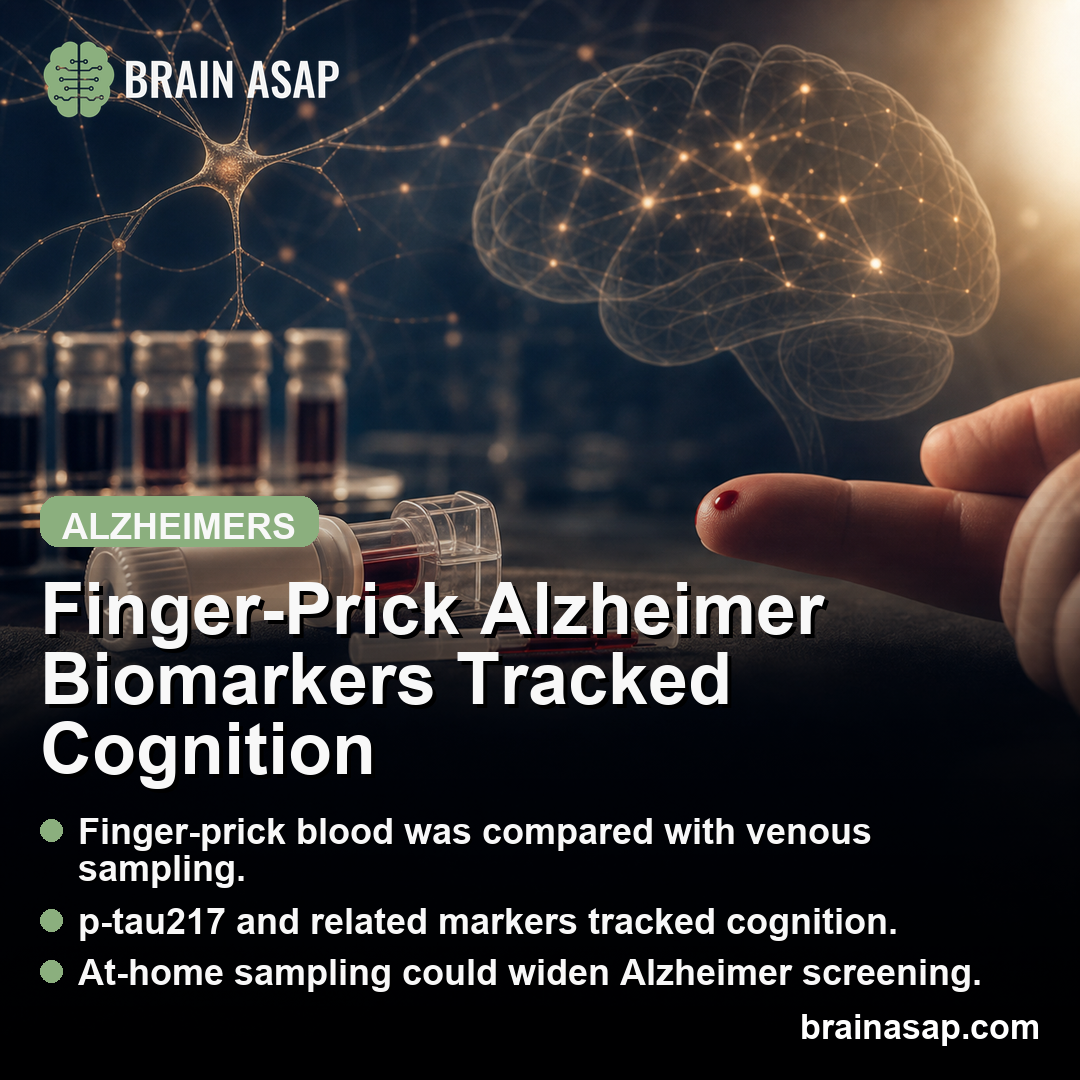
TL;DR: A 2026 study in Nature Communications found that self-administered finger-prick blood tests for phosphorylated tau 217 (p-tau217), an Alzheimer’s tau marker, and glial fibrillary acidic protein (GFAP), an astrocyte-injury marker, correlated with cognition and function in older adults.
Key Findings
- Remote sampling: Participants used capillary finger-prick blood collection rather than standard clinic-based venous blood draws.
- 174-person cohort: The PROTECT study sample included cognitively normal older adults and people with mild cognitive impairment or Alzheimer’s disease.
- Two biomarkers: Researchers measured p-tau217, a phosphorylated tau marker, and GFAP, a glial fibrillary acidic protein marker of astrocyte injury.
- Cognition link: Capillary biomarkers correlated with venous biomarkers and with cognitive and functional measures.
- Vascular difference: GFAP appeared associated with vascular risk, while p-tau217 followed a more Alzheimer’s-specific pathology route.
Source: Nature Communications (2026) | Corbett et al.
Finger-Prick Blood Collection Targeted an Alzheimer’s Access Problem
Alzheimer’s blood biomarkers are moving into clinical practice, but many people with early cognitive symptoms never reach specialist services. Clinic-based testing can also limit research recruitment and follow-up.
The study tested whether a remote capillary method could collect usable biomarker data outside a specialist clinic. Participants self-administered finger-prick sampling, and researchers compared those measures with venous blood and cognitive data.
The source highlights a major access problem: most people with early cognitive impairment are not assessed in specialist healthcare settings. A home-compatible test can support triage if the biomarker readout is reliable enough.
Remote collection also changes the research workflow. Large prevention studies and treatment trials need repeated measurements, and repeated clinic blood draws can become a barrier for older adults.
p-tau217 and GFAP Measured Different Biology
Phosphorylated tau 217 (p-tau217) is a blood marker tied to Alzheimer’s tau pathology. Glial fibrillary acidic protein (GFAP) reflects astrocyte-related brain-support-cell injury and inflammation, which can overlap with Alzheimer’s and vascular brain disease.
The two markers shaped different interpretations. p-tau217 is closer to Alzheimer’s-specific pathology, while GFAP appeared more connected to vascular risk in this sample.
Together, the markers may be more informative than either measure alone. A tau-linked result and an astrocyte-injury result point clinicians toward different follow-up questions.
- p-tau217: A tau phosphorylation marker used to detect Alzheimer’s-type pathology.
- GFAP: An astrocyte-injury protein that may rise in several brain-injury or vascular-risk contexts.
- Cognition: Computerized cognitive testing added functional context to the blood measures.
PROTECT Data Linked Capillary Biomarkers With Cognition
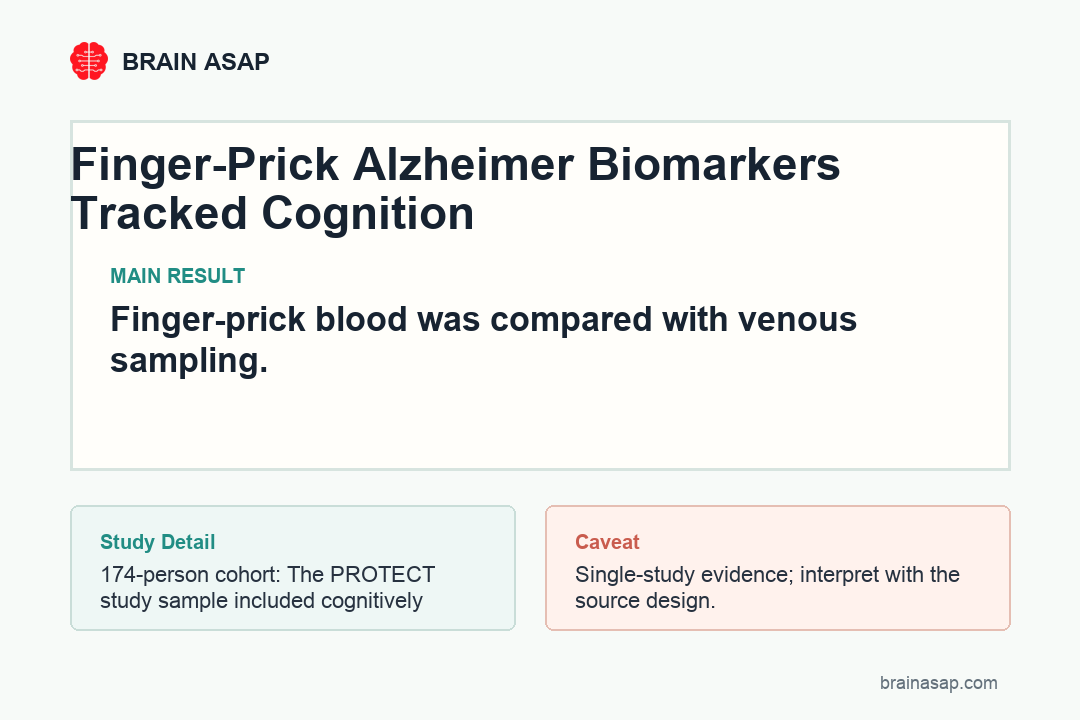
The study used 174 older adults from the PROTECT research study. Participants ranged from cognitively normal to mild cognitive impairment and Alzheimer’s disease, giving the analysis a broad risk spectrum.
Capillary biomarker levels correlated with venous blood biomarkers. They also correlated with cognition and function, which is the clinically relevant bridge.
A blood measure has more value when it tracks the cognitive state clinicians and families are trying to understand.
Researchers also combined biomarkers with computerized cognitive testing to identify people at higher Alzheimer’s risk. That combination fits a triage model: screen broadly, then send higher-risk people for more definitive assessment.
The computerized testing piece is not cosmetic. Cognitive performance gives the blood measures clinical context, especially when a person has subtle symptoms that have not yet triggered a specialist referral.
A practical screening pathway could therefore combine three layers:
- Symptom history: memory, function, and daily-change reports from the patient or family.
- Brief digital cognitive test: computerized performance measures that add functional context.
- Capillary blood biomarkers: finger-prick p-tau217 and GFAP values that help prioritize referral.
Concordant abnormal results would justify faster specialist referral than any single soft sign.
GFAP Added Vascular-Risk Context to Alzheimer’s Blood Testing
GFAP did not behave like a duplicate p-tau217 marker. The study reported that GFAP appeared associated with vascular risk, while p-tau217 did not show the same vascular-risk pattern.
The difference is clinically helpful because cognitive decline often comes from mixed pathology. Alzheimer’s disease, vascular brain injury, inflammation, sleep disorders, and other risks can overlap in older adults.
A triage panel that separates an Alzheimer’s-linked tau readout from a broader astrocyte-injury marker could help clinicians decide who needs amyloid or tau confirmation, vascular-risk management, or closer cognitive follow-up.
GFAP therefore should not be read as a simple Alzheimer’s substitute. Its value may come from flagging brain stress that intersects with vascular health and dementia risk.
That interpretation is especially relevant for older adults with hypertension, diabetes, stroke risk, or white-matter disease. In those patients, Alzheimer’s pathology and vascular injury can both contribute to memory and daily-function problems.
Home Sampling Could Expand Trials and Early Assessment
Patient feedback supported acceptability and usability of the capillary method. A test people can complete remotely could reduce clinic burden and make follow-up easier in long studies.
The strongest near-term use is not standalone diagnosis. Capillary blood biomarkers could help identify who should receive specialist workup, confirmatory imaging or cerebrospinal fluid testing, or enrollment screening for Alzheimer’s trials.
False positives, mixed pathology, assay differences, and access to follow-up care remain practical limits. The study supports scalable risk triage, especially when blood markers are interpreted alongside cognition and function.
Health systems would still need clear referral pathways after a positive screen. A scalable finger-prick test only helps patients if the next step is available and understandable.
The test also needs equity planning. Remote sampling can widen access, but only if people receive kits, instructions, result explanations, and follow-up options that do not depend on specialist knowledge, frequent clinic travel, private digital support, or a caregiver who can manage testing logistics at home.
Without that pathway, a technically scalable biomarker could still leave families with unclear risk information and no timely clinical decision.
Citation: DOI: 10.1038/s41467-026-71448-2. Corbett et al. Alzheimer’s Disease blood biomarkers measured through remote capillary sampling correlate with cognition in older adults. Nature Communications. 2026
Study Design: Observational biomarker study comparing remote capillary blood markers, venous blood markers, cognition, and function.
Sample Size: 174 older adults who were cognitively normal or had mild cognitive impairment or Alzheimer’s disease.
Key Statistic: Capillary p-tau217 and GFAP correlated with venous biomarkers and with cognitive and functional measures.
Caveat: The findings support triage and risk stratification, not diagnosis from one finger-prick sample alone.