TL;DR: A 2026 study in Microbiome found that in older adults at metabolic risk, virgin olive oil was linked to better cognitive preservation and richer gut microbiota, while common refined olive oil pointed the other way.
Key Findings
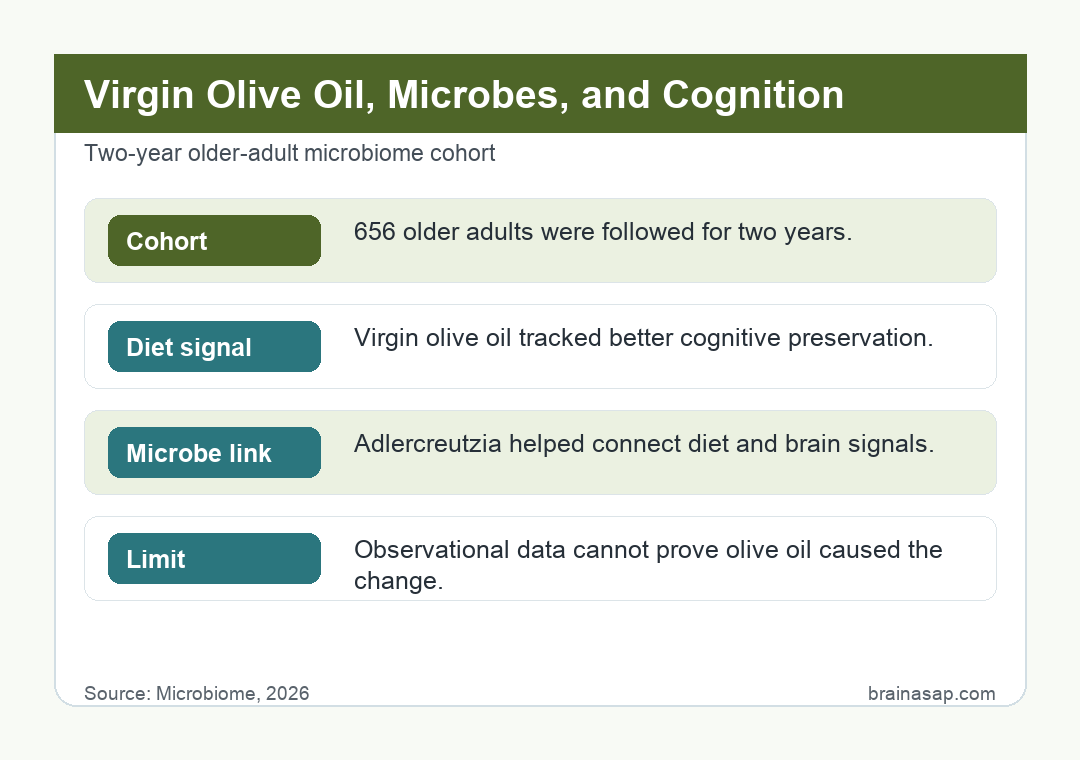
- Metabolic-risk cohort tracked over time: The analysis followed 656 older adults who were 55-75 years old, cognitively healthy at baseline, and had overweight or obesity plus metabolic syndrome.
- 2-year cognitive battery: Researchers measured multiple neuropsychological domains at baseline and after 2 years.
- Virgin oil tracked preservation: Higher virgin olive oil intake was associated with improved cognitive change and more diverse baseline gut microbiota.
- Common oil tracked decline: Common olive oil, which includes refined and pomace oils, was linked to lower alpha diversity and accelerated cognitive decline.
- Adlercreutzia entered mediation: Mediation analysis flagged the bacterial genus Adlercreutzia as a possible mediator between virgin olive oil and general cognitive function.
Source: Microbiome (2026) | Ni et al.
Olive oil is usually treated as a single Mediterranean-diet ingredient.
Virgin olive oil forced this study to split the bottle in two: minimally processed oil looked different from common refined olive oil in both the gut and cognition.
Virgin and Refined Olive Oil Looked Biologically Different
The paper separated total olive oil into virgin olive oil and common olive oil. Virgin olive oil is obtained mechanically and retains more polyphenols, tocopherols, and other minor bioactive compounds.
Common olive oil has a similar fat profile but loses many of those compounds during refining.
The comparison therefore focuses less on fat grams and more on food processing inside a familiar ingredient.
That processing distinction gives the result biological plausibility.
Polyphenols and related compounds can interact with oxidative stress, inflammation, and microbial metabolism in ways that refined oil may not reproduce even when the fatty-acid profile looks similar.
PREDIMED-Plus Gave the Gut-Brain test a Human Cohort
The analysis used 656 participants from PREDIMED-Plus, all with stool samples, food-frequency data, and cognitive testing.
The group was cognitively healthy at baseline but at elevated risk because of age, overweight or obesity, and metabolic syndrome.
The reason is many gut-brain claims lean heavily on animal data.
Here, the researchers could ask whether olive oil subtype related to microbial diversity and whether that microbial readout connected to cognition over 2 years.
- Population: 656 adults aged 55-75 with overweight or obesity and metabolic syndrome.
- Diet exposure: food-frequency data separated virgin olive oil from common refined or pomace oil.
- Gut readout: stool samples measured microbiota diversity and taxonomic patterns.
- Cognitive readout: neuropsychological testing tracked 2-year change from a cognitively healthy baseline.
Virgin Oil, More Diversity, and Better Cognitive Change
Higher virgin olive oil consumption was associated with improved cognitive function over follow-up and a more diverse gut microbiota structure at baseline.
Common olive oil showed the opposite pattern: lower alpha diversity and faster cognitive decline.
The study also identified Adlercreutzia as a possible mediator taxon.
That does not prove one bacterium carries the whole cognitive effect, but it gives the gut-brain hypothesis a more specific microbial pathway to test.
Alpha diversity is a broad measure of how many microbial types, and how evenly distributed they are, appear within a stool sample.
It is not automatically good or bad in every setting, but in this cohort it helped separate the virgin-oil pattern from the common-oil pattern.
That helps explain why the microbiome result is more than decorative.
If the oil subtype travels with microbial diversity before cognitive change is measured, the gut readout becomes a plausible bridge between diet quality and later brain-related outcomes.
Why Refined Oil Is the Quiet Comparator
The press release frames the result as a quality issue: extra virgin olive oil preserves antioxidants, polyphenols, vitamins, and other compounds that refining can degrade.
The paper’s abstract supports the same direction without turning it into diet absolutism.
The safe interpretation is narrower. In this older Spanish cohort, the type of olive oil people consumed carried different associations with microbiota and cognitive change.
That distinction is helpful because nutrition advice often collapses an ingredient into one label.
If refining changes the minor compounds that interact with microbes, then “olive oil intake” may be too blunt for brain-aging research.
A Cohort readout, Not a Dementia Prevention Prescription
This was prospective and carefully adjusted, but it was not a randomized trial of virgin versus refined oil for dementia prevention. Diet, microbiota, cognition, medication, metabolic health, and lifestyle are deeply entangled.
Still, the finding has practical force because the exposure is ordinary. Choosing minimally processed olive oil is a plausible microbiome-targeted habit, even if the cognitive-protection claim still needs clinical testing.
The cohort also involved people at metabolic risk, not a random sample of all older adults.
Metabolic syndrome can shape inflammation, vascular risk, microbiota composition, and cognitive aging, so replication in other populations will matter.
Metabolic risk also makes the finding biologically coherent.
- Inflammation: metabolic syndrome can raise low-grade inflammatory signaling that also affects the brain.
- Vascular strain: cardiometabolic risk can influence cerebral blood flow and cognitive aging.
- Microbial metabolism: gut bacteria can change diet-derived compounds before they reach systemic circulation.
- Diet quality: minimally processed oil may travel with broader food choices that still need controlled testing.
Insulin resistance, vascular strain, low-grade inflammation, and gut-microbe metabolism can all intersect with cognition, so an oil subtype linked to both microbiota and cognitive change deserves a controlled test.
Those same risk factors also complicate interpretation. Medication use, weight change, baseline diet quality, physical activity, and cardiometabolic control can all influence the gut and the brain over a two-year window.
How to Read the Olive Oil-Microbiome Evidence
The evidence base here is best described as prospective cohort analysis within PREDIMED-Plus linking olive oil subtype intake, baseline gut microbiota, and 2-year cognitive change.
That design choice shapes the allowable claim as much as the main result does.
The sample also sets the boundary: 656 adults aged 55-75 with overweight or obesity and metabolic syndrome; mean age 65.0 years and 47.9% women.
The olive-oil findings are observational within a dietary-intervention cohort, so they do not show that one oil type directly changed cognition through the microbiome.
The most helpful numerical anchor is this: higher virgin olive oil intake was associated with better 2-year cognitive change and greater baseline gut microbiota diversity, while common olive oil tracked lower diversity and faster cognitive decline.
That finding is a guidepost for intervention studies, not a clinical dementia-prevention claim.
The mediation result should also be read carefully.
Adlercreutzia may sit on the pathway between virgin olive oil and cognition, or it may mark a broader dietary and microbial pattern that travels with minimally processed oil.
A mediation model can suggest a pathway, but it cannot prove that adding Adlercreutzia or changing one genus would preserve cognition.
The stronger claim is that the genus gives researchers a specific microbial readout to track in follow-up trials.
Where the Ni Result Fits Next
The larger value is the subtype split.
Many nutrition studies flatten olive oil into one exposure; this one asks whether minimally processed oil and refined common oil carry different microbiome and cognitive signatures.
The next step is intervention.
A randomized comparison of olive-oil subtype, with microbiome and cognition measured prospectively, would test whether the cohort readout reflects the oil itself or the broader lifestyle wrapped around it.
A strong trial would also standardize background diet enough to isolate the oil subtype.
Otherwise, virgin olive oil could still be a marker for a broader pattern of cooking, food quality, income, medication use, or adherence to Mediterranean-diet habits.
The microbiome readout should be repeated too.
If Adlercreutzia, diversity, microbial metabolism, or inflammation-linked markers change after assigning people to a specific oil, the mediation argument becomes much stronger than it can be in an observational cohort.
Citation: DOI: 10.1186/s40168-025-02306-4. Ni et al. Total and different types of olive oil consumption, gut microbiota, and cognitive function changes in older adults. Microbiome. 2026;14:68
Study Design: Prospective cohort analysis within PREDIMED-Plus linking olive oil subtype intake, baseline gut microbiota, and 2-year cognitive change.
Sample/Model: 656 adults aged 55-75 with overweight or obesity and metabolic syndrome; mean age 65.0 years and 47.9% women.
Key Statistic: Higher virgin olive oil intake was associated with better 2-year cognitive change and greater baseline gut microbiota diversity, while common olive oil tracked lower diversity and faster cognitive decline.
Caveat: Single-study evidence; interpret with the source design and sample.