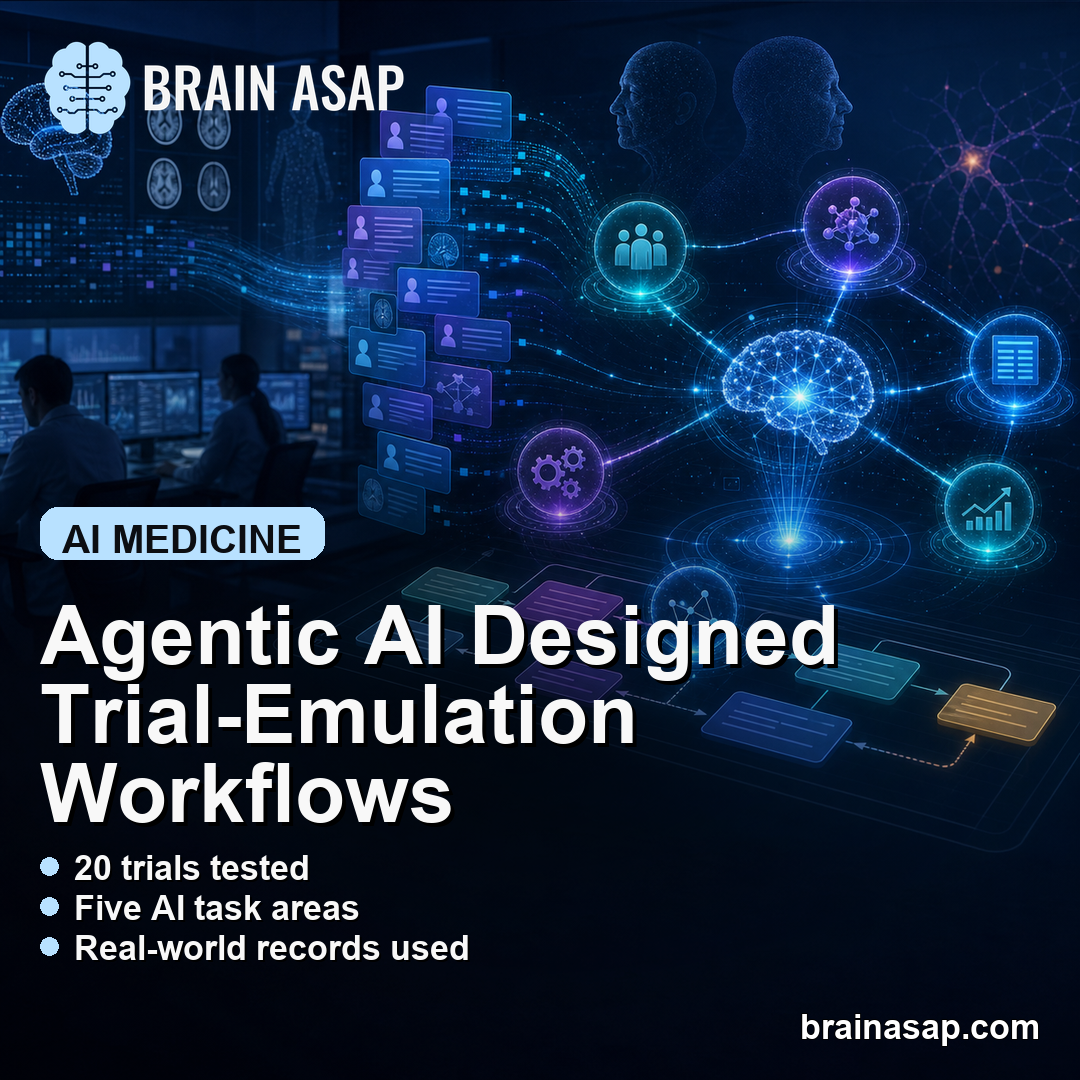
TL;DR: A 2026 Nature Communications paper introduced EmulatRx, a multi-agent AI framework that used real-world clinical data to help design target-trial-emulation workflows for acute and chronic diseases, including Alzheimer disease and Parkinson disease examples.
Key Findings
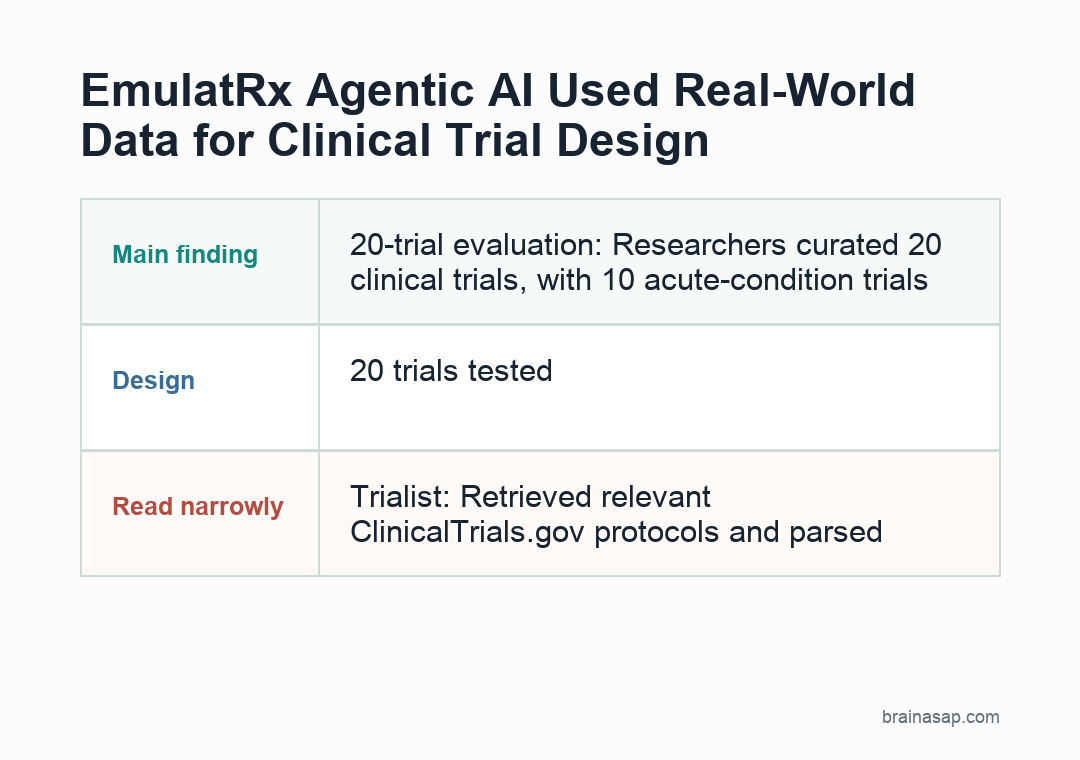
- 20-trial evaluation: Researchers curated 20 clinical trials, with 10 acute-condition trials from MIMIC-IV and 10 chronic-disease trials from INSIGHT.
- 5 task areas: The framework was tested on trial retrieval, eligibility parsing, SQL generation, causal analysis, and clinical-recommendation quality.
- Knowledge graph advantage: Trialist identified relevant ClinicalTrials.gov trials across query conditions when grounded in a clinical-trial knowledge graph.
- 266 concepts annotated: Eligibility parsing was compared against 266 manually annotated clinical-trial concepts.
- 13,942-patient case: In 1 heart-failure example, the system instantiated a cohort of 13,942 patients and selected 89 covariates for analysis.
Source: Nature Communications (2026) | Li et al.
EmulatRx is an agentic clinical-trial-design system, not a bedside diagnostic tool. It coordinates specialized agents that retrieve trial protocols, map eligibility criteria, generate database queries, run causal analyses, and assemble trial-design reports.
The framework targets a common research bottleneck. Target trial emulation tries to approximate a randomized-trial question using real-world data, but turning a written trial protocol into computable eligibility rules and fair comparisons usually requires repeated expert review.
EmulatRx Combined Trial Retrieval, EHR Mapping, and Causal Analysis
The system used a supervisor agent plus role-specific agents for clinical reasoning, informatics, statistics, and trial retrieval. Each role handled a different part of the target-trial-emulation workflow rather than asking 1 large language model to answer the whole clinical question.
Real-world data came from 2 sources. Acute-disease examples used MIMIC-IV, an intensive-care electronic health record database, while chronic-disease examples used the INSIGHT clinical research network across New York health systems.
- Trialist: Retrieved relevant ClinicalTrials.gov protocols and parsed eligibility criteria.
- Informatician: Translated clinical concepts into database queries using OMOP-style structured data.
- Statistician: Selected balancing and causal-inference methods for observational comparisons.
- Clinician: Reviewed whether variables and exclusions made medical sense.
This structure is important because trial design is not only text retrieval. It requires clinical definitions, database feasibility checks, confounder selection, outcome timing, and transparent reporting.
Twenty Trials Covered Acute and Chronic Disease Questions
The evaluation used 20 curated clinical trials. 10 trials focused on acute conditions such as septic shock, acute heart failure, acute pulmonary edema, and acute kidney injury.
10 trials covered chronic diseases including Alzheimer disease and Parkinson disease. That split forced the agents to handle both intensive-care time windows and longer follow-up eligibility constraints.
It also tested whether the workflow could adapt when outcomes, exclusions, and follow-up windows looked very different across source trials.
Researchers evaluated the framework across 5 core dimensions: clinical-trial query using a knowledge graph, entity extraction and trial parsing, SQL generation, causal inference and outcome analysis, and clinical reasoning quality.
- Trial retrieval: Could the system find protocols that matched disease, treatment, and eligibility constraints?
- Eligibility parsing: Could it extract clinical concepts from free-text criteria?
- Database execution: Could it turn those concepts into usable real-world-data queries?
- Analysis design: Could it choose an appropriate observational comparison method?
- Report quality: Could it produce a transparent trial-design report rather than a loose chat answer?
The trial-retrieval comparison showed why grounding mattered. The knowledge-graph-supported Trialist identified relevant trials across query conditions, while a direct ClinicalTrials.gov API query weakened when extra eligibility criteria were added.
Eligibility Parsing Was Checked Against 266 Annotated Concepts
For quantitative evaluation, eligibility criteria from the 20 selected trials were manually annotated by 2 biomedical informatics experts. The gold-standard set included 266 clinical concepts, and agreement was measured with Cohen’s kappa, targeting at least 0.7.
A parsed concept counted as correct only when all attributes matched the human annotation, including concept name, semantic category, temporal qualifier, and value. That is a stricter test than simply finding a keyword inside a protocol.
- Precision: How many extracted concepts were correct.
- Recall: How many gold-standard concepts were recovered.
- F1 score: The harmonic mean of precision and recall.
The paper reported that GPT-4o performed best among tested language models for concept identification, while the broader framework used retrieval, databases, and agent coordination to turn extracted concepts into trial-design steps.
A Heart-Failure Example Built a 13,942-Patient Cohort
1 showcase emulated a nesiritide trial in acute heart failure. The clinician agent proposed 89 covariates, and the informatician agent translated them into OMOP-compliant SQL queries that instantiated a cohort of 13,942 patients.
The statistician agent selected inverse probability of treatment weighting rather than propensity-score matching, then adjusted after detecting persistent imbalance in eosinophil counts. After clinician review, the workflow dropped that variable because it was not a primary confounder for the hemodynamic outcome context.
The observational analysis reported a hazard ratio of 0.5913, with a 95% confidence interval of 0.46 to 0.76, for the composite risk of rehospitalization and all-cause mortality in the nesiritide-treated group. The authors framed this as a trial-design demonstration, not as a replacement for a randomized trial.
- Main limitation: Real-world data are observational and can preserve confounding even after balancing.
- AI limitation: Agent outputs still depend on source data quality, tool access, and clinical review.
- Clinical use boundary: The framework informs trial design; it does not establish treatment efficacy by itself.
EmulatRx is most convincing as a methodological workflow. Agentic AI can make target-trial-emulation work more structured and auditable when it is grounded in clinical data, external tools, and domain-specific review roles.
Citation: DOI: 10.1038/s41467-026-74501-2. Li et al. Empowering clinical trial design with agentic intelligence and real-world data. Nature Communications. 2026;17:5501.
Study Design: Biomedical AI framework paper with evaluation across trial retrieval, parsing, SQL generation, causal analysis, and clinical reasoning tasks.
Sample Size: 20 curated clinical trials; 1 demonstration instantiated a 13,942-patient heart-failure cohort.
Key Statistic: Eligibility parsing was checked against 266 manually annotated trial concepts, and a showcase analysis used 89 covariates.
Caveat: Target-trial emulation from real-world data can inform trial design but cannot remove all observational confounding or replace randomized evidence.