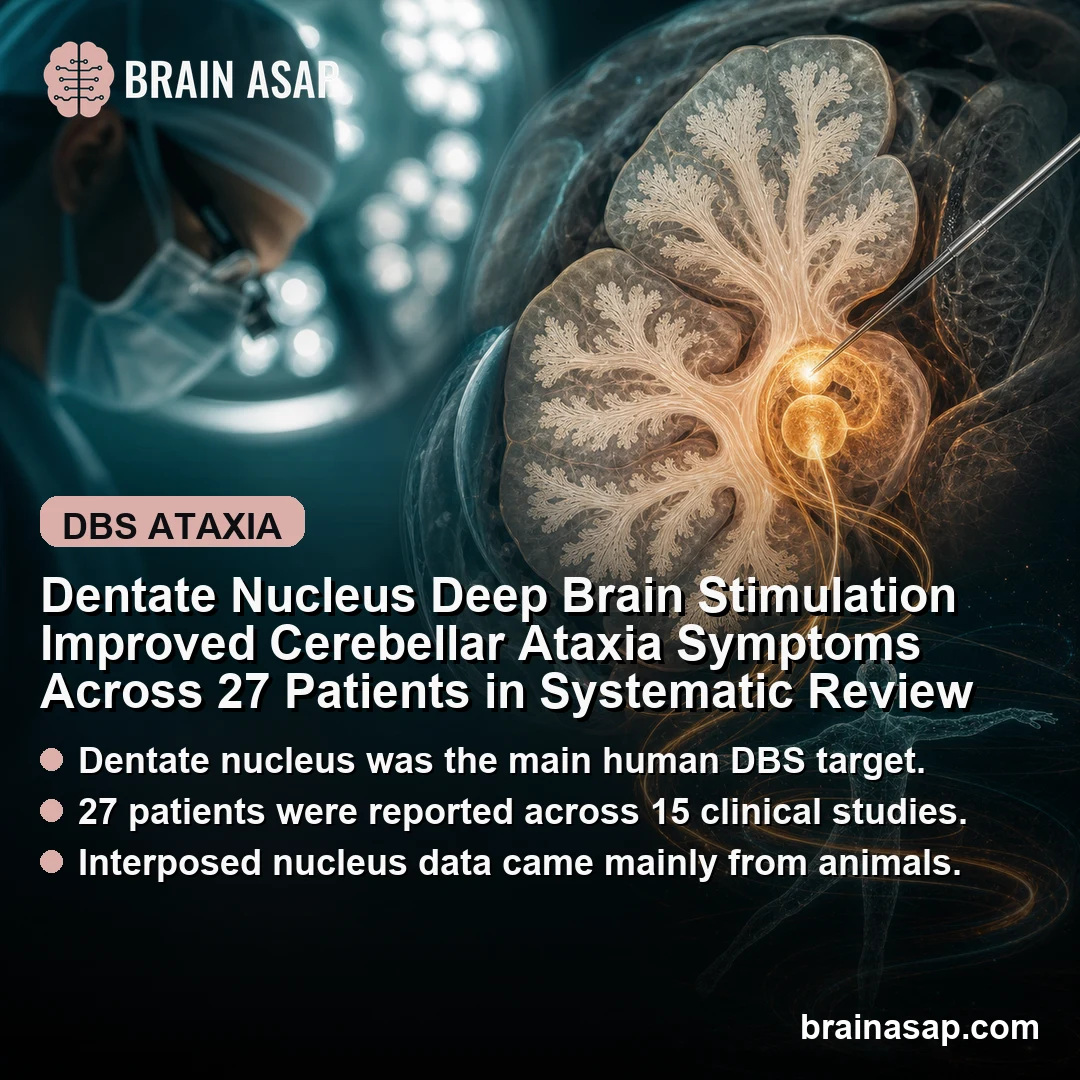
Dentate Nucleus Deep Brain Stimulation Improved Cerebellar Ataxia Symptoms Across 27 Patients in Systematic Review

Dentate Nucleus Deep Brain Stimulation Improved Cerebellar Ataxia Symptoms Across 27 Patients in Systematic Review

TL;DR: A 2026 systematic review in The Cerebellum found that deep brain stimulation (DBS) produced modest symptom improvement in selected cerebellar ataxia patients, with dentate nucleus stimulation most common in humans and interposed nucleus stimulation emerging from animal studies. Key Findings Dentate nucleus is the dominant human DBS target: Across 15 clinical studies (27 patients), …

Read more

AI Identified CgA-KO/PS19 Mouse Model of Asymptomatic Alzheimer’s Resilience

AI Identified CgA-KO/PS19 Mouse Model of Asymptomatic Alzheimer’s Resilience

TL;DR: A 2026 study in Acta Neuropathologica Communications used Boolean-network AI analysis of Alzheimer’s RNA-seq data to identify a 40-gene disease signature and validate CgA-KO/PS19 mice as a model of asymptomatic Alzheimer’s-like resilience. Key Findings 289-person training set: Boolean Network Explorer was trained on cortical RNA-seq data from 70 cognitively normal controls and 219 Alzheimer’s …

Read more

Blood miRNAs Linked to Hippocampal Volume and Brain Atrophy

Blood miRNAs Linked to Hippocampal Volume and Brain Atrophy

TL;DR: A 2026 Molecular Psychiatry study linked blood-derived microRNAs, short RNA regulators that help control gene expression, to left hippocampal volume and later brain atrophy in adults from the Rhineland Study. Key Findings Baseline MRI cohort: Researchers compared blood microRNA expression in 2,062 adults with baseline MRI measures of left and right hippocampal volume, hippocampal …

Read more

Rotenone Parkinson’s Fly Model Showed Sex-Specific Gene Responses

Rotenone Parkinson's Fly Model Showed Sex-Specific Gene Responses

TL;DR: A 2026 fly study in IBRO Neuroscience Reports found that long-term rotenone exposure produced stronger survival, climbing, oxidative-stress, and late immune-gene disruption in male Drosophila than in female flies. Key Findings 90 flies per sex were tracked: Survival assays used three sets of 30 male or female flies after rotenone feeding. Two disease windows …

Read more

tDCS Plus Cognitive Training Gave Short-Term Cognitive Benefit

tDCS Plus Cognitive Training Gave Short-Term Cognitive Benefit

TL;DR: A 2026 systematic review posted on medRxiv found that transcranial direct current stimulation (tDCS), a weak noninvasive brain-stimulation method, added to cognitive training produced a small short-term cognitive benefit across 27 trials, but the effect faded at follow-up and the evidence certainty was very low. Key Findings 27 controlled studies: The meta-analysis included 1,012 …

Read more

Human Substantia Nigra Neurons Reflected Recent Reward History

Human Substantia Nigra Neurons Reflected Recent Reward History

TL;DR: A 2026 iScience study recorded human substantia nigra neurons during Parkinson’s surgery and found that putative dopamine-neuron firing was higher after a prior reward, while the next response was modestly faster. Key Findings Direct human recordings: Researchers recorded 27 substantia nigra neurons across 13 sessions in 11 Parkinson’s disease patients undergoing deep-brain stimulation surgery. …

Read more

REDDI MEG AI Classified Four Neurodegenerative Diseases With 0.81 Balanced Accuracy

REDDI MEG AI Classified Four Neurodegenerative Diseases With 0.81 Balanced Accuracy

TL;DR: A 2026 preprint in medRxiv reported that REDDI, an interpretable AI pipeline using resting-state magnetoencephalography (MEG), classified four neurodegenerative diseases with mean balanced accuracy of 0.81. Key Findings The dataset covered four disease groups: it included 32 people with mild cognitive impairment, 18 with multiple sclerosis, 20 with Parkinson’s disease, and 39 with amyotrophic …

Read more

Rostral Prefrontal Gradient Predicted Creativity in Frontotemporal Dementia

Rostral Prefrontal Gradient Predicted Creativity in Frontotemporal Dementia

TL;DR: A 2026 study in Brain found that creativity in behavioral variant frontotemporal dementia tracked a rostral prefrontal cortex gradient, meaning the functional separation between default-mode and executive-control networks predicted creative performance. Key Findings 56-person clinical sample: researchers compared 27 patients with behavioral variant frontotemporal dementia (bvFTD) against 29 control participants from the ECOCAPTURE cohort. …

Read more

Parkinson’s Visual Hallucination Mouse Model Mapped Behavior Sequences

Parkinson's Visual Hallucination Mouse Model Mapped Behavior Sequences

TL;DR: A 2026 study in Signal Transduction and Targeted Therapy built a Parkinson’s visual hallucination mouse model and found that a combined behavior map identified hallucination-like episodes better than any single movement measure. Key Findings Model: Researchers used 6-OHDA to create Parkinson-like dopamine injury in male C57BL/6 mice, then used benzhexol hydrochloride to trigger Parkinson’s …

Read more

MRI Brain Pattern Index Predicted Alzheimer’s Conversion Risk

MRI Brain Pattern Index Predicted Alzheimer's Conversion Risk

TL;DR: A 2026 Molecular Psychiatry study tested Regional Vulnerability Index for Alzheimer’s disease (RVI-AD), a structural-MRI score of how closely a person’s brain pattern resembles amyloid-positive Alzheimer’s disease, and found that higher RVI-AD predicted conversion from mild cognitive impairment to dementia most strongly in the first 3 years. Key Findings 571-person reference map: Researchers built …

Read more