
TL;DR: A 2026 review in Drug Design, Development and Therapy argued that glucagon-like peptide-1 (GLP-1) receptor agonists, drugs that mimic a metabolic hormone involved in glucose control, have credible brain-protection mechanisms, but clinical evidence for n…
Read article ↗
TL;DR: A 2026 preprint in bioRxiv found that Magnetic Resonance Artificial Intelligence Velocimetry (MR-AIV), a physics-informed AI method for estimating brain fluid transport, produced stable velocity and permeability maps across several modeling stress tests…
Read article ↗
TL;DR: A 2026 study in Journal of Neuroinflammation found that people with multiple sclerosis had altered peripheral immunoglobulin repertoires, and several disease-modifying treatments shifted B-cell repertoire patterns after 6 months. Key Findings 33 MS pati…
Read article ↗
TL;DR: A 2026 study in Open Life Sciences reported that ELAVL1, an RNA-binding protein, protected stressed retinal cells by maintaining WDR36 protein, reducing p53 activation, and limiting calcium overload in cell and acute mouse pressure-injury models. Key Fi…
Read article ↗
TL;DR: A 2025 study in Neurology used a Kaiser Permanente target-trial emulation and found that starting a statin was not linked to higher or lower Alzheimer disease or related dementia incidence after the first year. The first-year diagnosis increase likely r…
Read article ↗
TL;DR: A 2026 preprint in medRxiv reported that a urine beta-amyloid protein test kit separated mild cognitive impairment or Alzheimer’s disease from healthy controls in a multicenter Chinese sample, while a 51,187-person community screen showed age-related po…
Read article ↗
TL;DR: A 2026 computational study in PLOS One used GEO Alzheimer’s datasets, 130 machine-learning models, and molecular simulations to identify eight candidate genes that may sit in a trichostatin A-related Alzheimer’s disease network. Key Findings 949 predict…
Read article ↗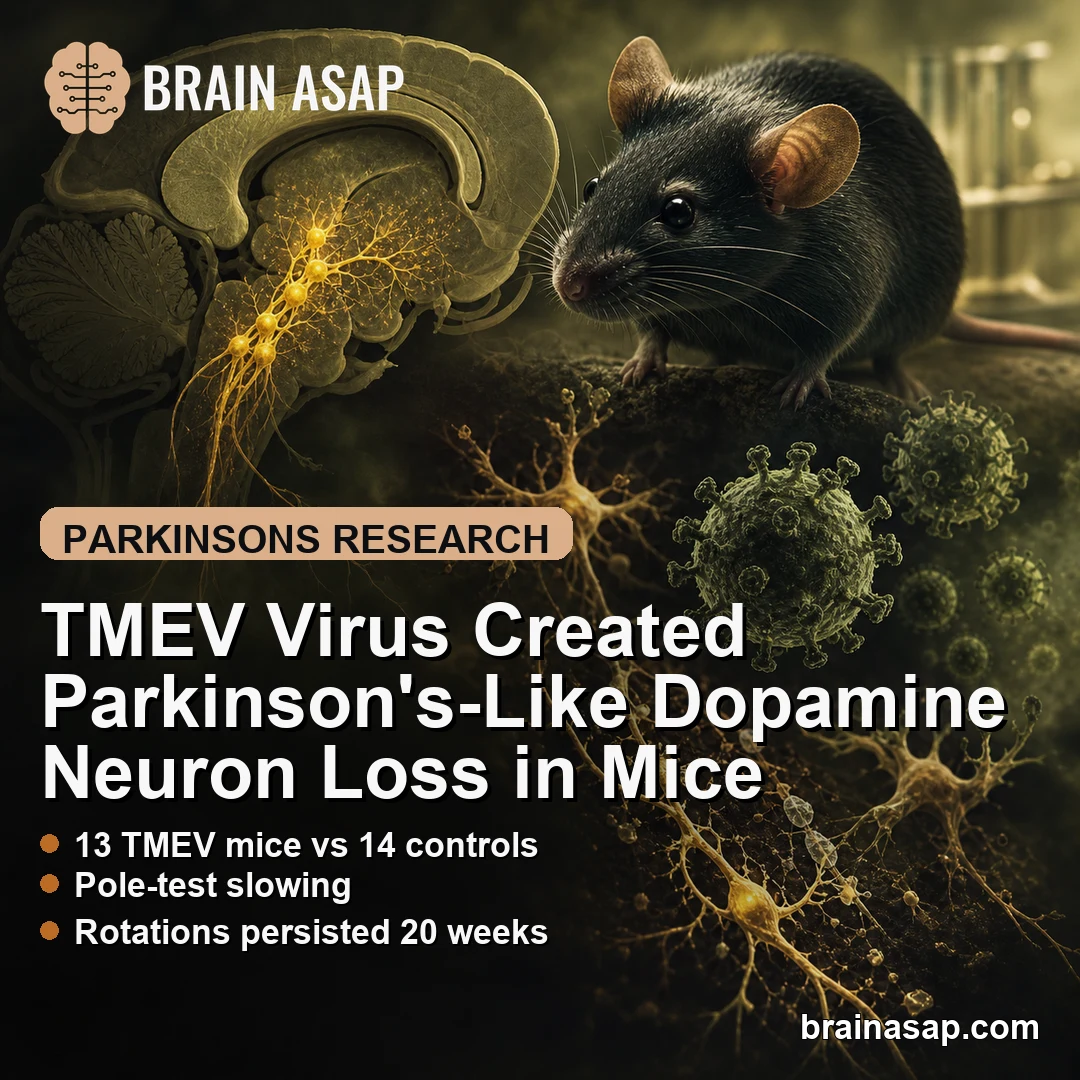
TL;DR: A 2026 study in Brain, Behavior, & Immunity – Health reported that Theiler’s murine encephalomyelitis virus (TMEV), a mouse neurotropic virus, infected substantia nigra dopamine neurons and produced Parkinson’s-like motor deficits in mice. Key Findings…
Read article ↗
TL;DR: A 2026 preprint on medRxiv found that older adults with mild-cognitive-impairment-level scores showed different resting facial action patterns than healthy controls, especially upper lip raiser, lip tightener, and lip suck measures. Key Findings MCI-lev…
Read article ↗
TL;DR: A 2026 narrative review in Neurological Research and Practice argued that Parkinson’s prevention is most actionable through physical activity, Mediterranean-style diet patterns, toxin reduction, earlier prodromal detection, and better rehabilitation aft…
Read article ↗