TL;DR: A 2026 study in Translational Psychiatry found that three different plasma p-tau217 assays separated Alzheimer’s dementia from controls and frontotemporal degeneration with excellent accuracy, shifting the test from whether the marker works to which pla…
Read article ↗
TL;DR: In Drosophila melanogaster, caffeine consumed at night impaired inhibitory control in an airflow task, especially in females. The effect was not explained by simple hyperactivity or sleep deprivation, and the study points to dopamine signaling in mushro…
Read article ↗
TL;DR: A 2025 study in Communications Biology found that a week-long mind-body retreat shifted brain-network, plasma-protein, metabolomic, and cell-growth measures, but the uncontrolled design keeps the result exploratory. Key Findings Healthy retreat attendee…
Read article ↗
TL;DR: A 2026 study in Nature Communications found that in mice, stress from inflammation, forced cell division, cancer-like pressure, and aging activated MLKL in blood-forming stem cells without causing widespread cell death. Instead, active MLKL built up in…
Read article ↗
TL;DR: A 2026 study in Psychopharmacology found that after 14 days of unpredictable chronic stress, a single 1-hour ayahuasca exposure restored sociability, reduced anxiety-like behavior, normalized cortisol, and rescued whole-brain BDNF in adult zebrafish wit…
Read article ↗
TL;DR: A 2026 MRI study in Brain Imaging and Behavior of 136 healthy young adults found no robust whole-brain gray matter, white matter, cortical thickness, or brain-age differences between early and late chronotypes. Key Findings 136 young adults: The study c…
Read article ↗
TL;DR: A 2026 preprint UK Biobank neuroimaging study in medRxiv found that the comorbidity group showed widespread lower cortical volume, subcortical differences, and white matter microstructure alterations, while several alterations appeared unique to the chr…
Read article ↗
TL;DR: A 2026 preprint birth-cohort study in medRxiv found that 91.1% of children had experienced violence by age 8, while age-8 violence exposure was associated with higher internalizing, externalizing, total problem scores, and disorder odds. Key Findings Ev…
Read article ↗
TL;DR: A 2026 network analysis study in European Archives of Psychiatry and Clinical Neuroscience found that insomnia was present in 18.3% and childhood trauma in 49.5% of patients, while daytime dysfunction and sleep-related distress were central nodes, while…
Read article ↗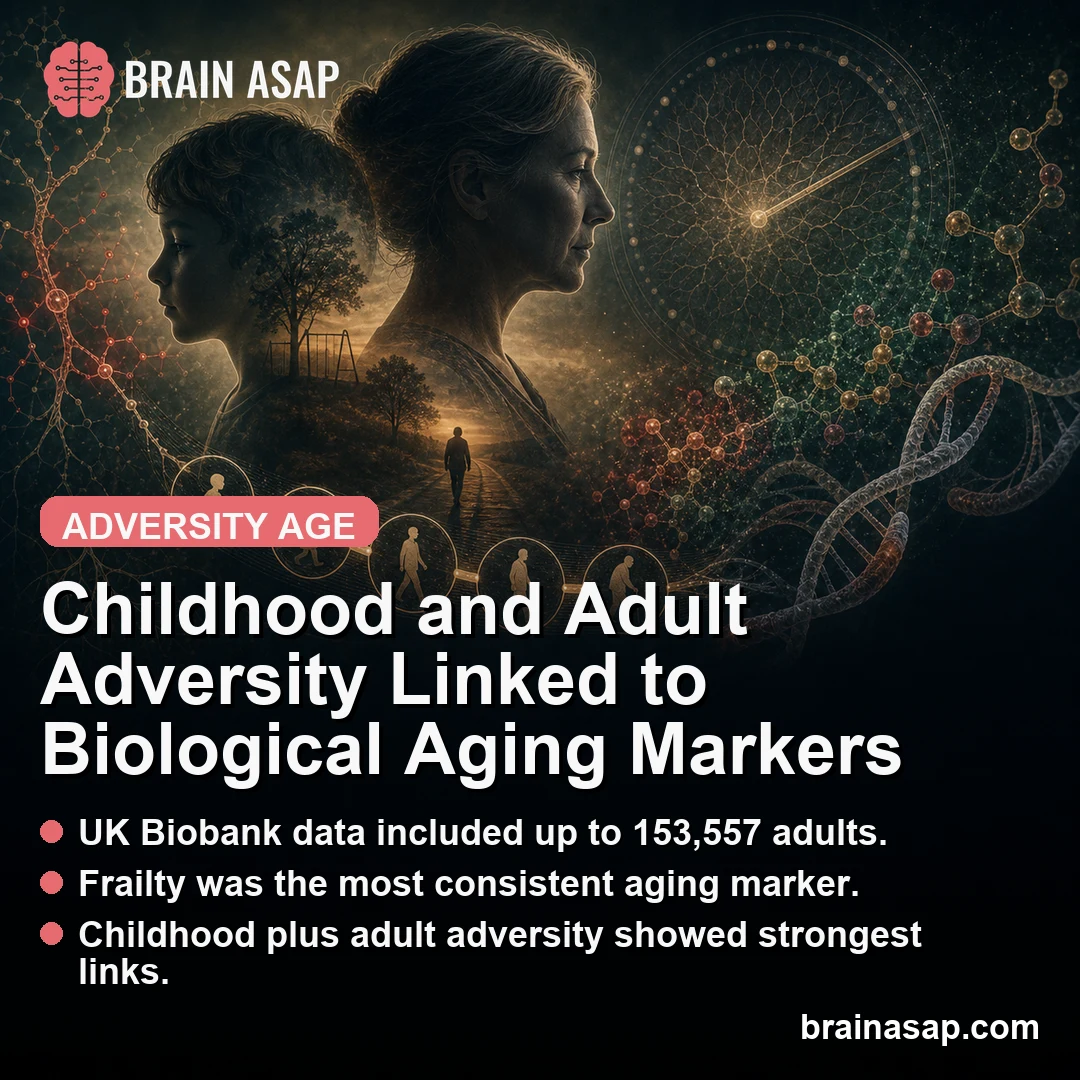
TL;DR: A 2026 BMC Medicine study of UK Biobank adults linked adversity in both childhood and adulthood to higher frailty, older metabolomic age profiles, lower grip strength, and some telomere differences, with the clearest associations in people reporting mul…
Read article ↗