Antidepressant Efficacy vs. CYP2C19 & CYP2D6 Metabolism Genetics (2024 Review)

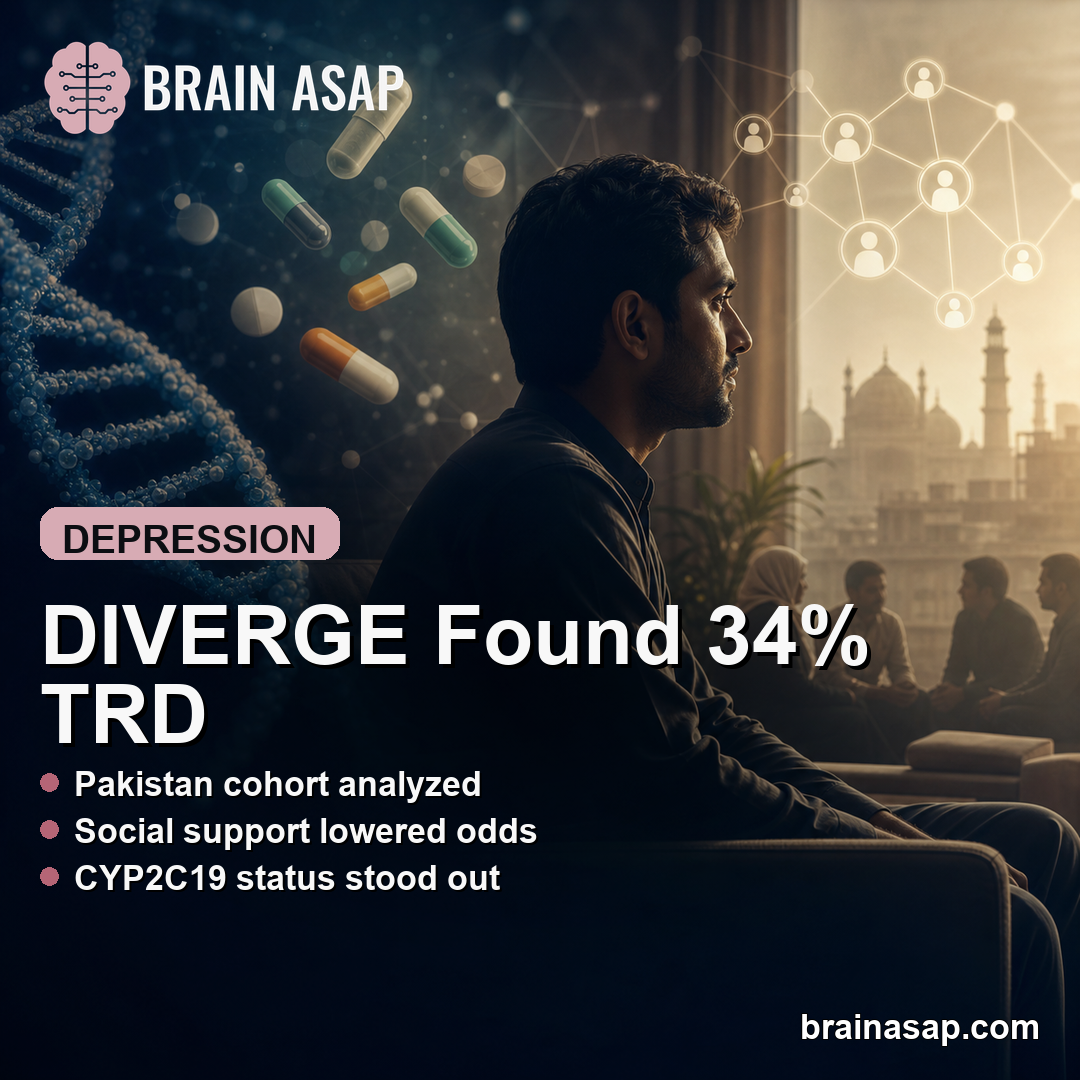
CYP2C19 poor metabolizers showed a nominally higher antidepressant remission rate compared to normal metabolizers, but overall genetic variations in CYP2C19 and CYP2D6 were not significantly associated with antidepressant response. Highlights: Higher Remission Rate: CYP2C19 poor metabolizers had a nominally higher remission rate (OR = 1.46) compared to normal metabolizers, but this did not hold after …

Read more

Occlusion Dysfunction (OD) Causally Linked to Alzheimer’s Disease (2024 Study)

Occlusion dysfunction (OD) is causally linked to an increased risk of Alzheimer’s disease (AD), while dentures restoration can mitigate this risk. Highlights: Periodontal disease (PD) and Alzheimer’s do not have a direct causal relationship (P = 0.395). Loose teeth significantly increase the risk of AD progression (P = 0.017, OR = 187.3567). Dentures restoration is …

Read more

Shared Genes & Biological Pathways in Depression & Alzheimer’s Disease (2024 Study)

A study found shared brain-specific mechanisms between Alzheimer’s disease (AD) and depression, particularly involving synaptic signaling and immune system pathways in the hippocampus, but no direct genetic overlap. Highlights: Six brain-specific eQTL genes (SRA1, MICA, PCDHA7, PCDHA8, PCDHA10, PCDHA13) are shared between AD and depression. Pathway analysis identified shared biological pathways, including synaptic signaling, myelination, …

Read more

Novel Risk Genes for Schizophrenia Discovered in High Altitude Tibetans via Whole-Exome Sequencing (2024 Study)

A study on Tibetans living at high altitudes identified novel risk genes for schizophrenia (SCZ) related to hypoxia, suggesting a unique genetic signature for SCZ in this population. Highlights: Whole-exome sequencing of 47 SCZ cases and 53 controls in Tibetans revealed 275 potential novel risk variants and two known variants. One gene, C5orf42, surpassed exome-wide …

Read more

PCSK9 Inhibitors May Increase Parkinson’s Disease & Reduce ALS Risk (2024 Study)

PCSK9 inhibitors significantly reduce the risk of amyotrophic lateral sclerosis (ALS) but increase the risk of Parkinson’s disease (PD). Highlights: ALS Risk Reduction: PCSK9 inhibitors marginally reduced the risk of ALS with an odds ratio of 0.89 (p = 0.048). PD Risk Increase: PCSK9 inhibitors increased the risk of Parkinson’s disease, with an odds ratio …

Read more

Psychological Trauma & Adversity May Accelerate Biological Aging (2024 Analysis)

Adversity accelerates biological aging through health-compromising behaviors like smoking and possibly social disconnection, and future research needs to focus on causal methodologies to better understand these processes and develop effective interventions. Highlights: Mechanisms of Accelerated Aging: Recent studies suggest that adversity accelerates biological aging, with health-compromising behaviors, especially smoking, playing a significant role in this …

Read more

Polygenic Scores May Improve Accuracy of ADHD Diagnosis when Combined with Standard Diagnostic Scales (2024 Study)

The ADHD polygenic score (PGS) adds slight yet statistically significant value to existing ADHD diagnostic tools, though it currently lacks clinical utility. Highlights: Study Overview: Researchers tested if adding a genetic score (ADHD PGS) to traditional diagnostic tools (ASRS and WURS scales) and family history could better predict ADHD. Improvement in Diagnosis: Adding the ADHD …

Read more

Micro & Long Non-Coding RNAs in Blood Samples May Accurately Diagnose Depression & Monitor Treatment Responses (2024 Study)

The study suggests that microRNAs (miRNAs) and long non-coding RNAs (lncRNAs) in blood and brain tissues can serve as significant biomarkers for diagnosing and monitoring major depressive disorder (MDD). Highlights: Diagnostic Potential: miRNAs and lncRNAs show significant variations in depressed patients, indicating their potential as diagnostic biomarkers for MDD. Treatment Monitoring: Changes in miRNA levels …

Read more

Autism Genetics & Immune Cell Activity: Causal Biomarkers Identified (2024 Study)

A study reported significant causal relationships between specific immune cell subtypes and autism spectrum disorder (ASD), highlighting 26 genetic correlations and potential biomarkers for early detection and treatment. Highlights: Significant Genetic Correlations: The study identifies 26 potential correlations between genetic predispositions in immune cell types (immunophenotypes) and the risk of developing ASD. Bi-Directional Analysis Results: …

Read more