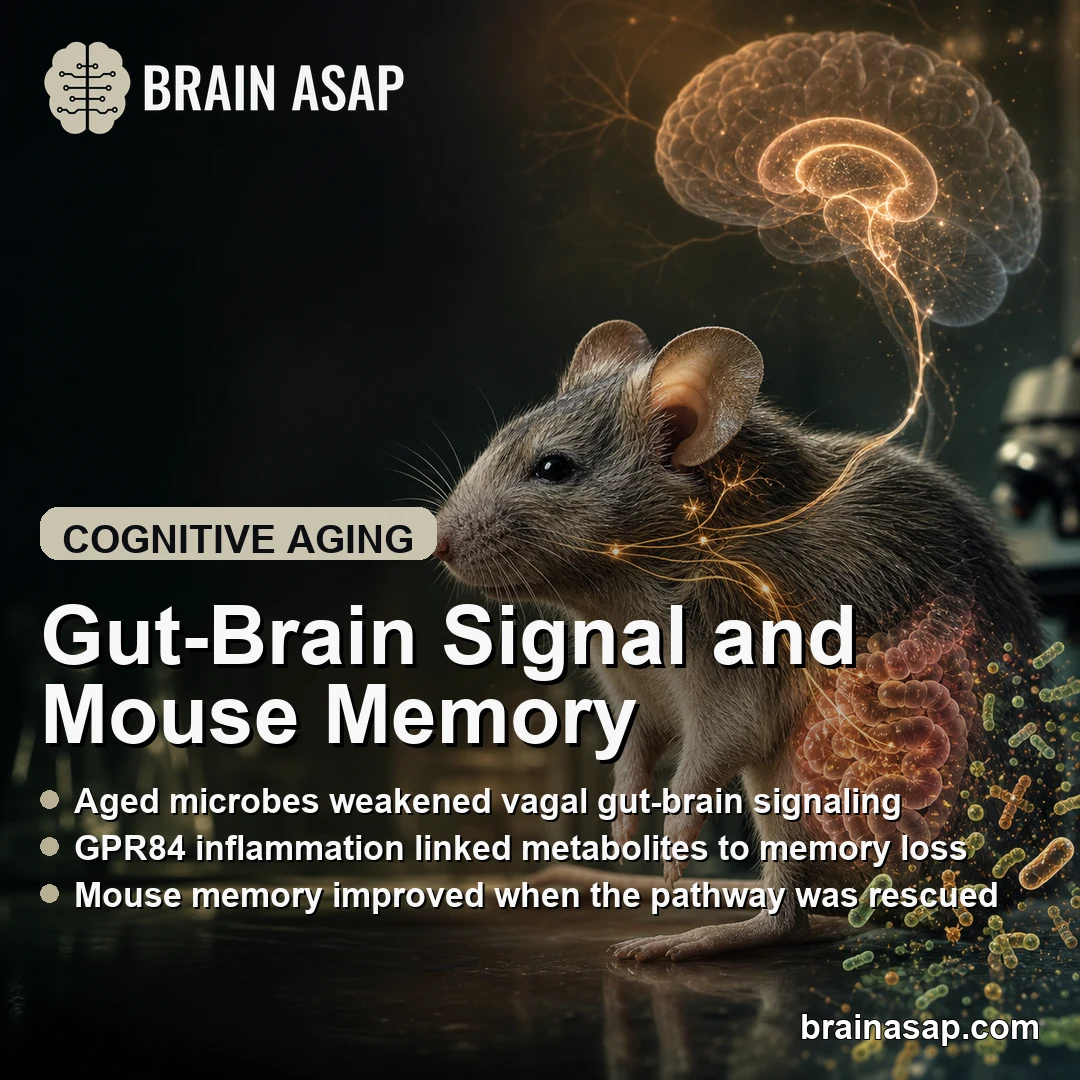
Aged Gut Microbiome Impaired Mouse Memory via Vagal Gut-Brain Signaling

Aged Gut Microbiome Impaired Mouse Memory via Vagal Gut-Brain Signaling

TL;DR: A 2026 mouse study in Nature found that age-related gut microbiome changes impaired vagal gut-brain signaling and hippocampal memory encoding, while several interventions restored memory performance in aged or microbiome-aged mice. Key Findings Aged microbiome transfer impaired memory: Young mice exposed to aged gut microbes showed worse novel object recognition and Barnes maze performance …

Read more

6PPD-Quinone Linked to Alzheimer’s Disease Pathways in Network Analysis

6PPD-Quinone Linked to Alzheimer’s Disease Pathways in Network Analysis

TL;DR: A 2026 study in Open Medicine used network pharmacology, Alzheimer’s disease transcriptomic datasets, machine learning, Mendelian randomization, and molecular docking to link 6PPD-quinone, a tire-wear chemical transformation product, with inflammation, oxidative-stress, kinase-signaling, and synaptic pathways relevant to Alzheimer’s disease. Key Findings 92 overlapping targets: Database mining found 92 molecular targets shared between 6PPD-quinone and …

Read more

Foamy Microglia Linked Oxylipins to Faster Multiple Sclerosis Progression

Foamy Microglia Linked Oxylipins to Faster Multiple Sclerosis Progression

TL;DR: A 2026 Nature Neuroscience study found that multiple sclerosis lesions rich in lipid-filled foamy microglia had a molecular profile tied to faster disability progression, cerebrospinal-fluid oxylipins, and a druggable lipid enzyme called MAGL. Key Findings 250 MS donors: Across Netherlands Brain Bank records, a higher proportion of lesions with foamy microglia correlated with faster …

Read more

Alcohol Plus Stress Impaired Midlife Cognitive Flexibility in Mice

Alcohol Plus Stress Impaired Midlife Cognitive Flexibility in Mice

TL;DR: A 2026 mouse study in Alcohol: Clinical and Experimental Research found that chronic intermittent ethanol plus repeated forced-swim stress left mice drinking more alcohol months later and impaired reversal learning in midlife, alongside locus coeruleus signs of oxidative stress and weaker adrenergic autoregulation. Key Findings Persistent effects reached midlife: The experiment followed 55 C57BL/6J …

Read more

BCG Immunotherapy Altered CNS Immunity and Alzheimer’s Biomarkers

BCG Immunotherapy Altered CNS Immunity and Alzheimer's Biomarkers

TL;DR: A 2026 open-label study in Communications Medicine found that Bacillus Calmette-Guerin (BCG) immunotherapy changed cerebrospinal-fluid immune-cell responses and Alzheimer-related biomarkers in 23 older adults. Key Findings Small trial context: 2 related 1-year open-label trials enrolled 23 adults aged 55 or older at one academic medical center. BCG dosing was simple: Participants received 2 intradermal …

Read more

PINK1/Parkin Mitophagy Review Clarified Parkinson Disease Mechanisms

PINK1/Parkin Mitophagy Review Clarified Parkinson Disease Mechanisms

TL;DR: A 2026 review in Translational Neuroscience summarizes why PINK1 and parkin, two genes linked to early-onset parkinsonism, keep pointing researchers back to mitophagy and autophagy as Parkinson disease mechanisms. Key Findings 18 PARK loci noted: The review frames familial Parkinson genetics as a route into molecular mechanisms, including PARK2 and PARK6. PARK2 encodes parkin: …

Read more

NF2-Mutant Meningiomas Lost Identity During Sarcoma-Like Transformation

NF2-Mutant Meningiomas Lost Identity During Sarcoma-Like Transformation

TL;DR: A 2026 study in Acta Neuropathologica found that rare NF2-mutant meningiomas can transform into aggressive sarcoma-like tumors while keeping clonal ancestry but losing normal meningioma molecular identity. Key Findings 9 matched tumor pairs: Researchers analyzed nine matched meningioma-sarcoma pairs with histology, immunohistochemistry, DNA methylation, sequencing, copy-number profiling, and proteomics. Shared NF2 ancestry: Sarcomatous recurrences …

Read more

Tanshinone IIA Review Maps Cerebrovascular Protection Mechanisms

Tanshinone IIA Review Maps Cerebrovascular Protection Mechanisms

TL;DR: A 2026 review in International Journal of Molecular Medicine summarized how tanshinone IIA, a compound from Salvia miltiorrhiza, may protect cardiovascular and cerebrovascular tissue through anti-inflammatory, antioxidant, anti-apoptotic, and nanodelivery-linked mechanisms. Key Findings Four mechanism families: The review grouped tanshinone IIA activity around inflammation, oxidative stress, apoptosis/fibrosis, and pathway regulation. Three named pathways: TLR4/NF-kB, …

Read more

Hyperglycosylation Linked Glucosamine to Faster Alzheimer Progression

Hyperglycosylation Linked Glucosamine to Faster Alzheimer Progression

TL;DR: A 2026 study in Nature Metabolism identified brain hyperglycosylation as a metabolic driver of Alzheimer disease in human tissue and mouse models, while glucosamine exposure was linked to worse outcomes in Alzheimer-related dementia records. Key Findings Human AD brains showed excess glycans: Spatial glycomics found elevated N-glycan abundance in Alzheimer frontal cortex samples compared …

Read more

Brain-Derived p-tau217% Better Classified Alzheimer Pathology

Brain-Derived p-tau217% Better Classified Alzheimer Pathology

TL;DR: A 2026 preprint in medRxiv found that brain-derived p-tau217%, a blood marker designed to isolate central nervous system tau, classified Alzheimer disease pathology better than standard plasma p-tau217 in several Alzheimer cohorts. Key Findings CNS-selective ratio: The proposed marker, brain-derived p-tau217%, estimates the share of circulating tau that is both brain-derived and phosphorylated at …

Read more