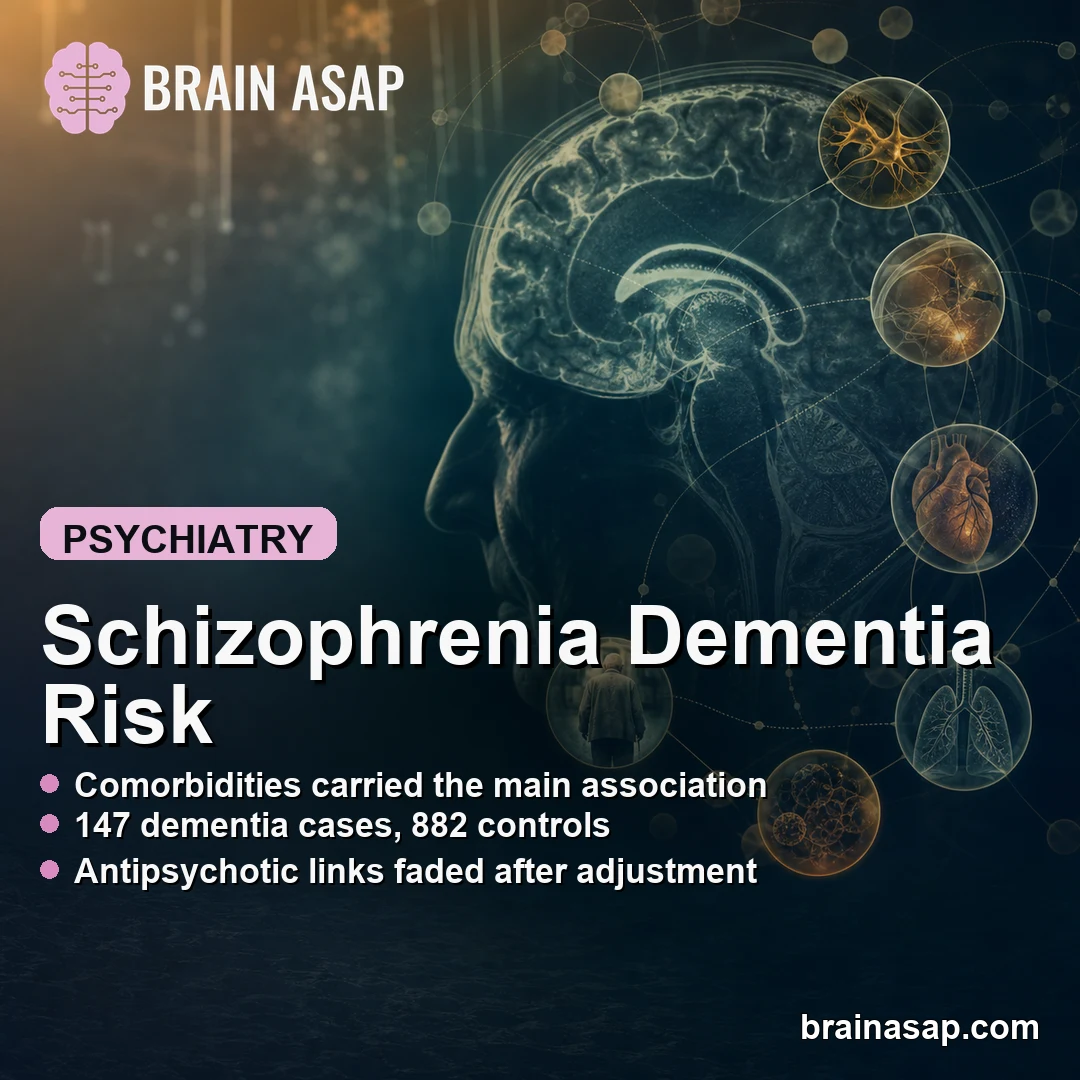
Schizophrenia Dementia Risk Tracked Comorbidities More Than Antipsychotics

Schizophrenia Dementia Risk Tracked Comorbidities More Than Antipsychotics

TL;DR: A 2026 study in BMC Psychiatry used Taiwan insurance records to find that dementia in people with schizophrenia was tied more strongly to age and linked medical comorbidities than to antipsychotic exposure after multivariable adjustment. Key Findings 147 dementia cases: Researchers compared 147 people with schizophrenia who developed dementia with 882 sex- and diagnosis-year-matched …

Read more

Putamen-Focused tTIS Lowered Parkinson’s Motor Scores

Putamen-Focused tTIS Lowered Parkinson's Motor Scores

TL;DR: A 2026 preprint posted to medRxiv found that intermittent theta-burst transcranial temporal interference stimulation (iTBS-tTIS), a noninvasive electrical method aimed at the right putamen, lowered left-sided Parkinson’s motor scores during stimulation in 19 patients. Key Findings 19 Parkinson’s patients and 19 healthy controls completed a randomized, double-blind crossover stimulation study. MDS-UPDRS III, the motor …

Read more

Pulse-Wave Coherence Was Lower in Mild Cognitive Impairment

Pulse-Wave Coherence Was Lower in Mild Cognitive Impairment

TL;DR: A 2026 medRxiv preprint found that older adults with Montreal Cognitive Assessment (MoCA)-defined mild cognitive impairment had less coordinated pulse-wave responses during a cognitive challenge than cognitively intact older adults. Key Findings Community cognitive-aging sample: The southern Taiwan dataset included 101 older adults: 12 reference participants, 50 people in a MoCA-defined mild cognitive impairment …

Read more

Parkinson’s Speech Pauses Increased With Sentence Length and Complexity

Parkinson's Speech Pauses Increased With Sentence Length and Complexity

TL;DR: A 2026 study in PLOS One found that people with Parkinson’s disease made more silent pauses while reading aloud, especially when sentences were longer or syntactically more complex. Key Findings Reading task compared 71 adults: Researchers compared 32 people with Parkinson’s disease and 39 older control participants. Parkinson’s readers paused more often: The Parkinson’s …

Read more

Brain-Heart Coupling Tracked Parkinson’s Disease and Freezing of Gait

Brain-Heart Coupling Tracked Parkinson's Disease and Freezing of Gait

TL;DR: A 2026 preprint in medRxiv used electroencephalography (EEG), a scalp electrical-activity recording method, and electrocardiogram (ECG) recordings to test whether brain-heart interplay, meaning coupling between brain-network organization and cardiac autonomic activity, tracks aging, Parkinson’s disease, cognitive screening scores, and freezing of gait. Key Findings Three datasets: Researchers analyzed resting EEG-ECG data from healthy young …

Read more

Oxidative Stress Reduced Brain Deubiquitylase Activity With Age

Oxidative Stress Reduced Brain Deubiquitylase Activity With Age

TL;DR: A 2026 Nature Communications study in aging mouse and killifish brains found that deubiquitylases (DUBs), enzymes that help edit protein-cleanup tags, lost about 40% of their catalytic activity with age even when many of the same enzymes were still present. Key Findings Brain DUB activity fell with age: In old mouse brains, researchers saw …

Read more

Loneliness Linked Alzheimer’s Disease and Suicide Risk Signals

Loneliness Linked Alzheimer's Disease and Suicide Risk Signals

TL;DR: A 2026 systematic review and meta-analysis in Psychogeriatrics linked loneliness with Alzheimer’s disease and several forms of suicidal behavior, with especially strong shared correlations for hopelessness, insomnia, entrapment, and stress. Key Findings 316 studies reviewed: Researchers found 44 studies on loneliness and Alzheimer’s disease, 261 on loneliness and suicide, and no original study that …

Read more

fMRI Biotypes Predicted tDCS Anxiety Response in Alzheimer’s-Risk Adults

fMRI Biotypes Predicted tDCS Anxiety Response in Alzheimer's-Risk Adults

TL;DR: A 2026 preprint on medRxiv used resting-state functional MRI (fMRI), a brain-connectivity scan taken while people are not doing a task, to divide older adults at Alzheimer’s risk into anxiety biotypes that responded differently to frontal-lobe tDCS stimulation. Key Findings Older-adult tDCS trial: The final sample included 199 older adults, with 99 sham tDCS …

Read more

Clomipramine Inhibited Itch and Improved Memory in Alzheimer’s Mice

Clomipramine Inhibited Itch and Improved Memory in Alzheimer's Mice

TL;DR: A 2026 mouse study in iScience found that blocking Itch, an E3 ubiquitin ligase involved in protein tagging, improved several memory-test readouts in an Alzheimer’s disease mouse model and reduced neuronal apoptosis, including when researchers used the existing drug clomipramine. Key Findings Two Itch strategies: Researchers tested AAV-delivered loss-of-function Itch mutants and clomipramine, a …

Read more

ATP11B-YAP Axis Linked Iron Transport to Cognitive Decline in Aging Mice

ATP11B-YAP Axis Linked Iron Transport to Cognitive Decline in Aging Mice

TL;DR: A 2026 mouse and cell study in Signal Transduction and Targeted Therapy linked ATP11B, a phospholipid-flipping transport protein, to hippocampal iron handling, mitochondrial failure, ferroptosis, and age-related cognitive decline. Key Findings ATP11B fell with brain aging: Older mice showed lower blood-brain-barrier tight-junction markers and ATP11B emerged from integrated aging, endothelial-cell, and transport-gene analyses. ATP11B …

Read more