Social Media Abstinence Did Not Improve Mood or Life Satisfaction in 10-Study Meta-Analysis of 4,674 Adults

Social Media Abstinence Did Not Improve Mood or Life Satisfaction in 10-Study Meta-Analysis of 4,674 Adults

TL;DR: A 2025 systematic review and meta-analysis in Scientific Reports pooled 10 social media abstinence experiments (N = 4,674 adults; abstinence 1–28 days) and found no significant effect on positive affect, negative affect, or life satisfaction. Key Findings Positive affect was unchanged: pooled Hedges’ g = 0.03 (95% CI [−0.11, 0.16], p = 0.69) across 9 studies and 14 …

Read more

Plasma p-tau217 AI Models Lost Utility Across Cohorts

Plasma p-tau217 AI Models Lost Utility Across Cohorts

TL;DR: A 2026 medRxiv preprint found that plasma p-tau217 AI models still separated amyloid-positive from amyloid-negative people across ADNI and A4, but calibration drift made the same probabilities less dependable for clinical decisions. Key Findings Calibration drift weakened clinical utility: The study trained plasma biomarker machine-learning models in one Alzheimer’s cohort and tested them in …

Read more

SimulAD Modeled Amyloid Clearance in Alzheimer’s Trials

SimulAD Modeled Amyloid Clearance in Alzheimer's Trials

TL;DR: A 2026 medRxiv preprint tested SimulAD, an Alzheimer’s disease progression simulator, and reported that it reproduced mean amyloid-clearance results within 5% error across six major phase III anti-amyloid trials while also separating positive trials from null trials in retrospective power analyses. Key Findings Six phase III trials: Researchers retrospectively simulated TRAILBLAZER-ALZ2, CLARITY AD, EMERGE, …

Read more

AI Chatbot Use for Companionship Predicted Higher Emotional Isolation Four Months Later in 12-Month Cross-Lagged Study

AI Chatbot Use for Companionship Predicted Higher Emotional Isolation Four Months Later in 12-Month Cross-Lagged Study

TL;DR: A 12-month four-wave longitudinal study in Psychological Science (N=2,149 adults across the UK, US, Canada, and Australia) found that feeling more emotionally isolated predicted higher chatbot use four months later — and that higher chatbot use, in turn, predicted further increases in emotional isolation at the next wave. Key Findings Bidirectional link with emotional …

Read more

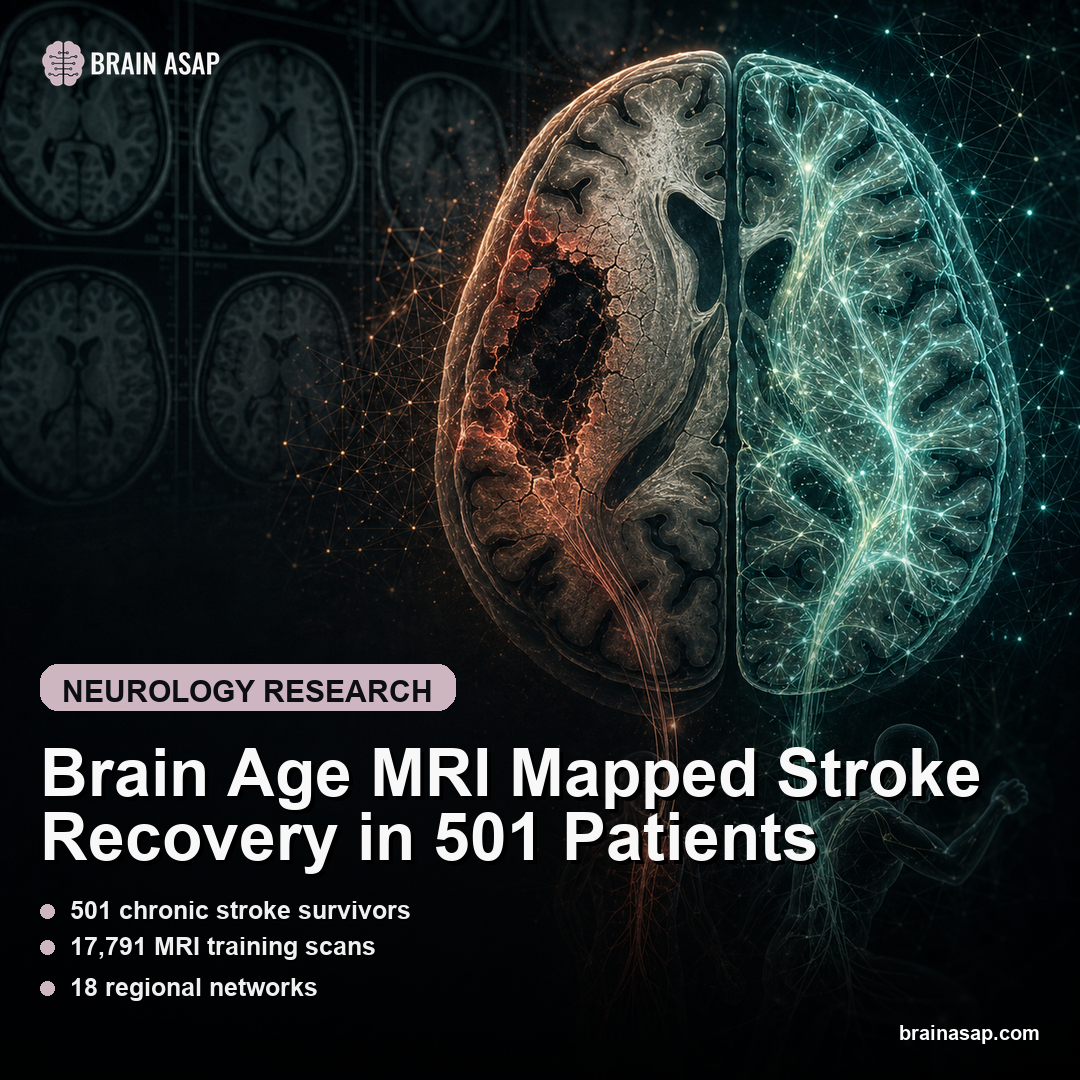
MRI Brain Age Mapped Stroke Recovery in 501 Patients

Brain Age MRI Mapped Stroke Recovery in 501 Patients

Brain Age MRI Mapped Stroke Recovery in 501 Patients TL;DR: A Lancet Digital Health ENIGMA study found that larger stroke lesions made the damaged hemisphere look biologically older, while severe motor impairment was linked to younger-appearing contralesional networks, likely reflecting compensation. Key Findings 501 chronic stroke survivors: The ENIGMA Stroke Recovery Working Group dataset included …

Read more

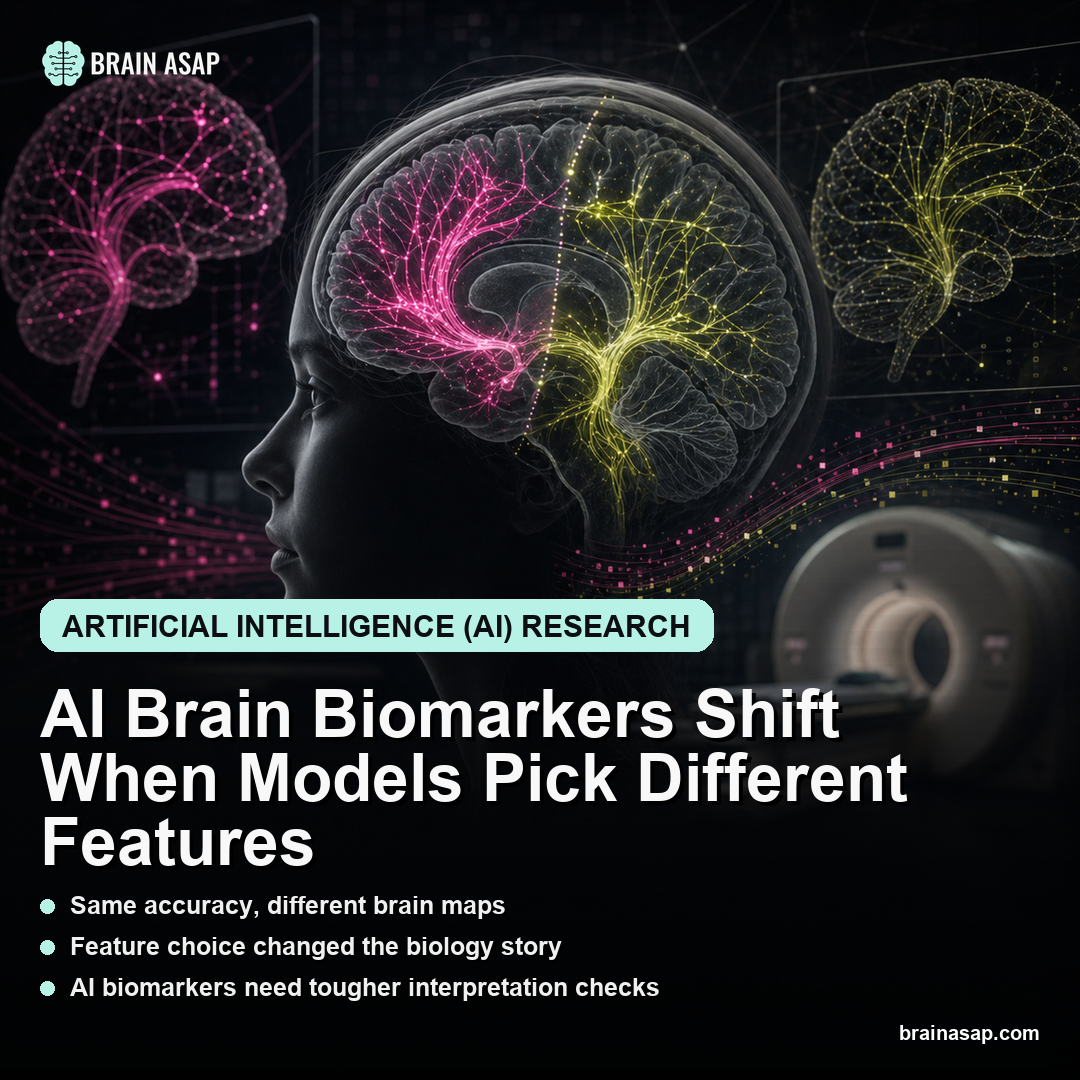
AI Brain Connectivity Biomarkers for Cognition Shifted Across Pipelines

AI Brain Biomarkers Shift When Models Pick Different Features

AI Brain Biomarkers Shift When Models Pick Different Features TL;DR: Across more than 12,000 participants and 13 outcomes, overlooked brain-connectivity features predicted cognition and psychiatric traits nearly as well as top-ranked features, but pointed to different underlying circuits. Key Findings Hidden features held predictive power: The authors tested their idea across HBN, ABCD, HCPD, and …

Read more

Epigenetic Biosignature of First-Episode Schizophrenia Identified via Machine Learning (2024)

A new study uses AutoML and blood DNA methylation data to identify novel gene biomarkers for diagnosing schizophrenia (SCZ) with high accuracy. Highlights: Biomarker Discovery: AutoML identified three schizophrenia-specific gene methylation biomarkers: IGF2BP1, CENPI, and PSME4. Methylation Analysis: IGF2BP1 showed higher methylation and PSME4 showed lower methylation in SCZ patients compared to healthy controls, while …

Read more

Advances in Electrical Neural Interfaces for Brain Augmentation & Neuroscience Research

Electrical neural interfaces are unlocking new possibilities for studying, restoring, and augmenting brain functions. These devices provide direct communication pathways to connect the nervous system with the external world. Recent innovations in neural electrode design, electronics, wireless transmission, integration of electrical and optical modalities, and neural data processing are rapidly advancing the capabilities of electrical …

Read more

Brain Machine Interfaces: Progress, Applications, Ethical Considerations

Brain-machine interfaces (BMIs) are emerging devices that connect the human brain to computers and machines, enabling an unprecedented two-way flow of information and control. BMIs offer extraordinary new capabilities but also present profound ethical dilemmas we must confront. Key Facts: BMIs acquire brain signals, analyze them via algorithms, and translate them into commands that control …

Read more

Brain Scans of Criminal Suspects & Privacy Rights: Coercive MRIs for Investigations?

New neuroimaging technologies are rapidly advancing our ability to examine the brain, revealing information about our memories, thoughts and even intentions. As these technologies improve, some are advocating for their use in criminal investigations and legal proceedings. But could mandatory brain scans used on suspects violate privacy rights? Key Facts: Neuroimaging technologies like MRI, CT, …

Read more