TL;DR: A 2026 Nature Communications paper introduced CAptVE, a fluorescent aptamer method that labels molecular features in mouse brain tissue while preserving ultrastructure for electron-microscopy connectomics. Key Findings Detergent-free labeling: CAptVE us…
Read article ↗
TL;DR: A 2026 randomized trial in Scientific Reports found that adding esketamine to sufentanil patient-controlled analgesia lowered short-term postoperative depression and anxiety scores in elderly colorectal cancer surgery patients, without improving pain sc…
Read article ↗
TL;DR: A study in Communications Biology found that environmental enrichment, richer housing with objects, running space, and novelty, reduced early-life-stress-linked visceral pain and depression-like behavior in rats while normalizing a CB1 receptor-sensitiv…
Read article ↗
TL;DR: A 2026 paper in Current Therapeutic Research described an acute PGAD-like genital arousal episode after self-initiated duloxetine withdrawal, with symptoms resolving within 5 hours after emergency admission and no recurrence over 36 months. Key Findings…
Read article ↗
TL;DR: A 2026 study in Nature Communications used resting-state functional MRI (fMRI) to link major depressive disorder to more frequent but shorter visits to a salience-dominated brain state. Key Findings Resting-state fMRI compared depression with controls:…
Read article ↗
TL;DR: A 2026 methylome-wide study in Clinical Epigenetics found that genetically inferred CYP2C19 metaboliser status, a pharmacogenomic marker relevant to antidepressant handling, was associated with DNA methylation patterns in a large Scottish cohort. Key Fi…
Read article ↗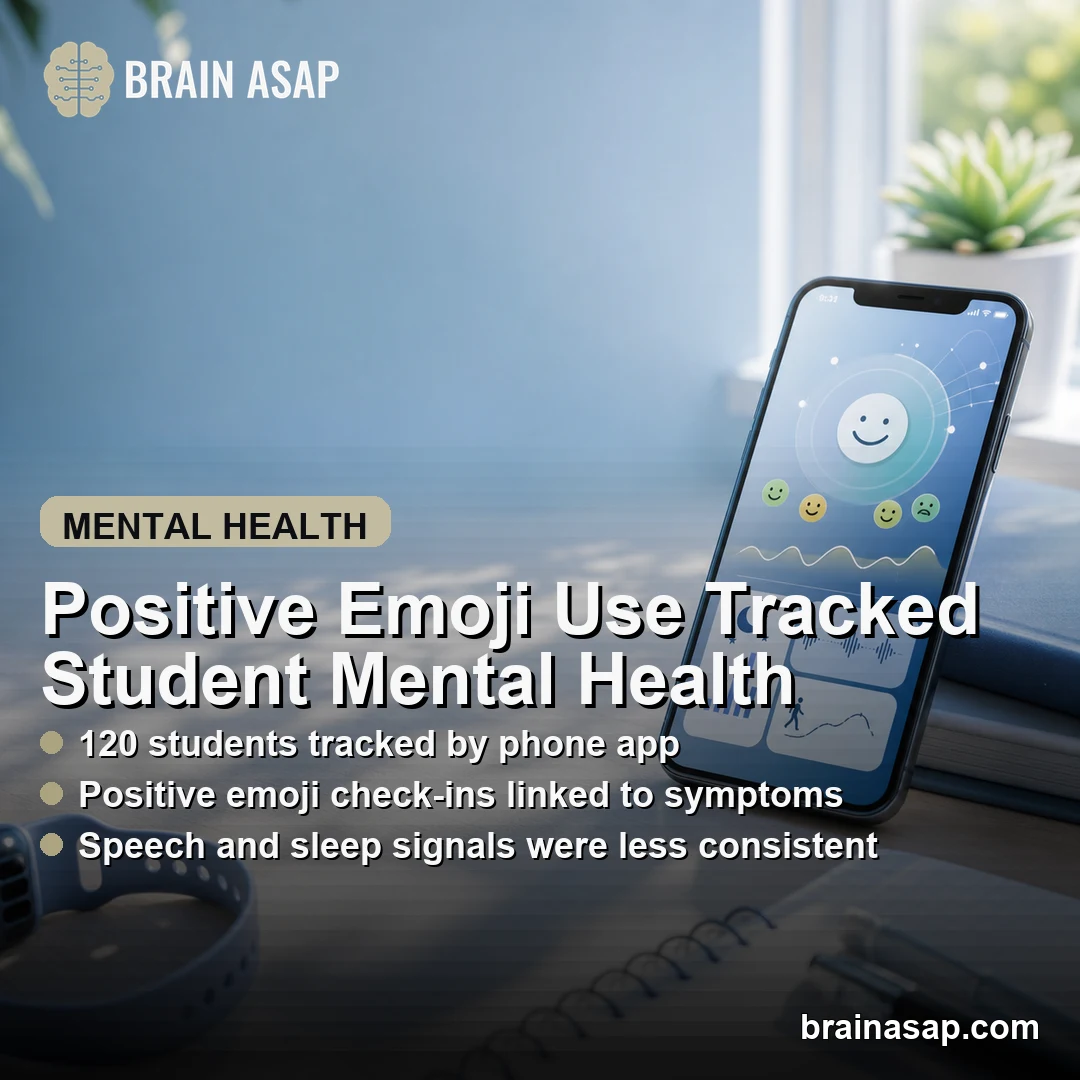
TL;DR: A 2026 Research Square preprint followed 120 college students with a smartphone app and found that a higher share of positive emoji check-ins was the most consistent digital marker tied to lower depression, lower anxiety, and higher flourishing. Key Fin…
Read article ↗
TL;DR: A 2026 randomized study in The Journal of Strength and Conditioning Research found that coherent breathing, a slow 6-breaths-per-minute breathing routine, improved several recovery markers in highly trained 400-meter athletes under repeated race stress…
Read article ↗
TL;DR: A 2026 mouse study in iScience found that blocking Itch, an E3 ubiquitin ligase involved in protein tagging, improved several memory-test readouts in an Alzheimer’s disease mouse model and reduced neuronal apoptosis, including when researchers used the…
Read article ↗
TL;DR: A 2026 medRxiv preprint found that a composite cerebral small vessel disease (cCSVD) score from routine T1 MRI predicted 3-month cognitive recovery after stroke better than any single small-vessel marker in a 65-person cohort. Key Findings Recovery wind…
Read article ↗