Right DLPFC tDCS Did Not Improve Working Memory in Schizophrenia
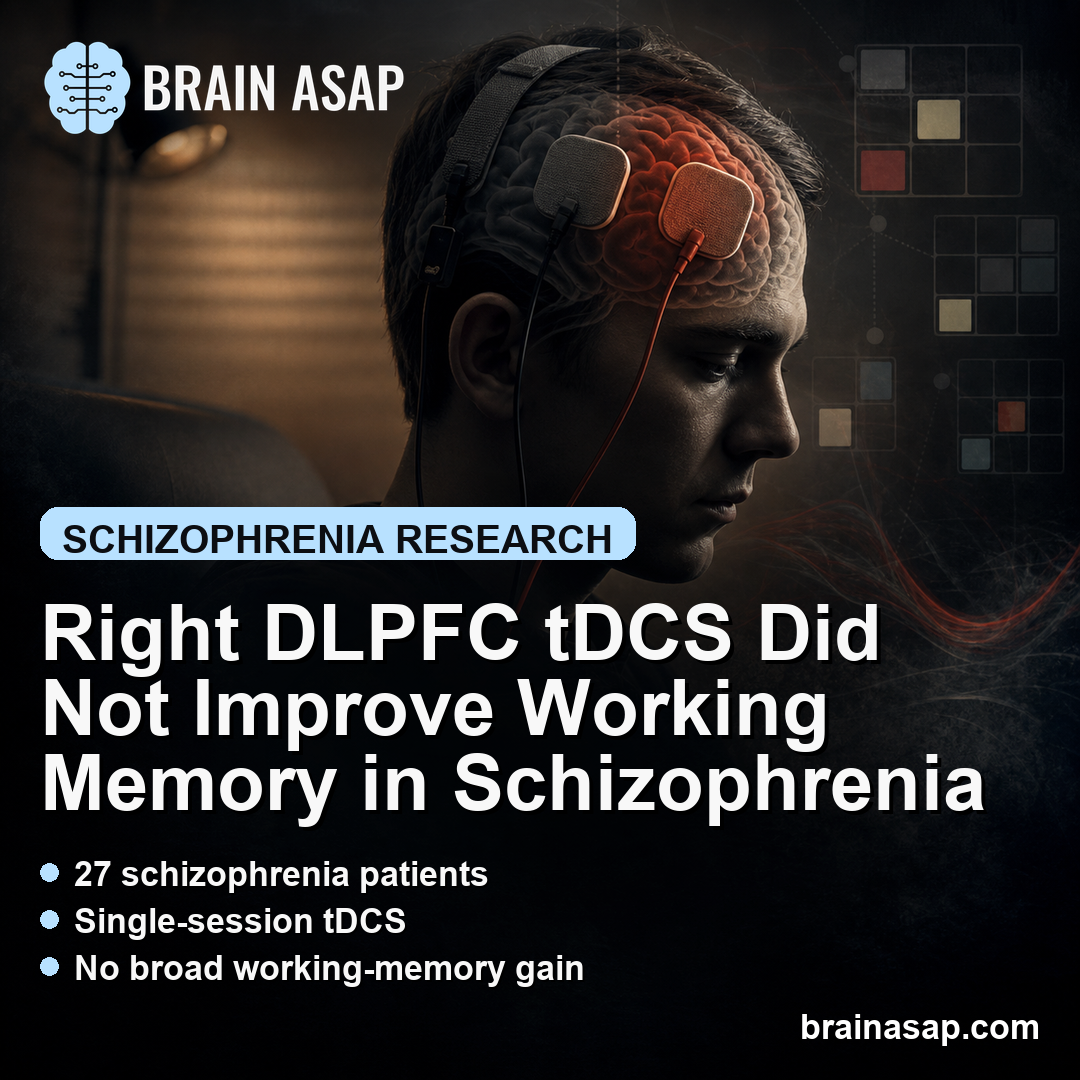
Right DLPFC tDCS Did Not Improve Working Memory in Schizophrenia

TL;DR: A 2026 sham-controlled study in BMC Psychiatry found that one 15-minute session of 1.5 mA anodal transcranial direct current stimulation (tDCS) over the right dorsolateral prefrontal cortex did not improve visuospatial or verbal working memory in clinically stable schizophrenia patients. Key Findings 27 schizophrenia patients: The final analysis included 14 men and 13 women …
Read more

Rare OCD Variants in NPY5R, DLGAP1, and MAPK8IP3 Tracked in Two Families

Rare OCD Variants in NPY5R, DLGAP1, and MAPK8IP3 Tracked in Two Families

TL;DR: A 2026 preprint in medRxiv used whole-genome sequencing in two families with many obsessive-compulsive disorder (OCD) cases and prioritized rare variants in NPY5R, DLGAP1, and MAPK8IP3, but the findings still need replication and functional testing. Key Findings Two densely affected families: Researchers sequenced 25 people from two multiplex OCD pedigrees, meaning families with several …

Read more

Putamen-Focused tTIS Lowered Parkinson’s Motor Scores

Putamen-Focused tTIS Lowered Parkinson's Motor Scores

TL;DR: A 2026 preprint posted to medRxiv found that intermittent theta-burst transcranial temporal interference stimulation (iTBS-tTIS), a noninvasive electrical method aimed at the right putamen, lowered left-sided Parkinson’s motor scores during stimulation in 19 patients. Key Findings 19 Parkinson’s patients and 19 healthy controls completed a randomized, double-blind crossover stimulation study. MDS-UPDRS III, the motor …

Read more

Pulse-Wave Coherence Was Lower in Mild Cognitive Impairment

Pulse-Wave Coherence Was Lower in Mild Cognitive Impairment

TL;DR: A 2026 medRxiv preprint found that older adults with Montreal Cognitive Assessment (MoCA)-defined mild cognitive impairment had less coordinated pulse-wave responses during a cognitive challenge than cognitively intact older adults. Key Findings Community cognitive-aging sample: The southern Taiwan dataset included 101 older adults: 12 reference participants, 50 people in a MoCA-defined mild cognitive impairment …

Read more

Psychotropic Medications Linked to Subcortical Brain Volume in Bipolar Disorder

Psychotropic Medications Linked to Subcortical Brain Volume in Bipolar Disorder

TL;DR: A 2026 Molecular Psychiatry ENIGMA mega-analysis found that medication status in bipolar disorder was linked to subtle differences in subcortical brain volume, with antiepileptic and antipsychotic exposure most consistently tied to smaller hippocampal and thalamic volumes. Key Findings 6,729-person ENIGMA sample: Researchers pooled MRI data from 2,664 people with bipolar disorder and 4,065 controls …

Read more

Flexible Polyimide Brain Implants Lowered Tissue Reactivity

Flexible Polyimide Brain Implants Lowered Tissue Reactivity

TL;DR: A 2026 study in Advanced Science found that flexible polyimide brain-implant probes produced lower long-term tissue reactivity than stiff silicon electrodes, while thinner probe designs and skull-detached mounting mattered less than the implant material itself. Key Findings Material mattered most: Flexible polyimide probes triggered less brain-tissue reactivity than stiff silicon electrodes. Not reaction-free: Polyimide …

Read more

Brain-Heart Coupling Tracked Parkinson’s Disease and Freezing of Gait

Brain-Heart Coupling Tracked Parkinson's Disease and Freezing of Gait

TL;DR: A 2026 preprint in medRxiv used electroencephalography (EEG), a scalp electrical-activity recording method, and electrocardiogram (ECG) recordings to test whether brain-heart interplay, meaning coupling between brain-network organization and cardiac autonomic activity, tracks aging, Parkinson’s disease, cognitive screening scores, and freezing of gait. Key Findings Three datasets: Researchers analyzed resting EEG-ECG data from healthy young …

Read more

Oxidative Stress Reduced Brain Deubiquitylase Activity With Age

Oxidative Stress Reduced Brain Deubiquitylase Activity With Age

TL;DR: A 2026 Nature Communications study in aging mouse and killifish brains found that deubiquitylases (DUBs), enzymes that help edit protein-cleanup tags, lost about 40% of their catalytic activity with age even when many of the same enzymes were still present. Key Findings Brain DUB activity fell with age: In old mouse brains, researchers saw …

Read more

Mouse Smell Receptors Followed a Spatial Code Linked to Brain Maps

Mouse Smell Receptors Followed a Spatial Code Linked to Brain Maps

TL;DR: A 2026 mouse study in Cell found that olfactory receptor neurons, the smell-sensing cells in the nose, were arranged in spatial bands that lined up with matching sensory maps in the brain’s olfactory bulb. Key Findings Organized receptor bands: Researchers found that odor receptor neurons were not randomly scattered across the mouse nose; receptor …

Read more

Newborn Metabolomics Linked Prenatal Air Pollution to Autism Risk Pathways

Newborn Metabolomics Linked Prenatal Air Pollution to Autism Risk Pathways

TL;DR: A 2026 study in Journal of Exposure Science & Environmental Epidemiology linked prenatal PM2.5 and non-freeway NOx exposure with newborn amino-acid metabolism pathways that also tracked autism spectrum disorder (ASD) diagnosis before age 5. Key Findings 100 newborn blood spots: Researchers analyzed 50 children later diagnosed with ASD and 50 matched controls from Kaiser …

Read more