Extra Virgin Olive Oil Increased Occipital Brain Connectivity in Pilot fMRI Study

Extra Virgin Olive Oil Increased Occipital Brain Connectivity in Pilot fMRI Study

TL;DR: A 2026 pilot study in Food & Function found that one month of extra virgin olive oil intake was associated with higher resting-state occipital functional connectivity than regular olive oil in 9 healthy young adults. Key Findings Occipital connectivity was the imaging endpoint: The 9-person neuroimaging substudy came from a larger randomized crossover trial …

Read more

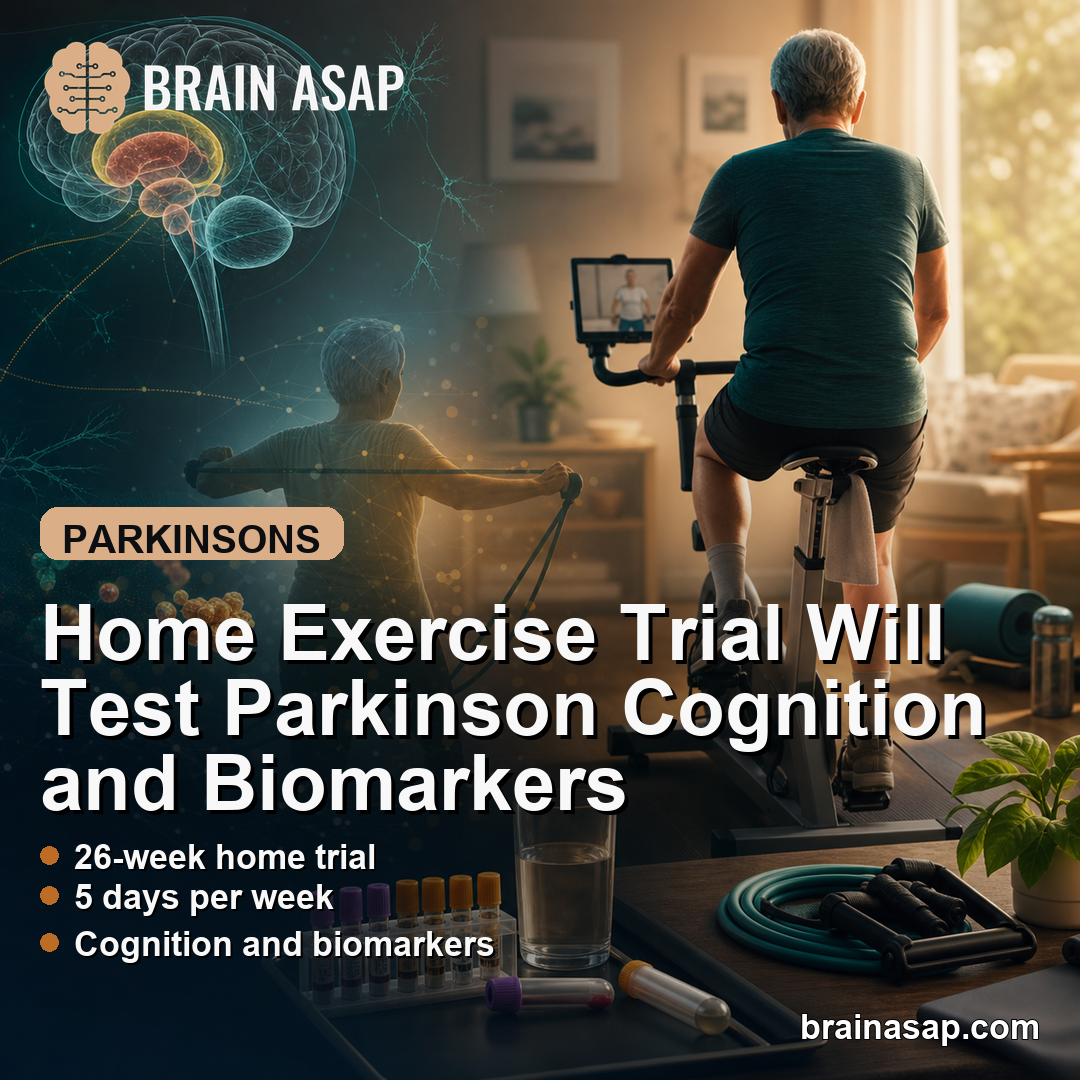
GLP-1 Agonists Showed Dose-Specific ON-Medication Motor Effects in Parkinson’s Disease

GLP-1 Agonists Showed Dose-Specific ON-Medication Motor Effects in Parkinson's Disease

TL;DR: A 2026 systematic review and exploratory network meta-analysis of 5 randomized trials in Neurological Sciences found dose-specific ON-medication motor improvements, measured while usual Parkinson’s drugs were active, for some GLP-1 receptor agonists, glucose-related metabolic hormone drugs, in Parkinson’s disease, but broader motor, non-motor, and quality-of-life evidence remained limited. Key Findings 5 randomized trials: The …

Read more

Targeted Memory Reactivation Changed Sleep Waves But Not Motor Retention in Parkinson’s

Targeted Memory Reactivation Changed Sleep Waves But Not Motor Retention in Parkinson’s

TL;DR: A 2026 medRxiv preprint found that targeted memory reactivation (TMR), replaying learned sounds during non-REM sleep, changed spindle and slow-wave density during a nap but did not improve motor memory retention in Parkinson’s disease or healthy older adults. Key Findings Parkinson’s and healthy older adults were compared: The experiment included 20 people with Parkinson’s …

Read more

Image Memorability Predicted N400 Encoding Signals More Than Recognition

Image Memorability Predicted N400 Encoding Signals More Than Recognition

TL;DR: A 2026 study in Cognitive, Affective, & Behavioral Neuroscience found that image memorability, the stable tendency of an image to be remembered across people, predicted N400 brain responses at encoding even after later recognition success was modeled. Key Findings 24 analyzed participants: Researchers recorded event-related potentials (ERPs), scalp-measured brain responses time-locked to image viewing, …

Read more

Natural Daylight During Office Hours Improved Glucose Time-in-Range and Shifted Substrate Metabolism in Type 2 Diabetes

Natural Daylight During Office Hours Improved Glucose Time-in-Range and Shifted Substrate Metabolism in Type 2 Diabetes

TL;DR: A 2026 randomized crossover trial in Cell Metabolism compared natural daylight against standard artificial office lighting in 13 older adults with well-controlled type 2 diabetes and found that natural-daylight days produced more time in a healthy blood-glucose range (about 51% vs 43%), smaller glucose swings, and a metabolic shift toward burning more fat and …

Read more

Three or More Live Births Was the Only Reproductive Factor Linked to Lower Stroke Risk in Framingham Women

Three or More Live Births Was the Only Reproductive Factor Linked to Lower Stroke Risk in Framingham Women

TL;DR: A 2026 study in the Journal of the American Heart Association followed 1,882 stroke-free women from the Framingham Heart Study for a median of 18 years and found that having three or more live births was associated with a reduced risk of clinical stroke and lower MRI markers of vascular brain injury — the …

Read more

Lower-Body Cues Matched Whole-Body Accuracy in Female Body Size Judgments

Lower-Body Cues Matched Whole-Body Accuracy in Female Body Size Judgments

TL;DR: A 2025 study in BMC Biology found that people judged female body size about as accurately from lower-body images as from whole-body images, but isolated thigh regions alone were not enough. Key Findings Two body-perception experiments: Researchers tested 99 participants in Experiment 1 and 116 participants in Experiment 2 using a bodyline task. Lower-body …

Read more

IQ at Age 23 Predicted Socioeconomic Status at Age 27, With Genes Explaining 69-98% of the Link in TwinLife Germany

IQ at Age 23 Predicted Socioeconomic Status at Age 27, With Genes Explaining 69-98% of the Link in TwinLife Germany

TL;DR: A 2026 study in Scientific Reports used the German TwinLife panel (228 monozygotic and 212 same-sex dizygotic twin pairs) to show that intelligence quotient (IQ) at age 23 predicted four socioeconomic status (SES) outcomes at age 27, with genetic factors explaining 69-98% of the IQ-SES association. Key Findings IQ at age 23 predicted SES …

Read more

Acute and Post-Acute Settings Initiated Most Cognition-Altering Prescriptions in Older Adults With Dementia

Acute and Post-Acute Settings Initiated Most Cognition-Altering Prescriptions in Older Adults With Dementia

TL;DR: A 2026 study in JAMA Network Open analyzed Medicare claims for adults 66+ from 2008 to 2021 and found that cognition-altering medications — antipsychotics, benzodiazepines, hypnotics, anticholinergics — were disproportionately initiated in emergency rooms, hospitals, and skilled nursing facilities rather than doctors’ offices, especially in dementia patients (43% of antipsychotic starts vs 22% of …

Read more

Language and Theory of Mind Brain Systems Were Already Distinct in 3- to 9-Year-Old Children

Language and Theory of Mind Brain Systems Were Already Distinct in 3- to 9-Year-Old Children

TL;DR: A 2026 Communications Biology fMRI study found that language and theory of mind, the ability to infer other people’s mental states, were already neurally distinct in children aged 3-9 rather than slowly separating during development. Key Findings Children show distinct neural specificity for language and theory of mind in superior temporal lobe — just …

Read more